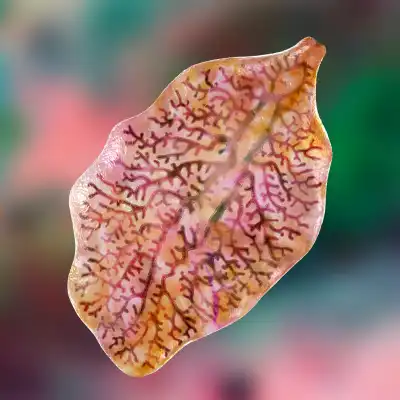

Feeling constantly anxious, wired, and exhausted despite lifestyle changes? Parasitic infections may be the culprit. Intestinal parasites may disrupt GABA, serotonin, and sleep—key factors in anxiety disorders and mental disorders.
Ever feel like your anxiety has a mind of its own?
Like your body is running on high alert for no reason, no matter how much you try to relax?
You wake up exhausted, your heart races over nothing, and your brain won’t shut up—but you can’t figure out why.
It’s as if something inside you is keeping you stuck in fight-or-flight mode.
Well, something might be.
I know, it sounds dramatic but stick with me.
These little freeloaders disrupt neurotransmitters, inflame your brain, hijack your appetite, and throw your entire nervous system into chaos.
If you’re constantly craving sugar, waking up at 2 AM, or feeling like your anxiety is biologically hardwired, it’s time to ask: “Who’s really running the show inside my body?”
Because if parasites are at the wheel, no amount of deep breathing is going to fix it.
But once you kick them out, your body knows exactly how to heal.
Key Takeaways:
- Parasites commandeer your brain chemistry, keeping you stuck in fight-or-flight.
- Gut infections lead to inflammation that fuels anxiety.
- No amount of meditation, breathwork, or therapy will override a biochemical hijacking. (But it IS fixable!)
To Start: Parasites Hijack Your GABA
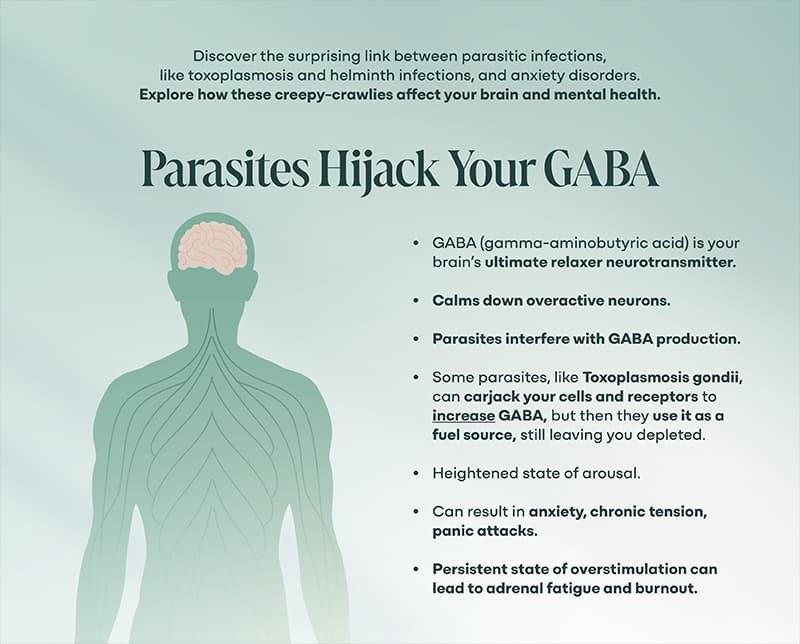
GABA (gamma-aminobutyric acid) is your brain’s ultimate relaxer neurotransmitter (1, 17).
GABA receptors are concentrated in the regions of the brain that control anxiety and fear (17). (If there’s no GABA attached to those receptors, anxiety and fear can be left unchecked.)
It calms down overactive neurons and keeps you from feeling like a squirrel on an espresso binge.
But guess what?
Parasites interfere with GABA production (1, 2), leaving you perpetually stuck in fight-or-flight mode.
Some parasites, like Toxoplasmosis gondii, can carjack your cells and receptors to increase GABA, but then they use it as a fuel source, still leaving you depleted (1).
Essentially, the parasite forces your cells to make GABA and then gobbles it all up for fuel, leaving you with none.
Your cells do allll the work but receive none of the benefit.
RUDE!
Without adequate GABA, your nervous system remains in a heightened state of arousal, making it difficult to relax or even sit still.
This can result in anxiety, chronic tension, panic attacks, and an inability to wind down at the end of the day.
Over time, this persistent state of overstimulation can lead to adrenal fatigue and burnout, exacerbating anxiety even further.
Have you tried meditation, breathwork, or lifestyle changes to reduce your anxiety, only to find they didn’t help?
Tha’s because the root of your anxiety is parasitic.
If parasites are suppressing GABA, no amount of mindfulness will override the biochemical chaos they create.
Identifying and eliminating these intruders is the first step toward restoring balance to your nervous system.
The worst part?
Since many mainstream health professionals don’t consider parasites in cases of anxiety, you might be left taking ineffective treatments that mask symptoms rather than resolving the root cause.
But GABA depletion is just one piece of the puzzle—parasites don’t stop at taking over your brain chemistry; they also wage war on your gut, triggering inflammation that keeps your anxiety levels sky-high.
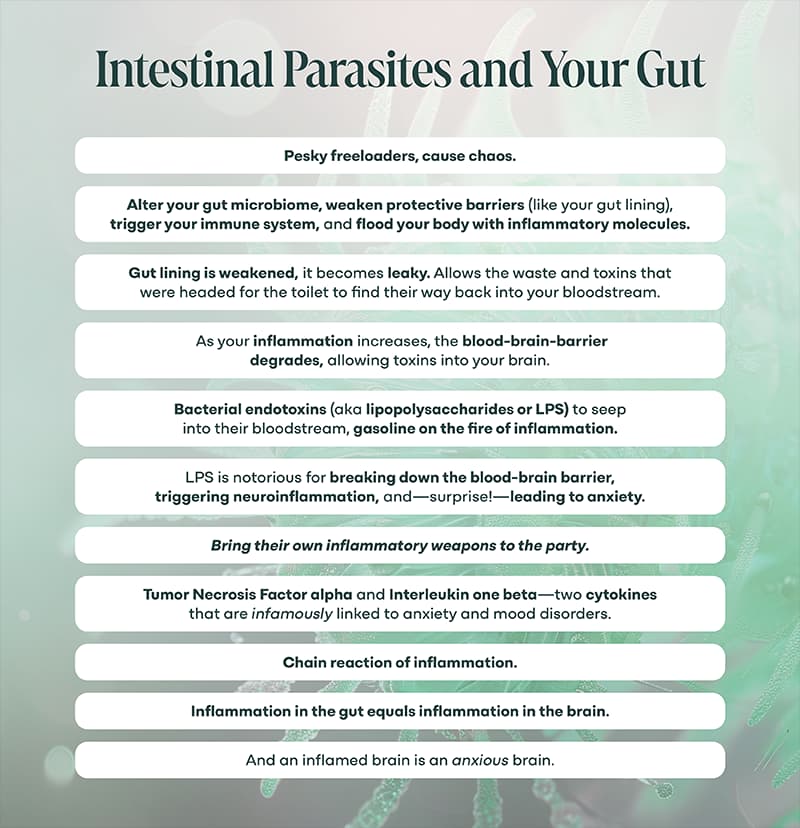
Intestinal Parasites and Your Gut
One way parasites mess with your mind (literally) is through inflammation and endotoxins.
When these pesky freeloaders take up residence in your gut or other tissues, they don’t just lounge around—they cause chaos.
They alter your gut microbiome, weaken protective barriers (like your gut lining), trigger your immune system, and flood your body with inflammatory molecules (3, 5, 6, 7, 8, 9, 10, 15).
The result? A system-wide alarm that doesn’t turn off.
When your gut lining is weakened, it becomes leaky. This allows the waste and toxins that were headed for the toilet to find their way back into your bloodstream.
As your inflammation increases, the blood-brain-barrier degrades, allowing toxins into your brain (3, 14).
Not good.
Take Toxoplasma gondii—a parasite that’s particularly good at hijacking both your gut and your brain.
It can infect virtually any cell with a nucleus but loves to invade and take over your immune cells (12).
In a 2023 study, mice with chronic T. gondii infections developed leaky gut, which allowed bacterial endotoxins (aka lipopolysaccharides or LPS) to seep into their bloodstream (10).
And once LPS gets into circulation, it’s like gasoline on the fire of inflammation (14).
The brain’s immune cells (microglia) freaked out, especially in the amygdala—the part of the brain that processes fear and anxiety (10).
And guess what? Those mice started acting really anxious.
This lines up with what we already know about the gut-brain axis.
LPS is notorious for breaking down the blood-brain barrier, triggering neuroinflammation, and—surprise!—leading to anxiety (10).
But parasites don’t just rely on bacterial endotoxins to do their dirty work.
They bring their own inflammatory weapons to the party.
Gondiicysts in the brain, for example, spark the release of Tumor Necrosis Factor alpha and Interleukin one beta—two cytokines that are infamously linked to anxiety and mood disorders (10, 14).
So, what’s the takeaway?
Whether it’s from direct parasitic toxins or the secondary bacterial havoc they unleash, these infections set off a chain reaction of inflammation that can leave you feeling constantly on edge, wired, and anxious.
Inflammation in the gut equals inflammation in the brain.
And an inflamed brain is an anxious brain.
If you feel like your anxiety gets worse after eating certain foods or during digestive distress, you’re not imagining things.
The inflammation disrupts neurotransmitter function, making emotional regulation even harder.
Additionally, the presence of endotoxins can overstimulate your immune system, leading to chronic fatigue, headaches, and mood swings.
These symptoms compound anxiety, creating an overwhelming cycle of mental and physical distress.
But it’s not just about inflammation and endotoxins—there’s another parasite-gut-brain connection—serotonin.
Struggling with anxiety or chronic symptoms?
Don’t just mask them—get to the root. Take the Parasite Self-Assessment and start your path to real healing."
Take The Parasite AssessmentThe Gut – Brain Connection & Serotonin Depletion
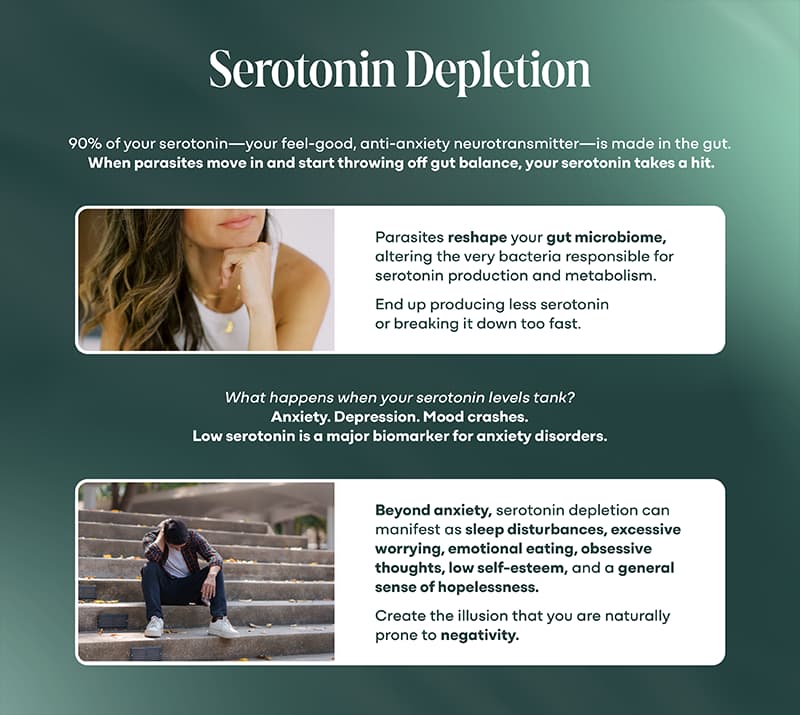
Let’s talk about another way parasites can kidnap your mental health: by messing with your serotonin levels.
About 90% of your serotonin—your feel-good, anti-anxiety neurotransmitter—is made in the gut.
So, when parasites move in and start throwing off gut balance, your serotonin takes a hit.
Parasites aren’t just passive residents; they actively consume the very chemicals your brain relies on for stability.
Remember the mice in the T. gondii study I mentioned previously? The serotonin (5-HT) levels plummeted (10).
And it’s not just T. gondii.
Helminths (aka parasitic worms) are also guilty of serotonin sabotage (19).
These parasites don’t just steal nutrients—they reshape your gut microbiome, altering the very bacteria responsible for serotonin production and metabolism.
Normally, your gut bugs both make and regulate serotonin, but when parasites stir the pot, you can end up producing less serotonin or breaking it down too fast.
What happens when your serotonin levels tank?
Anxiety. Depression. Mood crashes.
We already know that low serotonin is a major biomarker for anxiety disorders.
And if parasites are actively draining this essential neurotransmitter, it’s no wonder so many people feel chronically on edge or emotionally drained without knowing why.
Beyond anxiety, serotonin depletion can manifest as sleep disturbances, excessive worrying, emotional eating, obsessive thoughts, low self-esteem, and a general sense of hopelessness.
Over time, this biochemical imbalance can create the illusion that you are naturally prone to negativity, when in reality, your gut is working against you.
This is why gut health is everything when it comes to mental health.
If parasites are actively interfering with your neurotransmitter production, no amount of positive affirmations will fix the problem.
Serotonin loss alone is enough to wreak havoc on your mood, but parasites don’t stop there—they also hinder your sleep, keeping you trapped in a cycle of exhaustion and anxiety.
The Sleep-Wrecking, Anxiety-Spiking Cycle of Parasite Infections
If you’ve ever felt like a sleep-deprived zombie and couldn’t figure out why, you might have parasites messing with your circadian rhythm.
Yep, they don’t just steal nutrients and wreck your gut—they also seize control of your sleep, which can send your anxiety levels through the roof.
Let’s start with a dramatic example: Trypanosoma brucei, the parasite behind African sleeping sickness.
This nasty bug is famous for flipping your sleep-wake cycle upside down—making people unbearably sleepy during the day and wide awake at night (20).
Research in mice showed that T. brucei shrinks the host’s circadian period, meaning their biological clock is basically shattered (21).
These infected mice started running on some bizarre parasite-driven time zone, mirroring the disrupted sleep seen in human sleeping sickness.
But you don’t need to have an exotic parasite to have your sleep wrecked.
Even common gut parasites can turn your nights into a battle.
Take pinworms (Enterobius vermicularis), for example—these little nightmares cause relentless anal itching at night, which means constant sleep interruptions (22). (And if you’ve ever tried to function after a week of bad sleep, you know exactly how quickly anxiety and irritability creep in.)
The science here is clear: chronic sleep disruption jacks up stress hormones like cortisol, keeps your nervous system stuck in fight-or-flight mode, and cranks up anxiety levels.
Over time, this chronic state of exhaustion weakens your immune system and leaves you vulnerable to further infections.
The 2 AM Parasite Party
Ever wake up at 2 or 3 AM for no reason?
That’s prime parasite party time.
Many species are most active in the middle of the night, releasing toxins that stress your liver and wake you up.
Add in their disruption of melatonin production, and you’ve got a recipe for sleep deprivation—which only worsens anxiety.
This nightly pattern creates a vicious cycle: the less sleep you get, the harder it is for your body to detox, allowing the parasites to thrive and keep the cycle going.
As if wrecking your sleep wasn’t enough, parasites also take over your appetite—driving intense cravings for sugar and carbs to fuel their own survival at the expense of your health.
Sugar, Dairy, and Other Junk Cravings? That’s the Parasites Talking
Let’s talk about parasites and food cravings—because if you’re constantly jonesing for sugar, it might not be you doing the craving.
One of the theories emerging in recent years is that parasites can manipulate their host’s appetite to benefit their own survival (23).
In other words, they trick you into feeding them exactly what they need to thrive.
Clinicians have long noticed that people with parasites often have intense sugar cravings, and now there’s growing evidence to support why (23).
The leading theory?
Certain gut parasites hijack neurochemical pathways that regulate appetite.
Since serotonin plays a major role in satiety, parasites that disrupt serotonin production may keep you feeling hungry, particularly for easy-to-digest, high-energy foods—aka sugar and carbs (24).
It’s basically the parasite whispering: “Hey, how about a cookie? Or maybe a whole sleeve of them?”
And it’s not just theory—animal studies have shown that Toxoplasma gondii infection alters dopamine levels and food preferences, possibly making hosts crave sweet foods.
From the parasite’s perspective, a sugar-heavy diet is a goldmine—simple carbs like glucose and even lactose (from dairy) provide a constant energy supply for them.
This is why many functional medicine practitioners recommend cutting sugar and dairy when dealing with a parasitic infection—because guess who loves those foods?
The little invaders living rent-free in your gut.
Here’s where it gets even worse: indulging in parasite-driven cravings creates a vicious cycle. Blood sugar spikes and crashes—especially the post-sugar-drop panic attack—are a well-known trigger for anxiety, nervousness, and mood swings.
When your blood sugar tanks after a sugar binge, your body freaks out and releases adrenaline to compensate, making you feel jittery, irritable, and on edge. Sound familiar?
To top it off, parasites can also steal key nutrients—iron, magnesium, even causing secondary lactose intolerance (looking at you, Giardia).
These deficiencies can trigger even more cravings, fatigue, and anxiety, turning your body into a playground of biochemical chaos (24).
But parasites don’t just manipulate what you eat—they also trigger immune reactions that flood your body with histamine, leaving you anxious, inflamed, and on edge.
Histamine and Anxiety
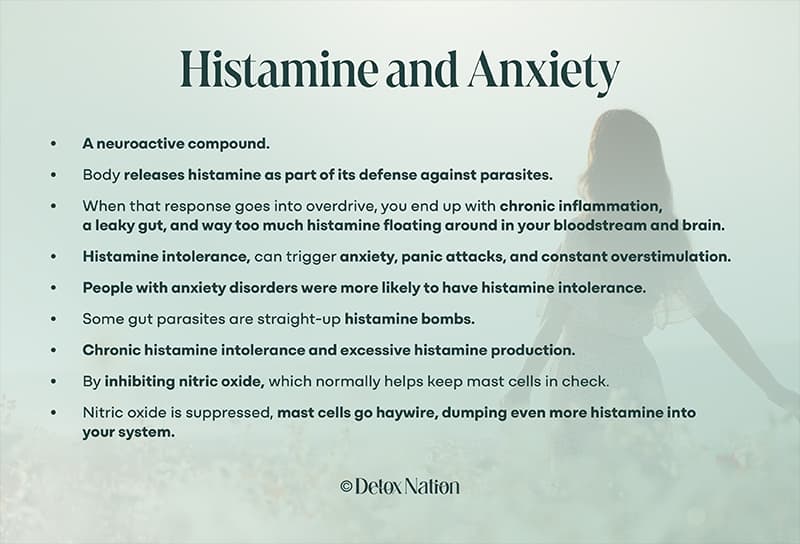
Let’s talk about histamine—the overlooked anxiety trigger that parasites love to exploit.
If you think histamine is just about seasonal allergies, buckle up, because it’s also a neuroactive compound that can jack up your anxiety levels when it’s running wild in your system.
Here’s the deal: your body releases histamine as part of its defense against parasites (11, 16).
Sounds good in theory, right?
Except when that response goes into overdrive, you end up with chronic inflammation, a leaky gut, and way too much histamine floating around in your bloodstream and brain (11).
And high histamine? That’s a direct ticket to feeling wired, restless, and anxious.
Take malaria (Plasmodium infection), for example.
Research has shown that infected animals experience massive mast cell activation, leading to sky-high histamine levels in their blood and intestines (25).
Mice infected with Plasmodium yoelii had gut permeability issues, increased mast cell activity, and intense systemic inflammation—but when they were given antihistamines, they improved.
Translation? Excess histamine was a big part of the problem.
And if you’ve ever dealt with histamine intolerance (aka your body’s inability to break down histamine properly), you already know it can trigger anxiety, panic attacks, and constant overstimulation.
One study even found that people with anxiety disorders were more likely to have histamine intolerance—because histamine, acting through the H1 receptor in the brain, is a known anxiety trigger (26).
Animal studies back this up: blocking H1 receptors reduces anxiety, while activating them increases it (26).
Now, let’s bring this back to parasites.
Some gut parasites—like Blastocystis hominis—are straight-up histamine bombs.
This sneaky protozoan has been linked to chronic histamine intolerance and excessive histamine production.
How? By inhibiting nitric oxide, which normally helps keep mast cells in check.
When nitric oxide is suppressed, mast cells go haywire, dumping even more histamine into your system.
The result?
You’re left anxious, inflamed, and overstimulated, all because of an immune reaction gone rogue.
With allll the ways parasites can take over your body—your brain chemistry, gut, sleep, cravings, and immune system—it’s no wonder anxiety feels inescapable. But here’s the good news: once you identify the real culprit, you can finally take back control of your health.
So, What Can You Do About It?
If parasites are behind your anxiety, here’s the reality: no amount of willpower, mindset shifts, or self-care routines will override a biochemical hijacking.
Your neurotransmitters are being siphoned off.
Your gut is inflamed.
Your body is stuck in fight-or-flight because the alarm never got shut off.
That’s why you can’t “just calm down.”
And the hard truth is that no one is coming to fix this for you.
Your doctor probably won’t consider parasites as the cause of your anxiety.
They won’t show up on a standard lab test.
And if you tell people, “I think my anxiety might be caused by parasites,” you might get some weird looks.
But your body is built to heal.
Once you identify and eliminate these parasites, your brain chemistry can rebalance.
Your gut can repair itself.
Your immune system can stop overreacting.
And that constant, wired, edge-of-your-seat feeling?
It can disappear.
The key is getting to the root cause—not slapping a band-aid on your symptoms and hoping for the best.
To find out if your anxiety or chronic symptoms might be caused by parasites, Take the Parasite Self-Assessment.
You don’t have to stay stuck in survival mode.
You just need to kick out the invaders keeping you there.
Struggling with anxiety or chronic symptoms?
Don’t just mask them—get to the root. Take the Parasite Self-Assessment and start your path to real healing."
Take The Parasite AssessmentFAQs
-
How do I know if parasites are causing my anxiety?
– If you experience persistent anxiety despite lifestyle changes, along with gut issues (bloating, constipation, diarrhea), sugar cravings, poor sleep, and unexplained fatigue, parasites could be a hidden factor. Nighttime waking (especially around 2-3 AM) and worsening anxiety after eating certain foods are also red flags. -
Can parasites really change brain chemistry?
– Yes! Parasites like Toxoplasma gondii consume or disrupt GABA and serotonin, two neurotransmitters essential for relaxation and emotional balance. They also trigger neuroinflammation, which can increase anxiety and stress responses. -
What are the most common parasites that contribute to anxiety?
– Toxoplasma gondii (linked to neuroinflammation and mood disorders), Blastocystis hominis (triggers histamine release), helminth infections (worms that disrupt serotonin levels), Trypanosoma brucei (wrecks circadian rhythms), and pinworms (cause sleep disturbances and inflammation). -
Can parasites cause food cravings?
Yes! Many parasites manipulate appetite and cravings by altering gut bacteria and neurotransmitter levels. They push you toward sugar and carbs because they thrive on simple sugars—but indulging in these cravings leads to blood sugar spikes and crashes that worsen anxiety.
-
Why does my anxiety feel worse at night or after eating?
Parasites release toxins at night, which can stress the liver and wake you up (often around 2-3 AM). Some also interfere with melatonin production. After eating, certain foods (especially sugar, dairy, or high-carb meals) can feed the parasites, causing inflammation and neurotransmitter imbalances that spike anxiety.
-
Why don’t doctors talk about parasites as a cause of anxiety or stress disorders?
Most conventional doctors aren’t trained to recognize chronic parasitic infections in developed countries, even though they are far more common than people think. Standard testing often misses them, and many symptoms are dismissed as IBS, anxiety disorders, or stress-related issues.
-
What is the association between parasitic infection and mental health issues?
Parasites can cause significant immune responses and neuroinflammation, leading to a heightened risk of developing a mental or neurological disorder, including anxiety. These chronic infections often cause significant symptoms and play a key role in the development of mental health and stress issues.