

You wake up stuffy.
Again.
Your nose feels like someone poured cement into your sinuses overnight, and breathing through your left nostril?
Not happening.
Maybe you’ve blamed allergies, the weather, your pillow, your cat, or just “getting older.”
But what if it’s not you at all?
What if the air inside your home—the place you spend most of your time trying to rest, recover, and heal—is keeping you stuck in a cycle of sinus misery?
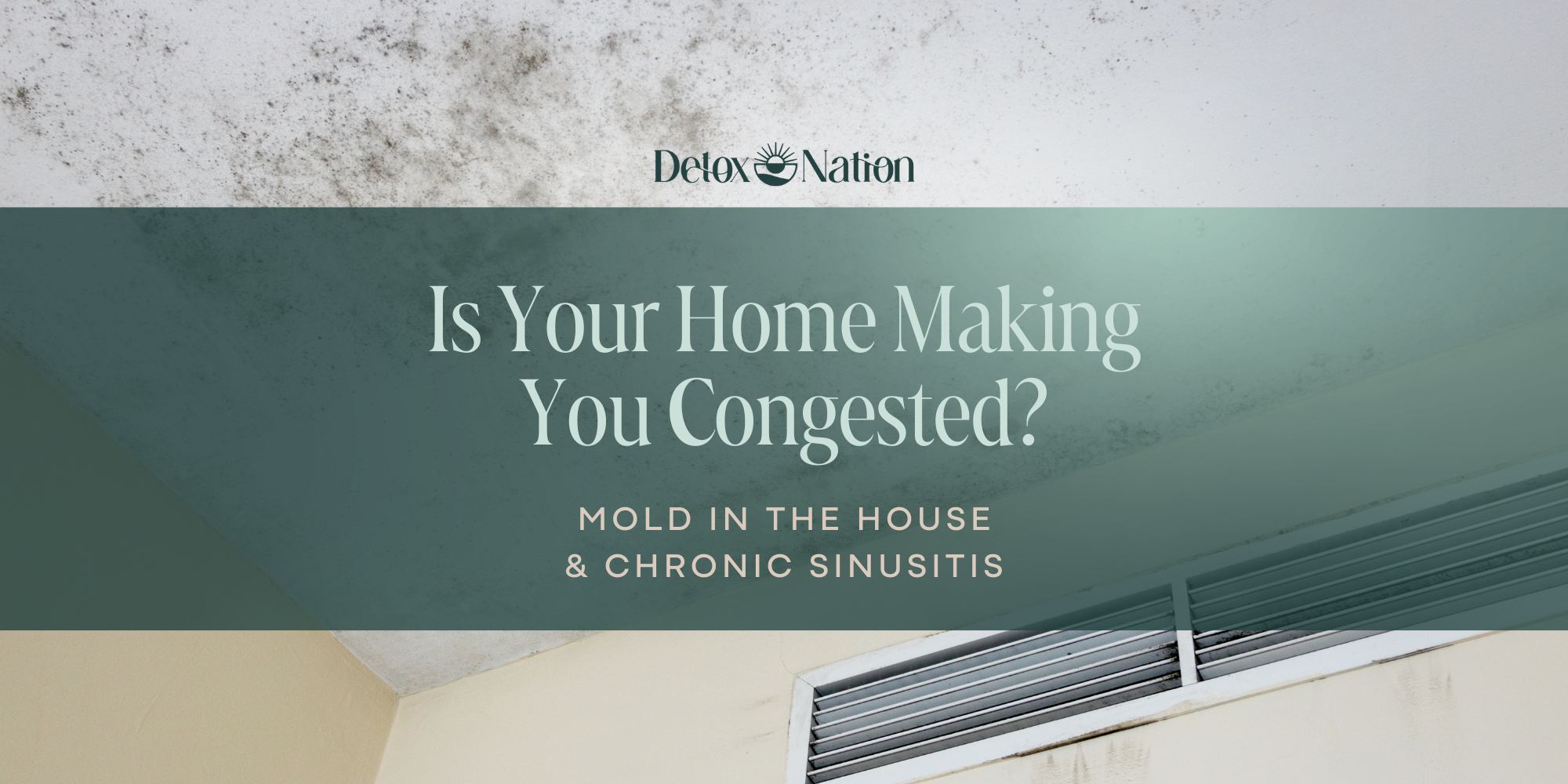
Mold exposure sinusitis is a major driver of chronic congestion, sinus pressure, and recurring infections.
Even if you’ve never seen visible mold, your body might be responding to the invisible particles and mycotoxins floating in your home’s air like it’s under biochemical attack. (Because it is.)
And if you’ve already tried every spray, pill, neti pot, or round of antibiotics to clear it up, and still feel like you’re walking around with a wet sponge in your face, it’s time to stop blaming your body and start investigating your environment.
This isn’t about paranoia—it’s about pattern recognition.
If your sinuses flare up every time it rains, or your symptoms magically improve when you travel, your home could be trying to tell you something.
Let’s get curious. Let’s talk about mold.
Key Takeaways
- Chronic sinus symptoms are often mold-related—not “just allergies.”
- Mold exposures are cumulative—and your body keeps the score.
- Real healing is possible.
The Mold Reality: You Don’t Have to See It to Breathe It
You don’t have to see mold growing in furry green patches on your ceiling for it to be wrecking your sinuses.
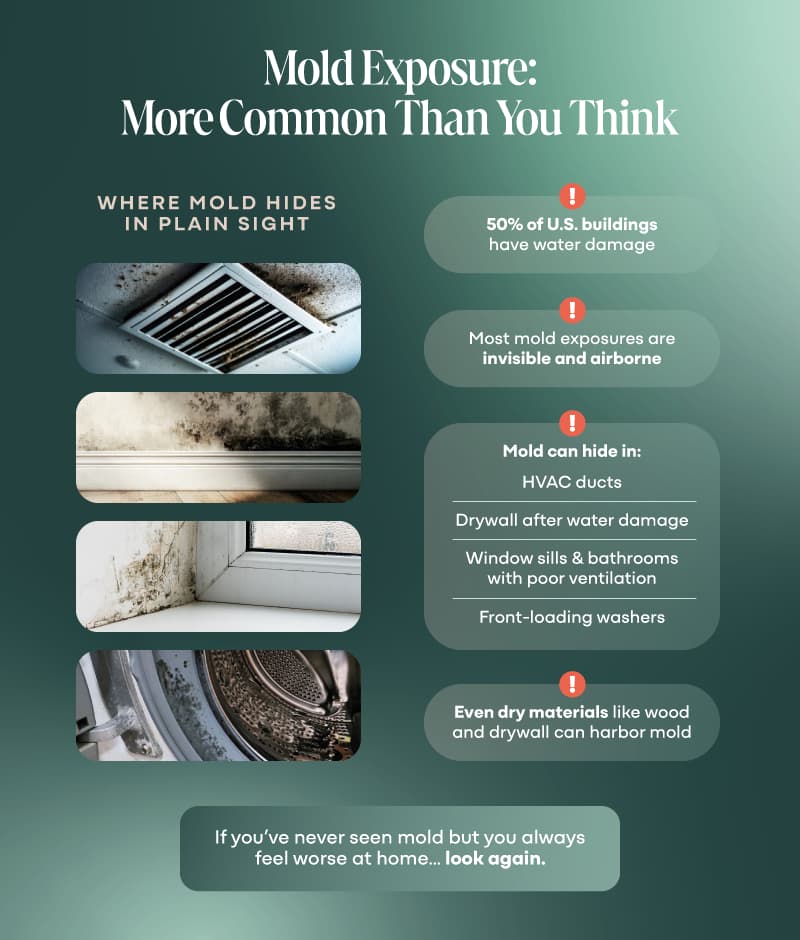
Most of the time, the most toxic mold exposures are invisible—and airborne (1, 2, 17, 18, 28, 32).
Let’s talk about where mold hides in plain sight:
- That slow leak under your kitchen sink that “didn’t seem like a big deal” (1, 3, 16, 17, 18, 22, 29, 33)
- The musty smell in your basement you chalked up to “old house vibes”
- Your front-loading washing machine that smells like a swamp when you open the door
- HVAC systems and ducts—especially if your A/C smells earthy or you haven’t changed the filter since – what year are we in again?
Even dry-looking materials like drywall and wood can harbor mold if there was water damage at some point in the past (1, 2, 3, 9, 16, 17, 18, 22, 29, 33).
And once mold establishes itself, it doesn’t need standing water—it just needs moisture in the air. (Looking at you, steamy bathrooms with no fan.)
Mold Facts
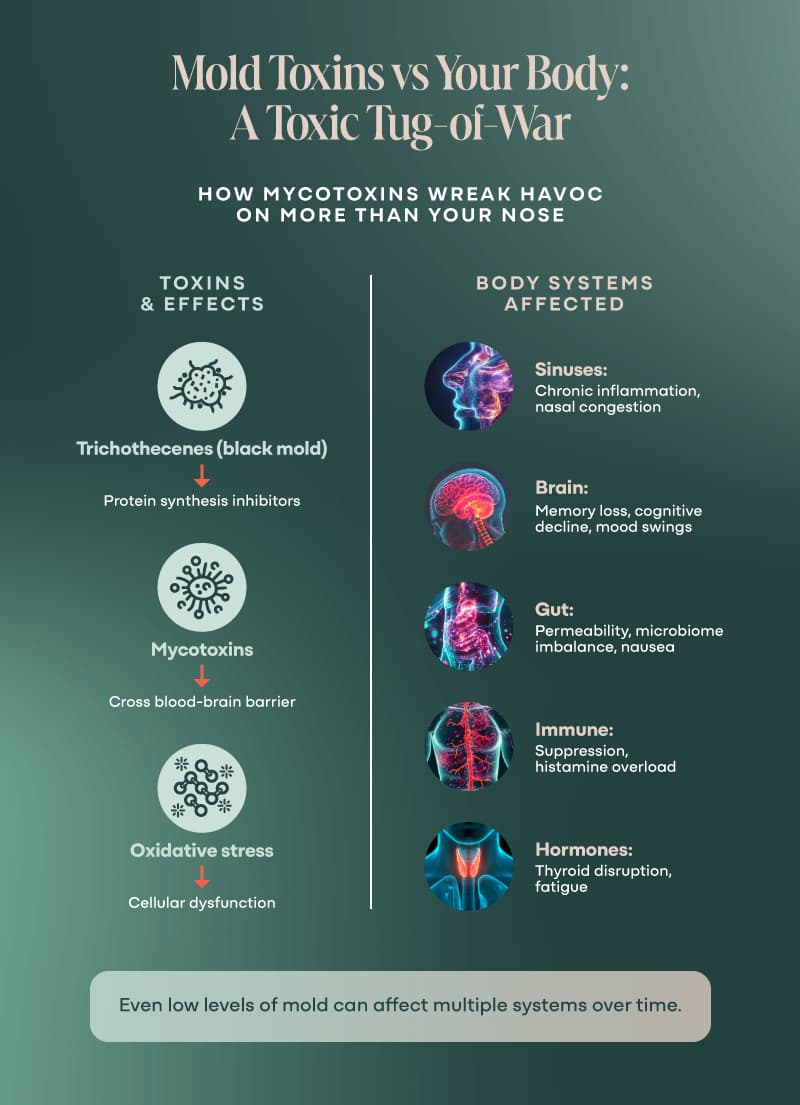
Here are some scary facts about mold and mycotoxins:
- There are over 500 known mycotoxins (11), and they are considered by some scientists to be more toxic than pesticides (18).
- They cause mitochondrial dysfunction, leaving your cells with little energy to function (4, 16).
- They damage the intestinal barrier and decrease nutrient absorption (11, 13, 24).
- Lipopolysaccharides (toxins released by gram-negative gut bacteria) increase the toxicity of certain mycotoxins (hello, black mold trichothecenes!) and increase the damage to olfactory epithelium, tracts, and bulbs (9, 28).
- Most exposure is to nanoparticles (think fragments and mycotoxins, not spores) which are up to 1 million times more numerous and are able to penetrate more deeply into your respiratory tissues (15).
- Up to 50% of buildings in North America have water damage (10, 22).
- Indoor nano particle concentration is up to 1,000 times more than the indoor spore count (5).
- Most industrial processing has zero impact on reducing mycotoxins (23).
- Mycotoxins can easily cross the blood-brain-barrier (5, 7, 17, 26) and cause neurotoxicity (7, 15, 16, 17, 20, 23, 33).
- Type 3 Alzheimer’s Disease is recognized to be caused by inhalation of biotoxins (like mycotoxins) (2).
- They are cytotoxic (toxic to a variety of cells) even at low exposures (10, 23, 25).
- They increase free radicals and cause oxidative stress (4, 14, 16, 17, 20).
We Can Help
You’re not doomed to live on decongestants and false hope forever. Start with the Mold Toxicity Quiz to begin connecting your symptoms to what might be lurking in your environment.
Take the QuizMold Doesn’t Travel Solo
Here’s where it gets even trickier: most mold exposures aren’t just one species of mold.
They’re mixed exposures—a toxic cocktail of multiple strains and the mycotoxins they produce.
Mixed mold and mycotoxins can be additive and synergistic, meaning one plus one can equal ten (8, 21).
Aspergillus, Penicillium, Chaetomium, Stachybotrys—they each bring their own “gifts” to the party.
And they love to tag along.
Mold spores cling to books, clothes, furniture, even that favorite throw pillow you brought from your old apartment.
If you’ve moved from one water-damaged building to another, there’s a good chance mold moved with you.
It’s not just mold. It’s your history with mold.
And your sinuses? They remember.
Mold Exposure Is Cumulative (And Your Body’s Had Enough)
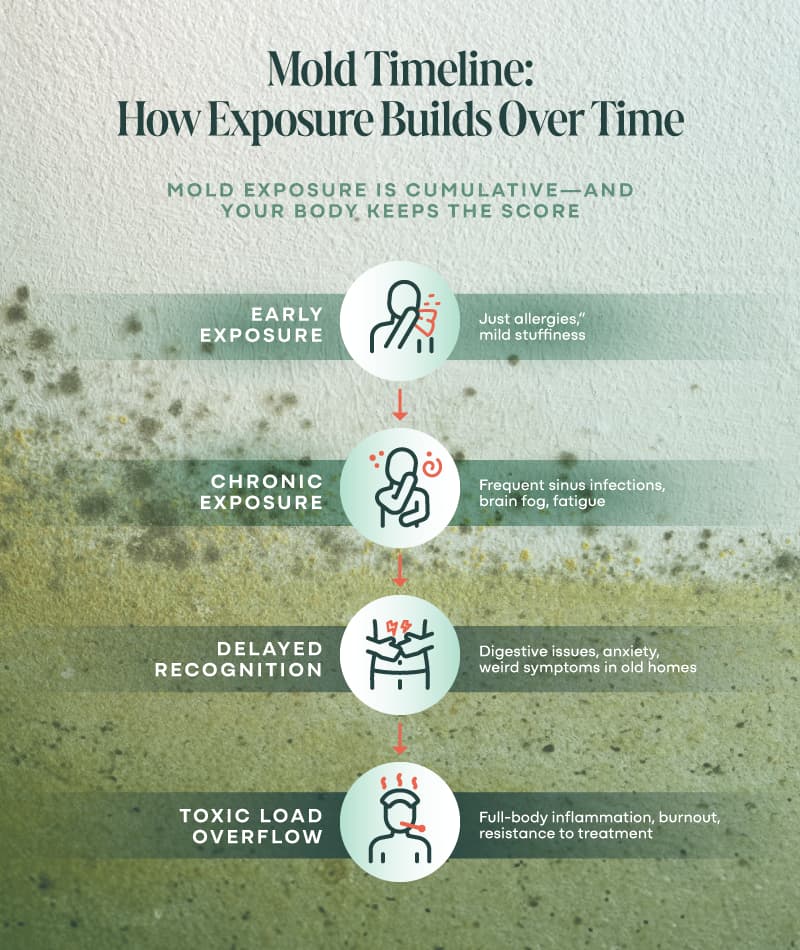
You don’t need to be living in a flooded basement to have a mold problem. You just need a few years of “not a big deal” exposures stacked on top of each other—until your body throws up its hands and says, “I’m done.”
Mold exposure is cumulative (27).
That means every damp apartment, every leaky dorm room, every steamy shower with no ventilation—all of it adds up inside your body like layers of invisible sludge.
It’s not just one moment of exposure that tips the scale. It’s the weight of it all, compounded over time.
Your body is brilliant. It can handle a lot, but it’s hard to keep up with this burden over time.
It’s been filing these exposures away in your sinuses, your gut, your mitochondria—doing its best to keep up with the cleanup.
But eventually, the toxic burden becomes too much.
Drainage pathways get bogged down.
Your immune system starts to falter.
The symptoms begin to pile up.
Stuffy nose? That’s not just mucus—it’s a traffic jam of inflammation, immune confusion, and possibly mold spores your body’s too exhausted to clear out anymore.
You might even notice that your symptoms get worse in humid weather, or when you turn on the heater or A/C.
Once you start unburdening your system, your sinuses—and the rest of you—can breathe again!
Mold Exposure Sinusitis: The Connection No One Told You About
If you’ve ever had a doctor tell you that your recurring sinus infections are “just allergies” or prescribed your fourth round of antibiotics this year, you’re not alone.
Chronic sinus problems aren’t always bacterial.
In fact, many cases are fungal—and mold is often the culprit.
Research shows a strong link between mold exposure and chronic rhinosinusitis (1, 10, 16, 29, 31, 32, 33).
Translation: if your nose is always clogged, drippy, or inflamed, mold may be living rent-free in your upper respiratory system.
How Mold Hijacks Your Sinuses
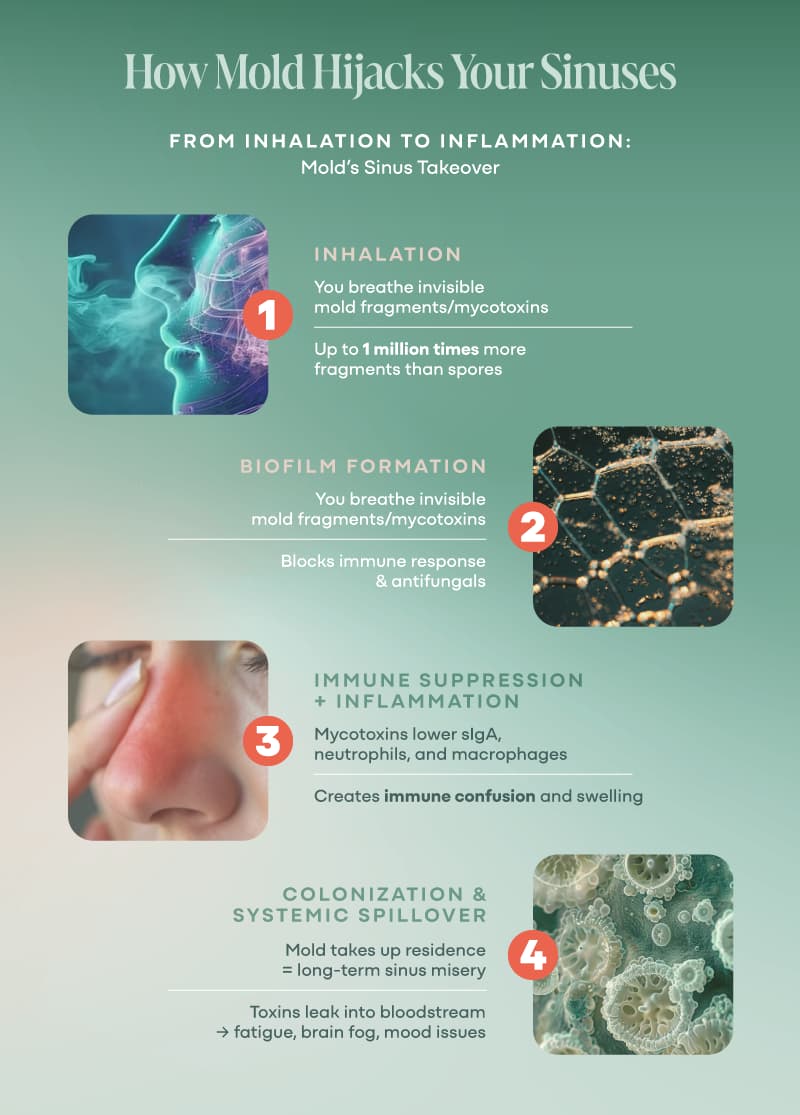
Here’s what mold exposure does to your sinuses:
- Triggers chronic inflammation — Your immune system goes on high alert, flooding your sinuses with inflammatory messengers that swell the tissue and clog up drainage (6, 9, 11, 13, 14, 16, 22, 26, 30, 33).
- Suppresses immune response — Mold is sneaky. Some mycotoxins weaken immune function over time, especially in mucosal areas like the sinuses (10, 15, 16, 22, 25, 30, 33).
- Creates biofilms — These are slimy, protective layers that mold and other microbes build like a biological “do not disturb” sign (3). Your immune system can’t see them. Your meds can’t reach them. But your body still feels them.
- Promotes colonization — Yep, mold can take up long-term residence in your sinus cavities (3, 5, 19, 31) so your sinuses become internal reservoirs of mold and mycotoxins (3). Think of it like black mold wallpaper inside your face. Not cute.
When you’re spraying decongestants and nothing changes—or you get temporary relief followed by a full rebound—you’re not treating the root cause.
You’re just shuffling symptoms around.
Mold in your sinuses is like having a squatter who changed the locks and is now throwing ragers every night. Until you evict them properly, the chaos continues.
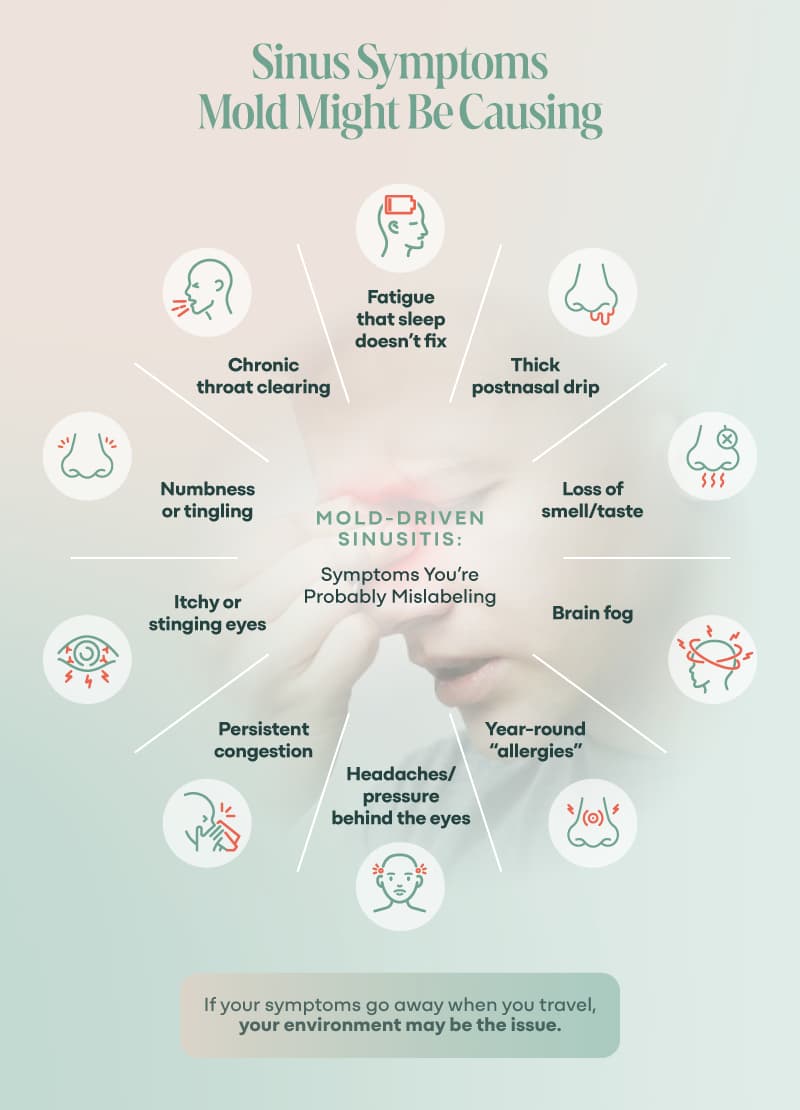
Symptoms of Mold-Driven Sinusitis (That You Might Be Mislabeling)
Chronic mold exposure doesn’t usually show up with a flashing neon sign that says, “Welcome to Fungus Town.”
It’s subtle. Creepy. And very, very easy to mislabel.
Most of the people I work with never suspected mold because their symptoms looked like everything else.
If you’re dealing with any of these, it’s time to give a side-eye to your environment:
- Constant or recurring nasal congestion, especially worse at home
- Postnasal drip that won’t quit, even with antihistamines (29, 30, 32)
- Headaches or facial pressure, especially behind the eyes or in the forehead (10, 16, 26, 29, 30, 32)
- Loss of smell or taste, even months after a cold (or COVID)
- Cognitive deficits and brain fog that makes you feel like you’re walking through molasses (10, 15, 16, 17, 26, 29, 30)
- Fatigue that sleep doesn’t fix (10, 15, 16, 17, 29, 30, 32)
- Mucus that’s thick, weirdly colored, or never fully clears
- “Seasonal allergies” that happen all year long
- Chronic cough or throat clearing (1, 10, 30, 33)
- Mystery digestive issues (10, 16, 23, 32) because your microbiome interacts with ingested mycotoxins (24)
- Mood swings that give you emotional whiplash (16, 17)
- Anxiety (10, 15, 16, 17) or depression (15, 16, 17)
- Numbness and tingling or the sensation of ants crawling on you (17, 26)
- Unexplained weakness (10, 17)
- Worsening asthma or breathing difficulties (1, 10, 16, 17, 29, 31, 33)
- Sluggishness, hair loss, and other signs of altered thyroid function (30)
You may even feel fine when you leave the house—but symptoms return within minutes of stepping back inside.
That’s a huge red flag that your home may be triggering your immune system.
This isn’t just annoying. Left unchecked, chronic sinus inflammation can lead to sleep issues, immune dysfunction, mood swings, and downstream digestive problems.
Your nose is the front door of your body’s filtration system. If it’s clogged, nothing flows right.

Your Home’s Terrain Is Your Internal Terrain
Your body is a mirror of your environment. If your home is stagnant, damp, and moldy, your sinuses are going to follow suit.
Think of it like this: you wouldn’t expect a fish to thrive in a filthy tank.
So why are we surprised when our bodies struggle in environments full of invisible toxins?
Mold doesn’t just irritate the nose—it creates a terrain that favors inflammation and dysfunction (11, 34).
That’s why chronic sinus congestion isn’t usually the problem—it’s a signal.
Your internal terrain has become overrun, congested, and overwhelmed, just like your external one.
When mold colonizes your body, it sends your immune system into overdrive while simultaneously clogging detox pathways.
That combo creates the perfect storm for chronic sinus issues, nervous system dysregulation, and immune confusion.
And if your body can’t drain properly, those toxins stay trapped. That inflammation you’re feeling in your face? It’s not just annoying—it’s a backlog.
Your sinuses are screaming for relief. But more importantly—they’re asking for a terrain reset.
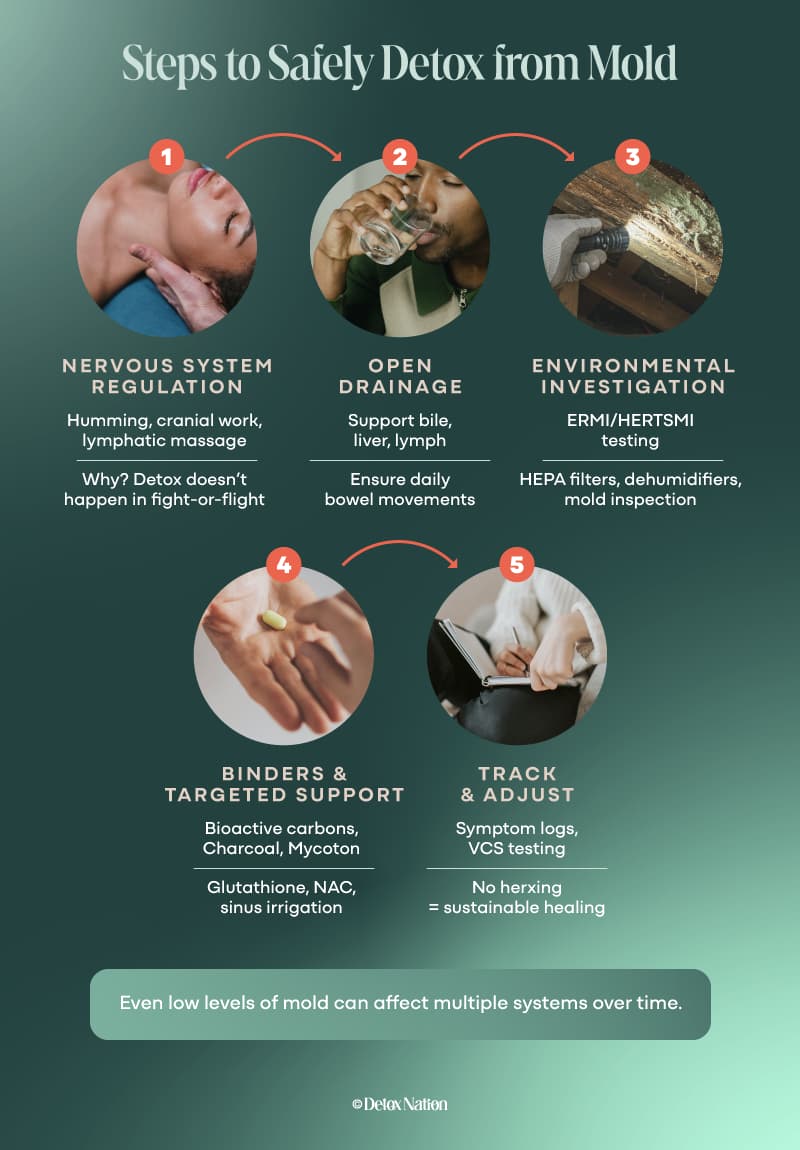
Detoxing from Mold: How It Helps Your Sinuses (and Your Sanity)
You can’t heal chronic sinus issues by treating your sinuses in isolation. You have to unload the system—and that means detoxing from mold.
But let me be clear: detoxing isn’t about chugging green juice and hoping for the best. It’s about setting the conditions for your body to do the work it already knows how to do.
Your sinuses are part of your drainage system. When mold and mycotoxins block your body’s ability to drain, you stay inflamed, congested, and stuck.
So, before you reach for another nasal spray, let’s talk about what real mold detox looks like.
Nervous System First
If you’re stuck in fight-or-flight, your body isn’t detoxing—it’s just surviving. That’s why we always start with nervous system regulation:
- Vagus nerve support (like humming, breathwork, cranial work)
- Grounding and structured routines to signal safety
- Lymphatic movement (self-massage of “The Big 6,” castor oil packs, rebounding)
If your nervous system doesn’t feel safe, detox becomes a trauma trigger instead of a healing strategy.
Open the Drains
Your sinuses are just one part of the drainage chain. You also need:
- Healthy bile flow from your liver and gallbladder
- Daily bowel movements (yep, we’re going there)
- Lymphatic flow to move the garbage out
- Cellular hydration to keep everything flushing
Until these exits are open, introducing binders or antifungals just stirs the pot—and your symptoms.
Clear the Load
Once the body’s ready, mold-specific detox tools can help lower the burden:
- Targeted binders (like bentonite clay, chlorella, or activated charcoal depending on your specific situation)
- Sinus support (Navage with binders or essential oils, if tolerated)
- Mitochondrial support to restore cellular energy (NAD+, CoQ10)
- Mycotoxin-specific nutrients (glutathione, NAC, sulforaphane)
And remember, detox isn’t linear. Your symptoms may shift in waves as your body rebalances. That’s not failure—it’s feedback.
Your sinuses are telling you the truth about your environment. The good news? You can change that terrain—and finally breathe again.
What to Do if You Suspect Mold in Your Home
Let’s say the puzzle pieces are clicking into place.
You’re congested, fatigued, foggy—and you’re starting to realize your home might be part of the problem.
Now what?
First: take a deep breath.
You don’t have to panic-purge your entire life or burn your house down (tempting, I know).
Start getting curious, taking stock, and making smart, manageable changes.
Notice the Patterns
Pay attention to when and where your symptoms flare. Keep a short log for a few days or weeks.
- What are your specific symptoms?
- Do you feel worse at home, and better when traveling?
- Are symptoms worse in certain rooms?
- Do you notice changes when the HVAC kicks on, after it rains, or in high humidity?
Your body is your best mold detector—listen to it.
Look for Clues
You don’t need to tear out drywall to start investigating. Look for:
- Water stains or bubbling paint
- Musty or earthy odors (especially in closets, bathrooms, or basements)
- Visible mold (duh—but remember, invisible mold is still mold)
- Persistent condensation on windows or pipes
- Chronic leaks or past water damage—even if it was “fixed”
Get a Real Test (Not Just a Sniff Test)
If you’re serious about confirming mold, consider:
- ERMI or HERTSMI-2 testing for dust samples (great for renters or those without obvious mold)
- Mold plates (helpful screening tool—not diagnostic, but cheap and illuminating)
- Hiring a qualified inspector (not just your buddy with a flashlight and Febreze)
And don’t forget the “sleeper exposures”: your car, your office, your air ducts, your mattress.
You can’t heal in the same environment that’s making you sick. And you don’t have to stay there, either.
Even small steps—like getting a high-quality HEPA air purifier, fixing that sneaky leak under the sink, or replacing moldy caulking—can start shifting the tide.
This Isn’t Just a Sinus Issue. It’s a Mold Wake-Up Call
If your sinuses have been shouting at you for months—or years—and nothing you’ve tried has worked, I want you to know that your body is trying to protect you.
The congestion, the brain fog, the sinus pressure that makes you fantasize about power-washing your face—it’s all communication.
And now you’re finally starting to speak the same language.
Yes, mold is a beast.
Yes, your home might be part of the problem.
But no, that doesn’t mean you’re doomed to live on decongestants and false hope forever.
The One Lab Test That Could Change Everything
The Detox Nation Mold Test + Consult is a comprehensive urine test that measures 40 different mycotoxins from 11 mold species—the most complete mold toxicity panel available—plus a 60-minute consultation with our expert team to review your results.
Get Your Mold Test + ConsultFAQs
1. Can fungus really live in my sinuses?
Yes—and it’s not just hanging out. It can colonize, build biofilms, suppress your immune system, and keep you chronically inflamed. Cute, right?
2. What if I don’t see fungus in my home?
Doesn’t matter. Most toxic fungal exposure is invisible—spores, fragments, and mycotoxins in the air. Your nose is breathing it in whether you see it or not.
3. How do I know if mold is causing my sinus issues?
Start with symptom patterns. Do you feel worse at home? Better when you travel? Constant congestion, postnasal drip, and brain fog that won’t budge = red flags.
4. Is mold exposure really that common?
Yep. Over 50% of U.S. buildings have water damage—and most people have no idea they’re living in one. Fungal exposure is the rule, not the exception.
5. What’s a “mixed mold exposure”?
It means you’re breathing in multiple mold strains and their mycotoxins all at once. They’re additive, sometimes synergistic. Translation: your body is juggling fireballs.
6. Can I detox mold just by taking supplements?
Nope. If your drainage pathways aren’t open and your nervous system isn’t regulated, you’re just stirring the pot. Detox is a process—order and strategy matters.
7. Is chronic sinusitis always related to mold?
Not always—but it’s often overlooked. If nothing else is working, fungi should definitely be on your radar.
8. Can I heal my sinuses without moving?
Sometimes. It depends on the fungal load, your body’s resilience, and how well you can clean and remediate. But healing in a mold-free environment is always faster.
9. Where should I start?
Take the Mold Toxicity Quiz. It’ll help connect the dots.