

You’re doing your best.
You’re journaling, taking supplements, and optimizing sleep hygiene.
You’ve read the mindset books (and underlined the good parts).
Maybe you’ve even taken the meds—and felt like a flat, colorless version of yourself in return.
Still, you wake up feeling heavy.
Joy feels like something you remember having (barely).
The smallest tasks feel like mountain climbs, and no one seems to get it—not your partner, not your doctor, not even the therapist who keeps reminding you to “breathe through the anxiety.”
But what if the root of your symptoms isn’t your mindset at all?
What if these are mold exposure symptoms?
Because the truth is: your anxiety or depression may be coming from your environment—specifically, from hidden mold exposure.
I know how wild that sounds. Mold? Like, the stuff on bread?
Yes.
But not just that. I’m talking about mycotoxins—microscopic poisons released by certain molds that can upend your brain chemistry, tank your energy, and set your nervous system to constant panic mode.
And the worst part?
Most people don’t even know they’re being exposed.
If your moods feel random, if your anxiety spikes for no reason, if you’ve started wondering “maybe I’m just wired wrong,” let’s stop right here.
You’re not broken. You’ve been poisoned.
This post is your roadmap to understanding how mold exposure can mimic and even cause depression, anxiety, and emotional disconnection—and more importantly, what you can do to reclaim your brain and your life.
Key Takeaways
- Depression and anxiety aren’t always rooted in your mind—they’re often triggered by what’s in your environment.
- Mycotoxins cause neuroinflammation, oxidative stress, mitochondrial damage, and neurotransmitter disruption.
- Detoxing mold the wrong way can make things worse, but when done properly, it allows you to heal.
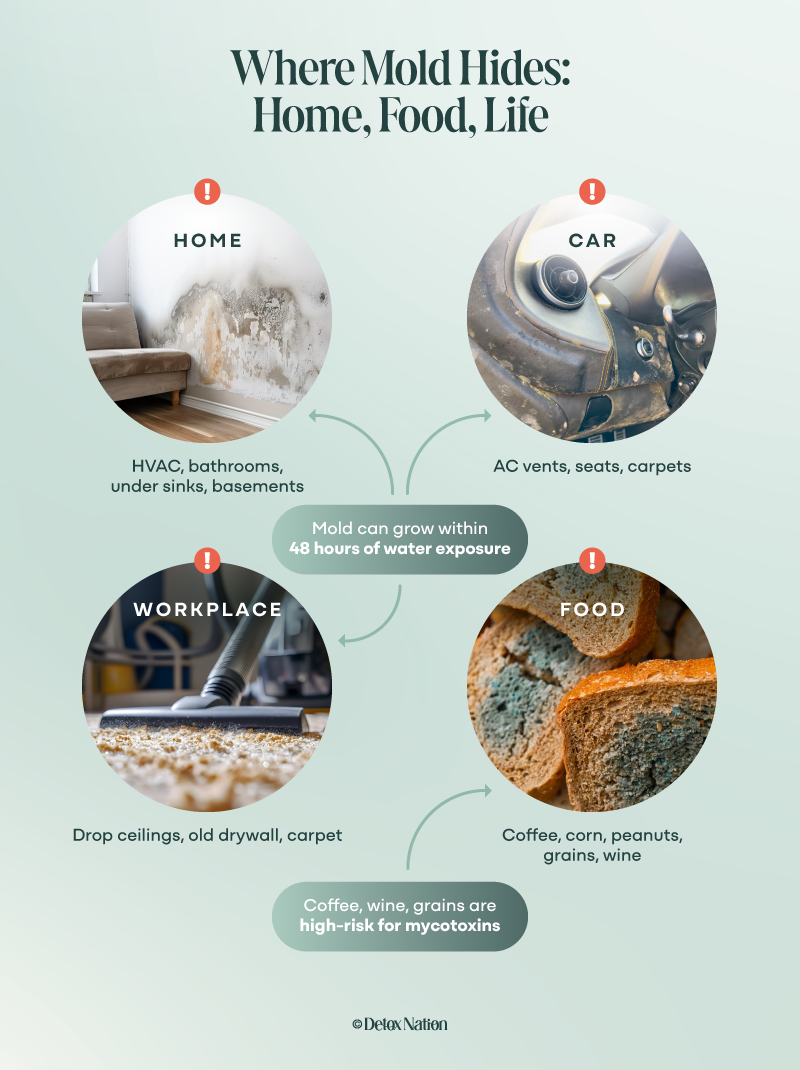
Where Mold Hides: You’re Probably Exposed and Don’t Know It
You don’t need to live in a flooded basement or hoarder house to be breathing in mold. This stuff is stealthy, and it’s everywhere (4).
It doesn’t always smell musty or show up in dramatic black streaks on the walls.
Mold hides behind paint, under carpet, inside your air ducts (11, 12, 21, 26, 27)—quietly undermining your health while you go about your day, wondering why your brain feels foggy and your moods feel like they belong to someone else.
In your home, the most common culprits are past water leaks that were “fixed” cosmetically but never properly remediated (11, 12, 21, 26, 27).
Even a small roof leak or slow drip under the sink can become a mold factory behind the scenes.
Bathrooms and laundry rooms are especially vulnerable—thanks to steamy showers, condensation-prone windows, and washing machines that never fully dry out (11, 12, 21, 26, 27).
And let’s not forget the HVAC system.
If you’ve never had your ducts cleaned professionally, you might be recirculating mold spores every time the heat or A/C kicks on.
Your car isn’t safe either.
Ready to start healing?
Find out where you are in the process—and what your body’s trying to tell you.
Take the Free Mold AssessmentIf you’ve ever had a sunroof leak or left the windows cracked during a storm, mold could be thriving in your car seats or air conditioning vents.
You roll up the windows, crank the fan, and unknowingly trap yourself in a moldy box on wheels. Fun, right?
Then there’s your workplace or school building.
Commercial spaces are mold magnets—drop ceilings, window units, poorly sealed foundations, and water-damaged drywall are common and rarely dealt with thoroughly.
Most people spend eight hours a day in a building that could be silently poisoning them. And no, your building manager isn’t testing for mycotoxins.
Even your food isn’t off the hook. Certain foods are more prone to mold contamination than others—coffee (especially cheap or non-organic beans), wine, beer, grains, corn, peanuts, pistachios, and dried fruits (2, 17, 19, 20).
If your gut’s been feeling off or your mood dips after meals, these hidden exposures could be part of the picture.
And those leftovers you meant to eat two nights ago? If they sat around in a humid fridge, they may be doing more harm than good.
You didn’t choose to be exposed to mold. Most people don’t.
But once you know where it hides, you can start to shift the conditions that have been sabotaging your brain and mood from the inside out.
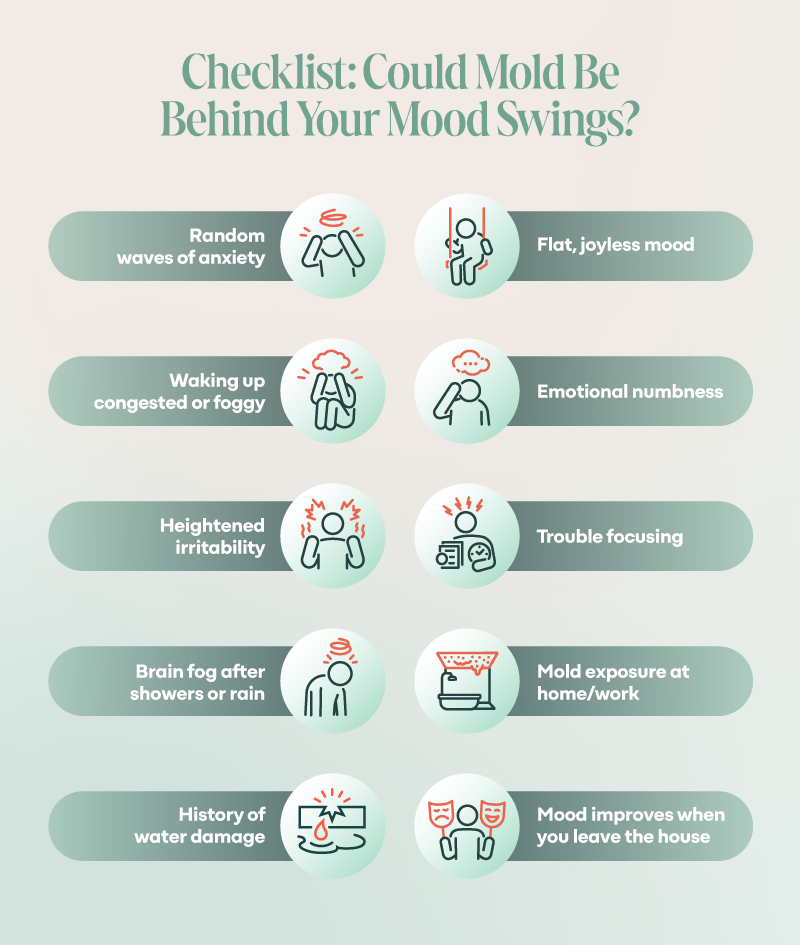
Mold Exposure Symptoms: Is Toxic Mold Behind Your Depression or Anxiety?
Most people think of mold exposure as a respiratory issue—maybe a stuffy nose or a weird cough. But for many of us, the first signs aren’t physical. They’re emotional.
If you’ve been feeling depressed, anxious, emotionally numb, or just “off,” and none of the usual tools are working—there’s a good chance your body’s dealing with something much deeper than a serotonin shortage.
Mold toxicity messes with your brain chemistry (10, 29), inflames your nervous system, (14, 25, 19) and scrambles your sense of safety in the world.
And the longer it goes unaddressed, the more it looks and feels like a mental health crisis.

Here are some of the most common mood-related symptoms I see in mold-exposed clients:
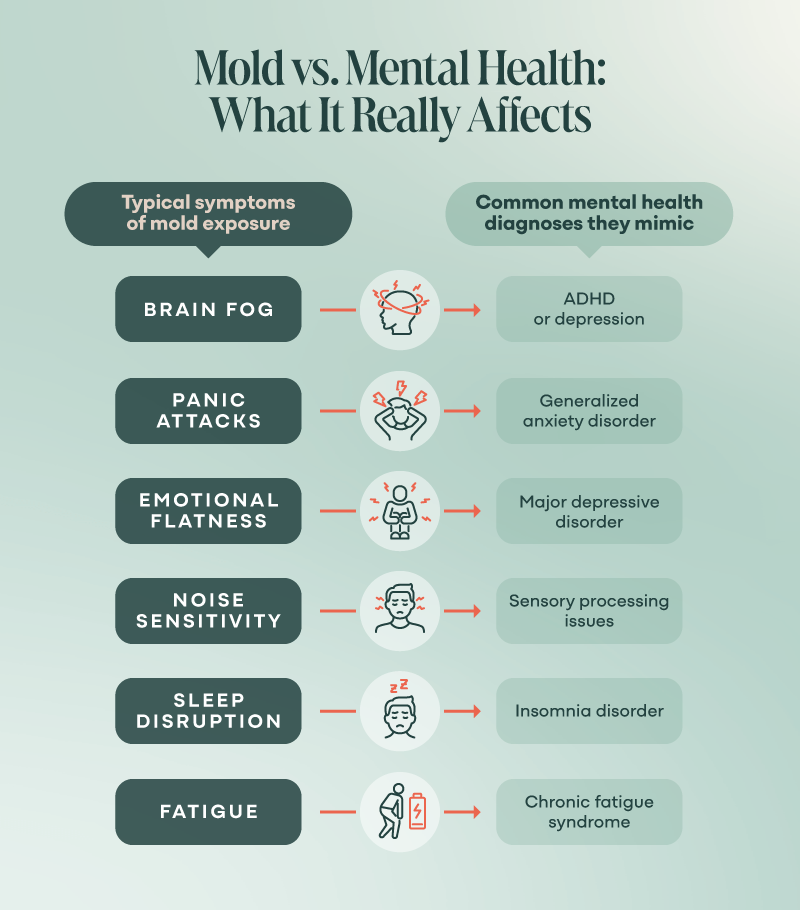
- Sudden mood drops that seem to come out of nowhere (10, 12, 14)
- Chronic anxiety or panic attacks, especially in specific environments (like your home or office) (3, 11, 12, 14)
- Emotional flatness, heaviness, and depression, like your joy got unplugged (3, 10, 11, 12, 14, 24, 28)
- Low motivation, apathy, or that “I’m a ghost in my own life” feeling
- Irritability, snapping at the people you love, even when you don’t mean to (10, 12, 14)
- Insomnia or broken sleep, even when you’re exhausted (3, 12)
- Brain fog that feels like walking through wet cement (14)
- Memory loss, confusion, and cognitive deficits (3, 10, 11, 14)
And while these symptoms get dismissed as “psychological,” mold almost always brings some physical sidekicks too—like sinus congestion (12), light sensitivity, buzzing or tingling sensations (14), new chemical sensitivities (12), fatigue (3, 10, 11, 12, 14), headaches (3, 12), or feeling overstimulated in noisy environments.
But most conventional doctors don’t ask about your environment. They won’t screen for mold or mycotoxins.
They’ll hand you a prescription or a pep talk—and maybe, for a minute, it helps. But if the root cause is mold, those tools are like rearranging furniture in a burning house.
Your body isn’t betraying you. It’s trying to tell you something.
If your symptoms don’t match your labs, if your mood doesn’t respond to your mindset work, if you feel like your emotions are glitching and no one believes you—it’s time to consider that your environment might be toxic, not your mind.
How Mold Rewires the Brain (And Why It’s Not Just ‘All in Your Head’)
Mold doesn’t just irritate your sinuses. It can rewire your brain.
The poisons released by mold—called mycotoxins (9, 22)—are tiny, fat-loving molecules that cross the blood-brain barrier like it’s no big deal (5, 6, 14, 16, 20, 25, 29).
They can even gain direct access to your brain via olfactory pathways (your nose and its nerves) (11).
Over five hundred mycotoxins have been identified (9, 19) and industrial processing has zero impact on reducing them (22).
Once they’re in your body, they disrupt your nervous system, your immune system, and your emotional stability in ways that most doctors still haven’t been trained to recognize.
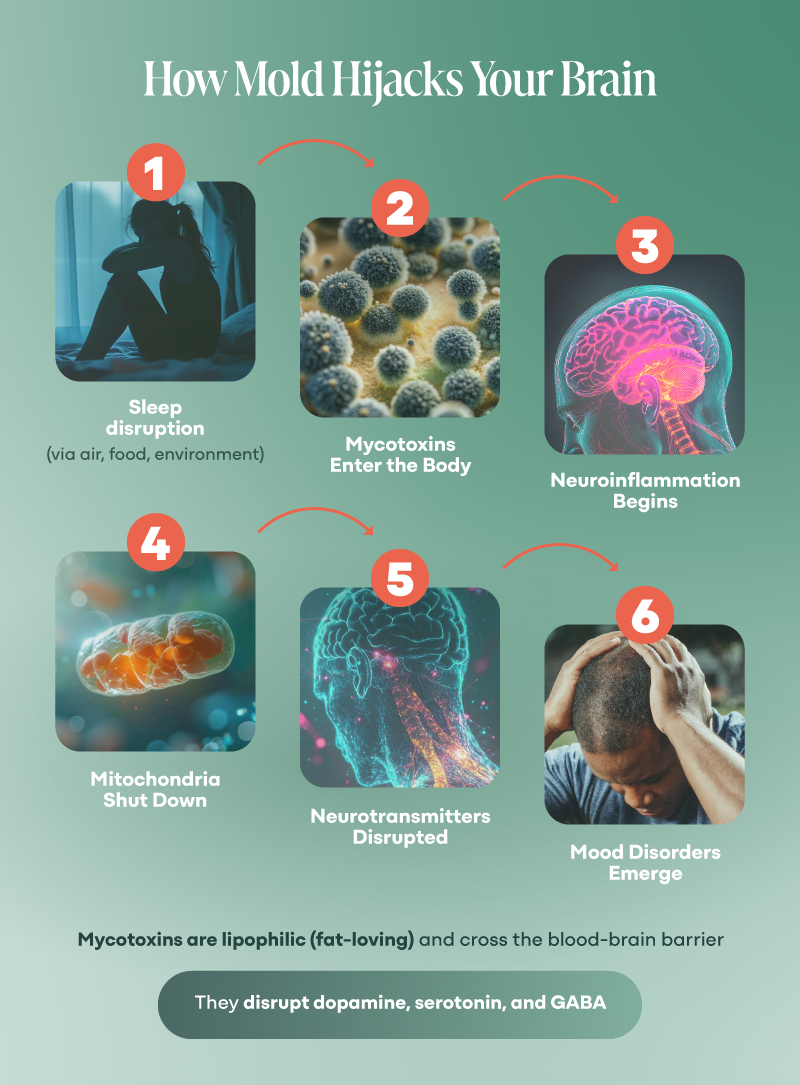
Here’s what we know from the research (and what I’ve seen repeatedly in my practice):
1. Neurotoxicity: When Mold Poisons Your Brain Cells
Certain molds (like Aspergillus, Stachybotrys, Penicillium) produce mycotoxins that damage the actual cells in your brain—particularly in areas tied to memory, mood, and sleep (1, 6, 7, 12, 14, 15, 16, 17, 18, 22, 26).
This causes nervous system dysfunction (16, 23, 25, 27, 29) and dysautonomia (12, 14).
One study found that ochratoxin A (a common mold toxin found in water-damaged buildings and contaminated food) disrupts mitochondrial function in the hippocampus—your emotional regulation center and memory library (17).
Mitochondria are the power houses of your body, producing the energy your cells need to do allll the things they do.
Mycotoxins cause mitochondrial dysfunction and toxicity (2, 6, 12, 15, 19, 25).
Think of it as mold-induced burnout at the cellular level.
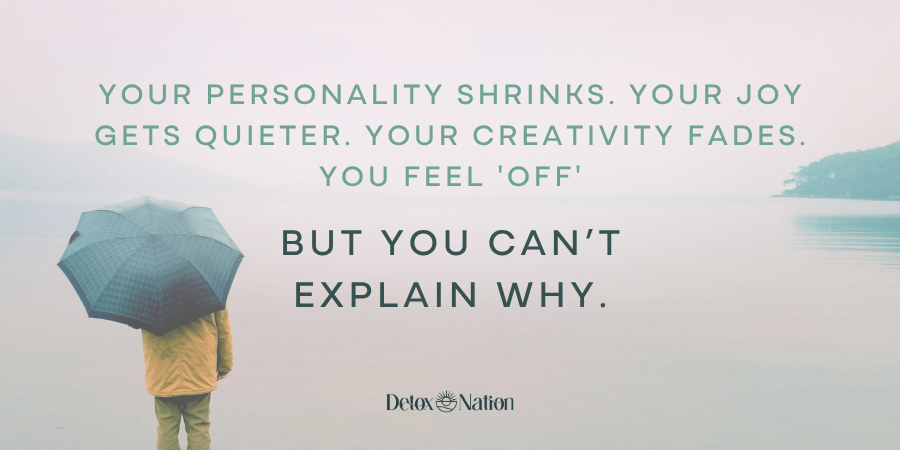
Your brain literally can’t make enough energy to function, let alone thrive. \
So, your personality shrinks. Your joy gets quieter. Your creativity fades. You feel “off”—but you can’t explain why.
2. Neuroinflammation: Brain on Fire
Mold triggers your immune system into a state of alarm, and when that alarm happens inside the brain, it’s called neuroinflammation (14, 25, 29).
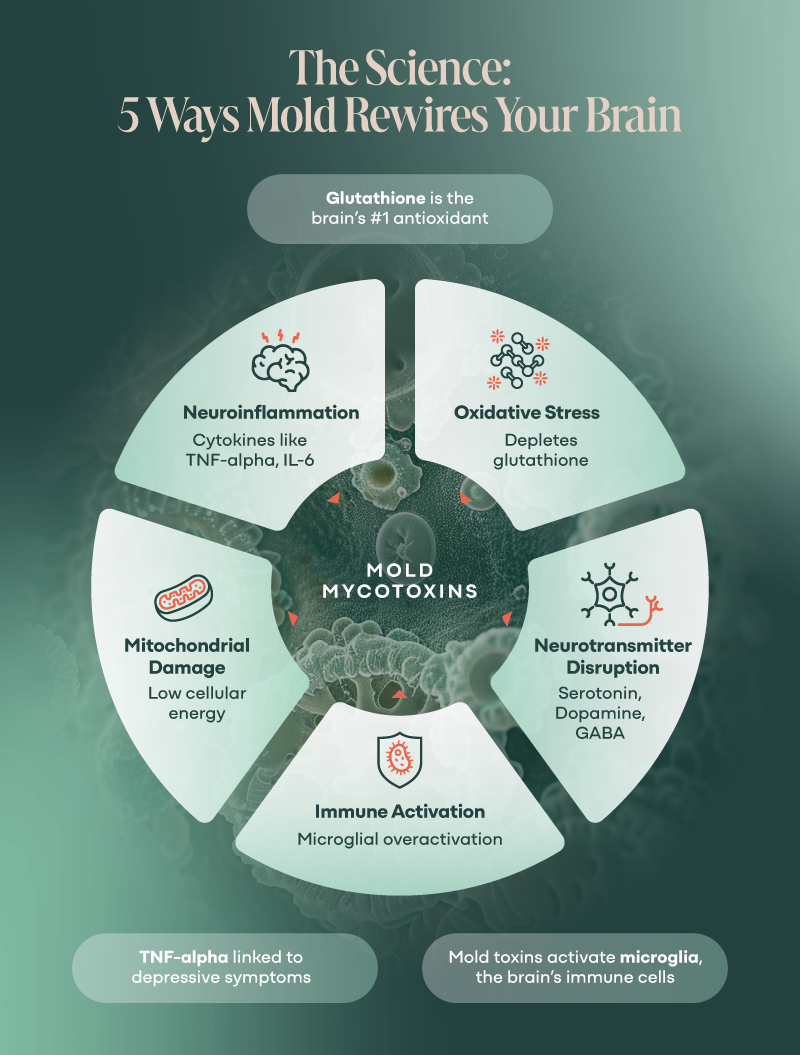
This is where we see cytokines—like TNF-alpha and IL-6—flooding the brain, shutting down neuroplasticity (aka your brain’s ability to adapt and grow) and disrupting emotional regulation (2, 21, 29).
Translation? You’re more sensitive to stress. You cry more easily. Or you don’t cry at all anymore—and that scares you.
Your resilience shrinks, and the tiniest challenges feel enormous. It’s not a character flaw. That’s inflammation.
3. Immune System Takeover: Microglial Mayhem
Mold activates your brain’s immune sentries—called microglia (3, 8, 11, 12, 16, 18, 19, 20, 21, 22, 23, 29).
These guys are supposed to protect your brain, but when they stay turned on too long (as they do in mold exposure), they go from guard dogs to wrecking balls.
This leads to long-term damage, including mood disorders and cognitive decline.
If you’ve ever felt like your brain just won’t turn back on, this might be why.
But they don’t stop there. Mycotoxins also cause abnormal Natural Killer cell activity, weakening your overall immune system (3).
4. Oxidative Stress: Your Antioxidants Can’t Keep Up
Mold exposure produces free radicals (1, 2, 6, 12, 15, 16, 19, 20, 25, 29) depletes your natural antioxidant defenses (2), especially glutathione—the brain’s main “clean-up crew.”
Without enough glutathione, your neurons get clogged with oxidative waste.
It’s like trying to think clearly with a fog machine in your skull.
This is why brain fog, fatigue, and even rage outbursts are so common in mold toxicity. Your brain is overwhelmed—and screaming for help.
5. Neurotransmitter Disruption: Your Feel-Good Chemicals Flatline
Mold interferes with the production and recycling of key neurotransmitters like (10, 29):
- Serotonin (mood, sleep, digestion)
- Dopamine (motivation, focus, reward)
- GABA (calm, balance, nervous system regulation)
So, you can feel anxious and wired and depressed and flat—all in the same day.
Mold disrupts your emotional rhythm, leaving you stuck in either overdrive or shutdown.
This isn’t about mental weakness. It’s about biochemical interference.
If your brain feels like it’s been hijacked—because one minute you’re fine and the next you’re spiraling—there’s a good chance it has.
And mold might be driving the getaway car.
Let’s bring some hope into the mix—because this next part is about what’s possible when you give your body the tools to heal.
Detoxing from Mold Can Change Your Brain—and Your Mood
Here’s the good news: your body isn’t broken—it’s just overwhelmed.
And once you start clearing out the mold, the fog starts to lift. Your emotional baseline rises. The spark comes back.
It doesn’t happen overnight, but it does happen. I’ve seen it again and again with clients who swore they were “just wired for depression” or had been labeled with treatment-resistant anxiety.
Once we identified mold as the missing link and started the right kind of detox—not the trendy kind, the targeted, bioregulatory kind—their mood started shifting in ways they didn’t think were possible.
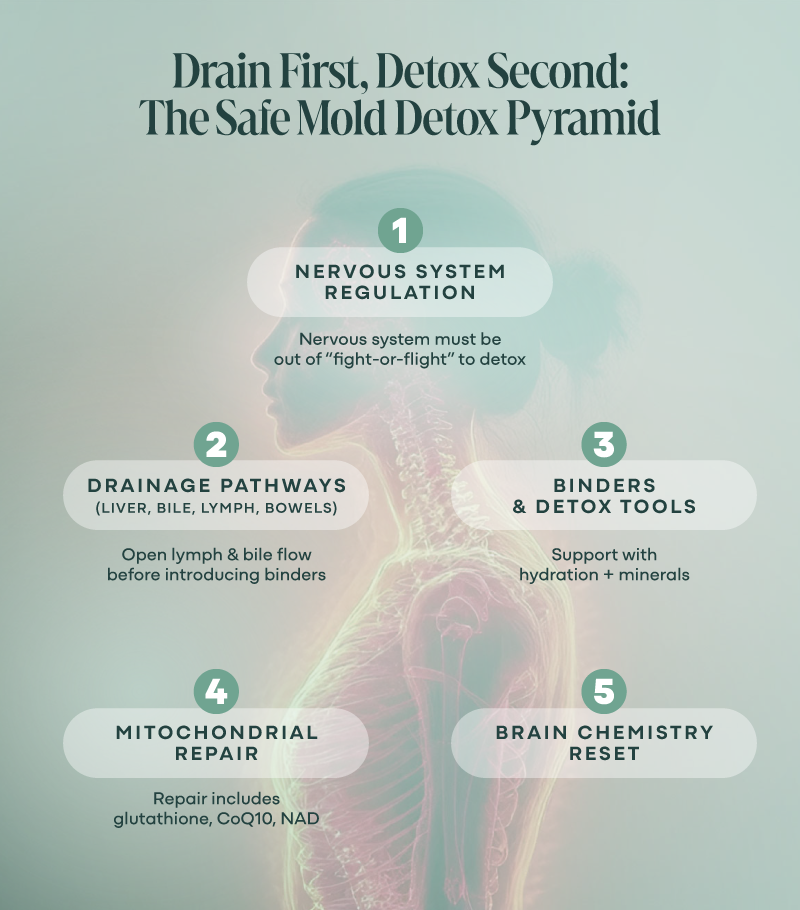
Here’s how detoxing mold restores your brain’s ability to feel like you again:
1. It Starts With Removing the Source
You can’t heal in the same environment that made you sick.
Whether it’s your home, your car, your office, or your coffee beans (yep, I said it), identifying and removing your mold exposures is the first step.
This is all about reducing the burden. Even small changes can make a big difference.
And no, running an essential oil diffuser isn’t going to cut it.
True mold remediation is methodical and often uncomfortable—but it’s worth it. Because without source removal, detoxing just turns into re-toxing.
2. Calm Your Nervous System or Detox Becomes a Trauma Trigger
If your nervous system is stuck in fight-or-flight, your body won’t prioritize healing. It’ll prioritize survival.
That’s why things like breathwork, somatic tools, Vagus nerve stimulation, and safe movement are non-negotiable.
You don’t have to “push through”—you have to support your biology.
Detox is a whole system shift.
3. You Have to Open the Drain Before You Detox
This is where most people get it wrong. You can’t just start popping binders and hope for the best.
If your drainage pathways are blocked—liver, lymph, bile, colon—those toxins have nowhere to go. And when that happens, your symptoms can intensify instead of improve.
This is why we always start with foundational drainage support: bitters, bile flow enhancers, lymph movement, hydration, minerals.
You’re not forcing detox—you’re setting the conditions for your body to do what it already knows how to do.
4. The Real Work: Binding and Removing the Mold Toxins
Once your body is ready, this is where the deeper detox begins.
We use binders to catch the mycotoxins and escort them out—through bile, into the gut, and out of the body. (This is not something you guess at, by the way. It needs to be customized to the type of mold exposure you’ve had and your sensitivity level.)
We also support mitochondrial repair—because your brain runs on cellular energy.
Think glutathione, CoQ10, NAD precursors, and targeted minerals.
We rebuild the antioxidant systems, restore brain chemistry, and repair the damage done by years of chronic exposure.
It’s not a quick fix. But it’s a real fix.
When mold stops whispering “you’re not safe” to your nervous system 24/7, your brain can finally rest.And when your brain can rest—you feel like yourself again.
Final Thoughts: It’s Not Your Fault—But It Is Your Opportunity
You didn’t choose to be exposed to mold.
You didn’t consent to breathe in invisible toxins while you slept, worked, or drank your morning coffee.
And you certainly didn’t sign up for the emotional fallout—feeling numb, anxious, or like a shadow of yourself.
But here’s what’s true: Your body is brilliant.
And it’s been whispering for years. Now it’s shouting. Let’s listen.
You can shift this.
You can reclaim your mood, your focus, your vitality—and you don’t have to do it alone.
The first step? Start playing health detective. Get curious. Let your symptoms be breadcrumbs—not a life sentence. If you’re wondering whether mold might be behind your brain fog, anxiety, or burnout, take 3 minutes to find out. Start the Free Mold Assessment.
If you’re ready to stop spinning and start clearing mold from your system—for real this time?
Our Healing Lab gives you a proven roadmap to safely and effectively reduce your body’s toxic load, regulate your nervous system, and start feeling like yourself again.
You’re resilient—and your body remembers how to heal. Let’s give it the support it’s been asking for.
FAQs
1. Can mold really cause depression or anxiety?
Yes. Fungal exposure—especially to mycotoxins—can disrupt neurotransmitters, inflame the brain, and overload your nervous system, leading to mood swings, panic attacks, and even emotional numbness.
2. What are some hidden sources of mold I should be aware of?
Think HVAC systems, under-sink leaks, front-load washers, cars with old water damage, and even foods like coffee, peanuts, and wine. If you’ve had a past leak or live in a humid area, mold-illness might be part of your story.
3. What symptoms suggest mold is affecting my mood?
Sudden mood crashes, irritability, unexplained anxiety, insomnia, brain fog, emotional disconnection, and feeling “off” despite doing everything right are big red flags.
4. How do I know if mold is the root of my emotional symptoms?
Start with our free Mold Assessment. It helps connect the dots between your symptoms and potential exposures, so you can stop guessing and start seeing the pattern.
5. Why hasn’t my doctor brought this up?
Most conventional practitioners aren’t trained to recognize fungal illness, especially when it presents with emotional or cognitive symptoms. That doesn’t mean it’s not real—it means it’s time to widen your lens.
6. Will detoxing from mold really help my mood?
Yes—if it’s done correctly. When you reduce fungal exposure, open your drainage, and support your nervous system, emotional resilience and clarity often return. It’s one of the most hopeful patterns I see in my practice.
7. Can I detox from mold on my own?
You can, but you shouldn’t wing it. Detoxing without the right sequence can backfire. That’s why we created the Mycotoxin Detox Program—to guide you step by step, safely and effectively.
8. What’s the first thing I should do if I suspect mold is a factor?
Identify and reduce your exposure. That might mean testing your home, replacing moldy items, or switching out mold-prone foods. Awareness is your superpower here.
9. Are there supplements that help with mold-related mood symptoms?
Yes—but timing and strategy matter. Think binders, mitochondrial support, glutathione, and anti-inflammatory tools. But these should follow proper drainage and nervous system work—not come first.
10. Is it really possible to feel like myself again?
Yes. Your body is brilliant and remembers how to heal. With the right support, your mood, energy, and clarity can return. I know this sucks—but it’s fixable.
Mold toxicity is fixable. Your body is amazing and can heal when you take action.
No matter what your results are, you’re not alone. I’m here to help every step of the way!
Take the Free Mold Assessment