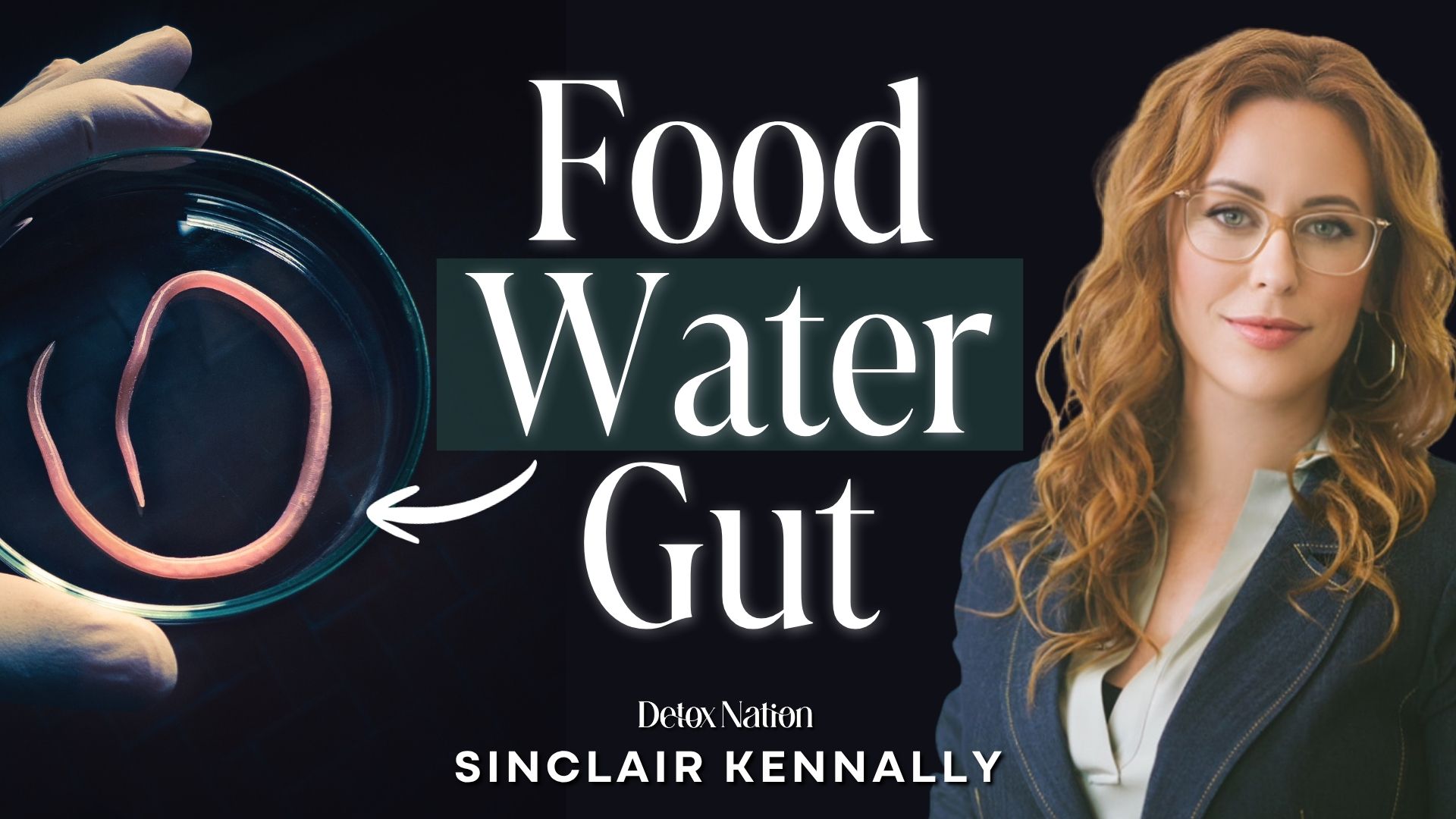


A rope worm might be the intestinal parasite you’ve never heard of—but it could be affecting your health. Found during detox protocols, these rope-like worms are often linked to gut issues, fatigue, and bloating.
Let’s talk about something deeply unsettling—something that could be inside you right now, and no, I’m not talking about that embarrassing memory from middle school.
I’m talking about rope worms.
Maybe you’ve been dealing with vague, unexplained symptoms—chronic bloating, stubborn brain fog, fatigue that won’t quit.
Maybe you’ve tried everything—clean eating, supplements, exercise—but it feels like the “old you” is gone for good.
And then, one day, during a detox protocol, boom—you pass something long, slimy, and way too structured to just be mucus.
You’ve just experienced one of the weirdest and most controversial mysteries in gut health.
But don’t panic.
This isn’t a horror movie (even though it might totally feel like one).
Your body is always working to heal, and if these things are coming out, that means something good is happening.
So, let’s dig into what rope worms might be, why they exist, and—most importantly—how you can clear them out for good.
Key Takeaways
- There are many theories about what rope worms are.
- Most people feel better after getting them out of their body.
- You can help support your body with detox and drainage.
So, what’s your next step?
It’s time to answer that call and start supporting your body the way it deserves. I invite you to join me and our tribe at our next Rapid Parasite Jumpstart to learn how to heal from allll the annoying parasites. Because you’re worth it.
Join Rapid Parasite ReleaseImagine This
It’s a beautiful Spring Day – your windows are open to let the fresh air in, and you’re humming along to your favorite tunes as you start to make a healthy dinner for your family.
Your pupper is snoozing on his favorite throw rug, your two youngest kiddos are outside kicking the soccer ball around, and your teenaged son (let’s call him Chris) is napping on the couch.
You’re relieved because he hasn’t been feeling great lately, so you started him on a new detox protocol, and he needs his rest.
All is well.
You hear a strange noise from the living room, and you poke your head around the corner to check on Chris.
Just in time to see a slimy rope-looking thing coming out of your son’s nose!
He’s starting to wake up and is freaking out, so you do your best to stay calm.
(But you’re legit trying not to vomit.)
When it’s finally out, it measures close to 2 meters (over six feet) in length!
Eeewwwww, gross!
Congratulations! You’ve just met your first “rope worm.”
A Brief History of Rope Worm
Rope worm first entered the spotlight in the early 2000s, thanks to detox practitioners who noticed its presence during cleansing protocols.
Mainstream science has largely ignored it, but this lack of acknowledgment hasn’t stopped anecdotal reports from flooding in.
Countless individuals claim they’ve passed long, rope-like structures during cleansing programs and experienced significant symptom relief afterward.
While official studies are scarce, this lived experience is hard to dismiss for those who’ve gone through it.
When you get something out of your body and feel better almost immediately, it’s worth paying attention to—even if the “experts” haven’t caught up yet.
Theories About What Rope Worm Is
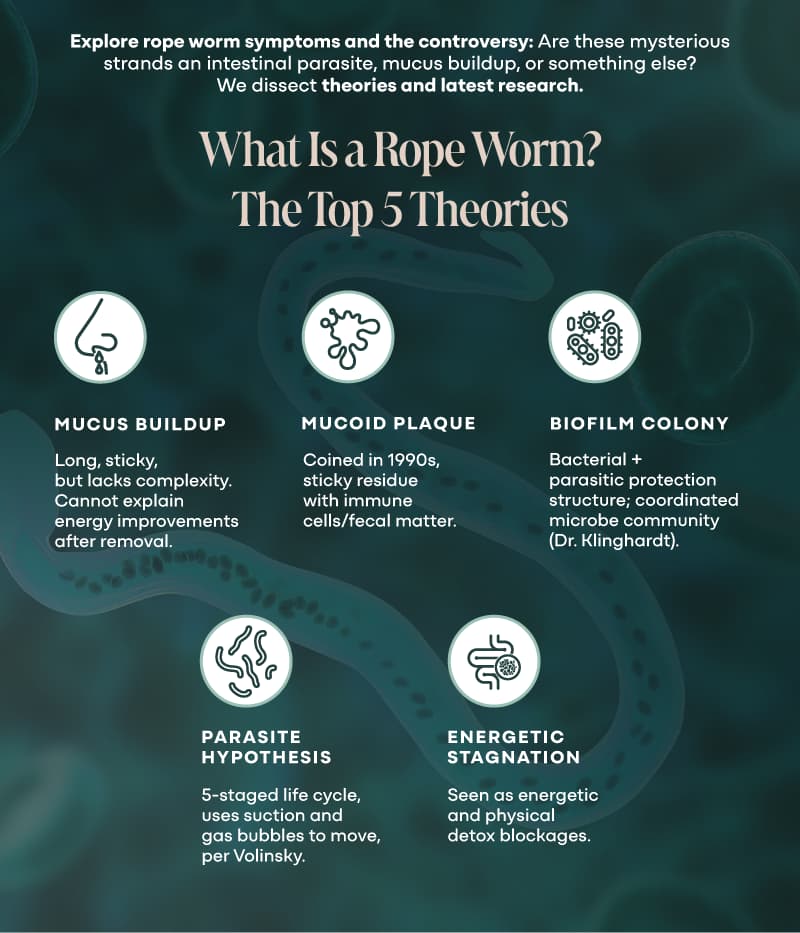
One of the most puzzling things about rope worm is the debate around what it is. Here are the leading theories:
Maybe Mucus Buildup?
At first glance, rope worms might look like nothing more than mucus, intestinal debris, or a mucus plug (7, 8, 11) but there are unique characteristics that suggest otherwise:
- They can grow up to several feet long, far larger than typical mucus (5, 9, 12, 13).
- Many exhibit distinct layers or segments resembling living organisms (2, 3, 5, 9, 12, 13).
- Anecdotal evidence shows dramatic health improvements after their removal, which seems disproportionate if they were “just mucus.”
Mucoid Plaque
The term “mucoid plaque” is also controversial (6).
The term was coined around the 1990s by a Naturopathic Doctor to describe the gunk coming out of him during an herbal cleanse (1).
Mucoid plaque is theorized to contain mucus (or something like mucus), fecal matter, immune cells, and other debris that get stuck in the crevices of your colon (1).
Biofilm Hypothesis
Some practitioners theorize that rope worms are accumulations of mucus and biofilm—a protective slime layer produced by bacteria and other pathogens (2, 9).
Biofilm shields pathogens from detection and eradication, making it a prime suspect in gut dysbiosis and microbial imbalances.
Cleansing or detoxing disrupts this layer, potentially leading to the expulsion of these rope-like structures.
Two key leaders in the natural health community have leaned into the biofilm hypothesis:
Dr. Dietrich Klinghardt, a world-renowned expert on Lyme Disease and its coinfections, stated in a 2020 podcast that he concluded rope worm is a community of different bugs living in a biofilm and communicating on a high level with each other (3).
In essence, they are coordinating to act as one organism for survival.
He also noted that, in his practice, he saw rope worm reproducing faster than it could be eliminated until he started including retrovirus treatments to support the patient’s immune system (3).
Dr. Klinghardt believes “that out of the total power that you need to expel a parasite, the best concoction of [substances] can do maybe 20% of that work. And the other 80% needs to come out of the patient’s own immune system.” (3)
The Weston-Price Foundation interviewed Laura Villanti in 2023, and she stated she believes rope worm to be “a community of organisms, part viral, part bacterial, that have learned to live together in this mucus-like substance.” (2)
GMO and Microbiome Disruption
Modern diets have introduced genetically modified organisms (GMOs) and processed foods that disrupt the gut microbiome.
Some believe these changes may lead to the creation of abnormal structures like rope worms.
While unsubstantiated, it’s worth considering in the broader context of today’s gut health challenges.
Energy and Detox Connection
Another theory steps into the energetic realm: rope worms could be manifestations of stagnation in the body’s detox pathways.
The idea is that physical symptoms often mirror deeper energetic imbalances.
By clearing these out, the body can restore its natural flow.
Human Intestinal Parasite Hypothesis
This theory is the most controversial: rope worms might be a previously unidentified type of parasite.
The segmented structure, movement in some reports, and health improvements post-expulsion lend weight to this idea.
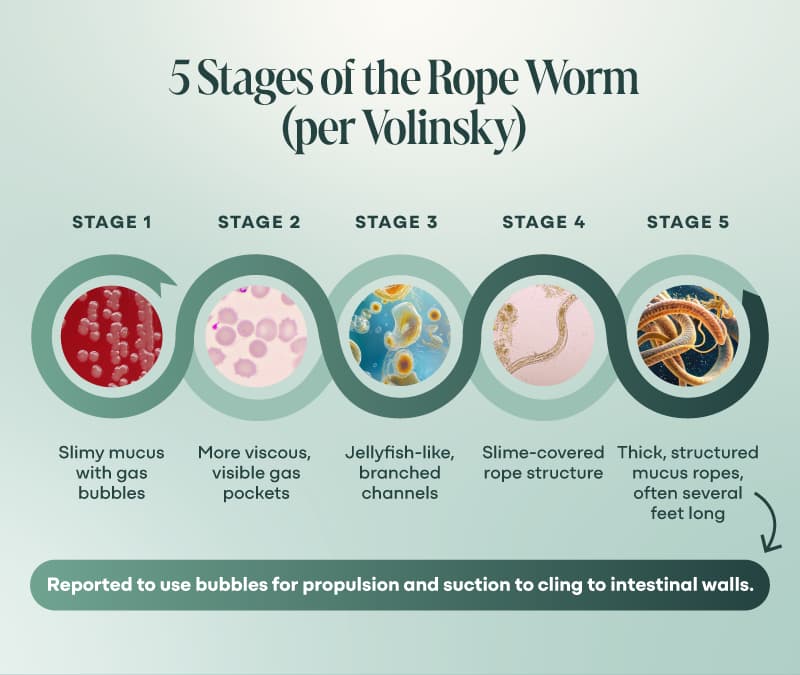
Alex Volinsky, the person who “discovered” rope worm, has described five stages of the rope worm to support the parasite hypothesis (5, 9, 12, 13).
- Stage 1: It looks like slimy mucus with gas bubbles. This is reported to be able to be “hosted” anywhere within the human body (12).
- Stage 2: Is more viscous, with what looks like visible gas pockets inside.
- Stage 3: Looks like a jellyfish with branched channels.
- Stage 4: Looks like a small rope covered in slime.
- Stage 5: Looks like a viscous mucous rope
He believes they use bubbles for propulsion and attach to the small intestine of the host via suction (9, 13).
However, he noted that unlike other parasites, rope worms don’t have a nervous system, muscles, or a reproductive system, and they dry out rapidly when exposed to air (13).
I’ve read conflicting reports about genetic testing on rope worm.
Some accounts say rope worm contains 99% human DNA (1, 6)
Others say it was a “composite” of various types of DNA – viral, bacterial, fungal, etc. (2, 3)
Still another paper states it contained 99% human mitochondrial DNA (4).
In an article published by Volinsky himself (12), he reported:
“Stage 3 showed 99% match to human pseudogene, chromosomes 8 and 17. Stage 5 had 99% match to human mitochondria DNA. There is 82.6% match between the COI sequences obtained from the rope worm’s stages 3 and 5. 18s gene sequences of stages 3 and 5 showed 99% human rRNA. There is 99.3% match between the two sequences. Illumina shotgun sequencing was also performed. Out of 15 Mbp sequenced less than 10% match bacterial and human DNA, while the rest currently has no match.”
Given that there is almost no peer-reviewed research available on rope worm, and no official genome mapping, all of this remains speculative.
And let’s be honest: no one’s lining up to fund a study on this.

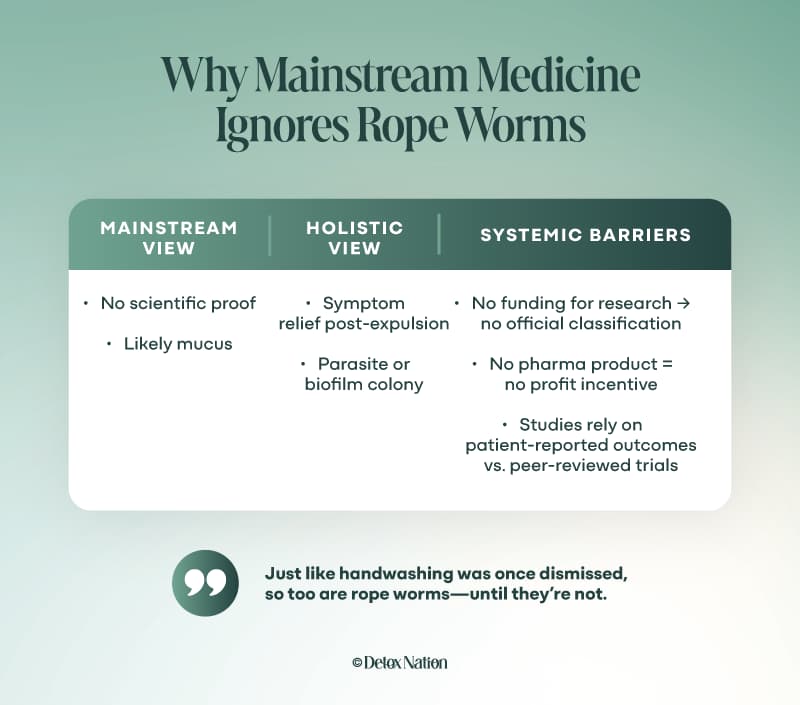
Why Mainstream Medicine Doesn’t Recognize Rope Worm Infection
It’s easy to dismiss rope worms as fringe pseudoscience, and that’s exactly what mainstream medicine tends to do. But there are systemic reasons behind this resistance:
- Dismissal of the Unconventional: If it doesn’t fit neatly into a research study or textbook, it’s often ignored. Mainstream medicine relies heavily on proven, replicable data, and rope worms exist outside these parameters. Just like parallel universes were considered to be science fiction – until they weren’t – history is filled with medical “quackery” that was later proven to be true. (Acupuncture, handwashing, energy fields, light therapy, and more!)
- Funding Gaps: Studying unclassified phenomena doesn’t attract much funding—especially when there’s no pharmaceutical payout at the end. Why pour money into something that doesn’t result in a marketable drug?
- Holistic Practitioners Take the Lead: Unlike conventional medicine, holistic and alternative practitioners are more likely to value patient anecdotes and consider unconventional explanations. (We also recognize the whole patient, not just their pieces and parts.) Holistic and functional practitioners are often on the front lines, observing patterns and exploring solutions where others won’t tread.
Ultimately, the divide comes down to paradigm differences.
Conventional medicine often aims to suppress symptoms while holistic care seeks to resolve root causes—even when they’re unconventional.
Symptoms Associated With Rope Worm
Rope worm doesn’t show up on a medical chart, but it can show up in your symptoms.
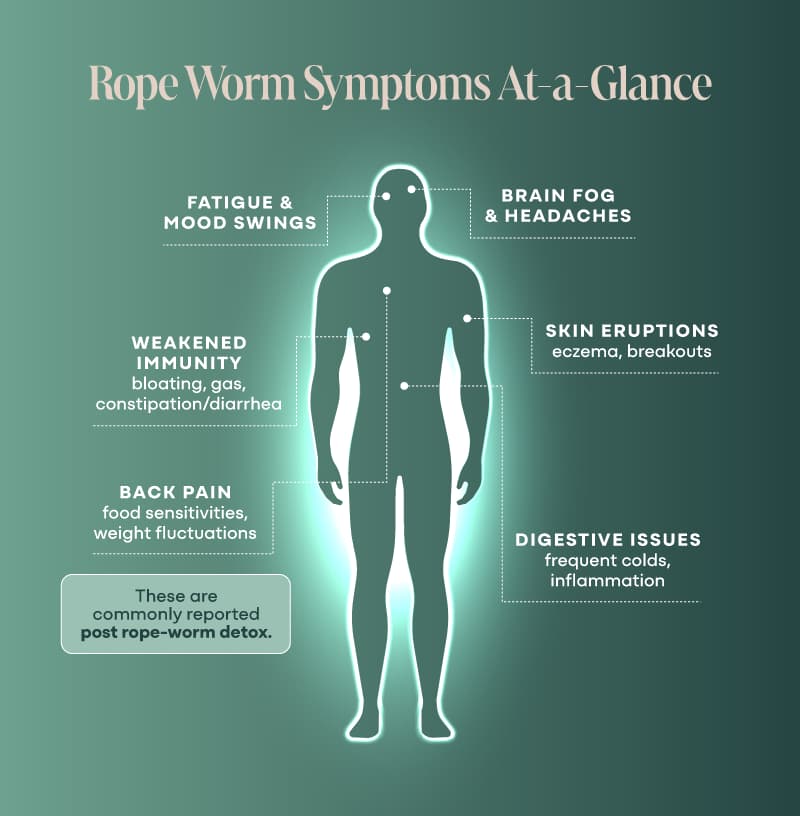
Many people experiencing this phenomenon report chronic digestive issues: bloating, irregular bowel movements, and stubborn gas that never seems to subside.
But it doesn’t stop there.
I’ve seen fatigue, brain fog, skin eruptions, and mood swings accompany this mysterious guest.
How about a weakened immune system (think: frequent colds), headaches, back pain, food sensitivities, weight changes, and inflammation (5, 9)
If this sounds like your daily life, you’re not alone.
These symptoms are frustrating, but they’re also important signals.
They’re your body’s way of telling you, “Something isn’t right in here.”
The good news?
With the right detox and drainage support, those signals can fade as your body’s balance is restored.
The ‘Feel Better’ Factor: Why Addressing Rope Worm Matters
Do you really care which theory is correct?
The bottom line? When you eliminate rope worms, you feel better.
This isn’t a placebo effect—it’s a noticeable shift in energy, mental clarity, and overall health.
Why?
Rope worms likely contribute to your toxic burden.
By removing them, you’re unblocking drainage pathways and clearing out microbial imbalances.
Your body functions best when it’s not bogged down by hidden obstacles, and rope worms appear to be a major one.
The “feel better” factor also includes emotional and even energetic relief.
People often report a sense of lightness or emotional breakthroughs after clearing these structures, suggesting a deeper connection between physical and emotional health.
Rope Worm and Detox/Drainage
Let’s get practical: your body’s ability to eliminate toxins is only as good as its drainage system.
Think of your drainage pathways—lymph, liver, kidneys, and gut—as a toilet.
If those pathways are clogged, just like a clogged toilet, everything backs up, leading to stagnation and toxicity.
When rope worms are present, they may act like a blockage in these systems.
Clearing rope worms isn’t just about removing the rope worm itself—it’s about addressing the environment that allowed it to thrive in the first place.
Supporting detox and drainage is crucial for unburdening the body. Key steps include:
- Hydration: Distilled water helps move waste through your lymphatic and urinary systems.
- Binders: Natural substances like activated charcoal or bentonite clay bind to toxins for easier removal.
- Movement: Gentle exercise or rebounders stimulate lymph flow.
- Herbs: Supportive herbs like dandelion or burdock root encourage liver and kidney function.
Detox isn’t a one-time event.
It’s a lifestyle of consistent unburdening that allows the body to thrive.
Practical Steps to Address Rope Worm
The good news is you don’t need a lab test to get started. If you suspect rope worm is a factor in your health challenges, here are some practical steps:
- Continue to Educate Yourself: You’re already here, so you’re off to a great start! To optimize your health, you’re going to have to unlearn things you thought were facts and open your mind to things you maybe never considered.
- Open Drainage Pathways: Hydration, coffee enemas, and rebounding are simple but powerful things you can do to help your body help itself.
- Detox Protocols: Start to build a detox-lifestyle. Minimize exposures to all toxins, eat clean food, and protect yourself from EMFs.
- Nervous System Regulation: Chronic stress hampers detox. Practices like breathwork, meditation, or gentle yoga support the parasympathetic nervous system—your body’s rest-and-digest mode.
- Focus on Gut Health: Strengthen your microbiome, eat organic foods, use digestive enzymes if necessary.
- Work with a Practitioner: A skilled parasite and detox-literate holistic practitioner can guide you through specific protocols tailored to your body’s needs.
The key here is patience.
Healing isn’t about forcing the body—it’s about creating the conditions for it to heal itself.
Conclusion
So, what about Chris, you ask?
After his Mom reached out to me and we talked through everything she was relieved to know she didn’t have to panic.
(Although she may still be recovering emotionally from witnessing that thing come out of her kid.)
And Chris was feeling much better with it OUT than he had felt with it IN.
Whatever they’re eventually determined to be, rope worms are a wake-up call.
They remind us to pay attention to the deeper toxic burdens our bodies carry.
Whether they’re parasites, biofilm, or something in between, addressing them can lead to profound shifts in how you feel.
No one else can do this for you.
It’s your body, your health, and your responsibility.
But here’s the good news: the rewards of doing the work are so worth it.
When you clear out the gunk—whether it’s a rope worm or just years of accumulated toxins—you feel lighter, clearer, and more alive.
So, what’s your next step?
It’s time to answer that call and start supporting your body the way it deserves. I invite you to join me and our tribe at our next Rapid Parasite Jumpstart to learn how to heal from allll the annoying parasites. Because you’re worth it.
Join Rapid Parasite ReleaseFAQ About Rope Worms
Q: How can I tell if I have rope worms?
A: Symptoms like chronic digestive issues, fatigue, and brain fog might indicate their presence, but a definitive diagnosis may be difficult until you pass them. You may also be experiencing an increase in mucus or notice the presence of strands of mucus in your toilet. The viscous mucus may look like actual worms or shed pieces of intestinal mucus.
Q: What’s the best way to eliminate rope worms?
A: Focus on detox and drainage support, including hydration, binders, enzymes, and gut-healing practices. Working with a holistic practitioner can also provide tailored guidance.
Q: Is it dangerous to pass a rope worm?
A: Passing a rope worm is not typically dangerous and is often associated with noticeable improvements in health. However, detox should always be approached carefully to avoid overwhelming the body.
Q: Why doesn’t mainstream medicine recognize rope worms?
A: Mainstream medicine often dismisses phenomena that lack peer-reviewed research or standardized classification. Rope worms fall into this category due to limited studies and funding.