

Cortisol gets a bad rap.
This stress hormone is a messenger. If your cortisol levels are off, it’s not a failure—it’s your body responding to chronic stress the best way it knows how.
Scroll through wellness blogs and you’d think it’s the root of all evil—causing belly fat, insomnia, anxiety, hormone chaos, and probably stealing your car keys too.
“Reduce cortisol!” they shout. “Lower stress hormones!” they promise. There’s even skincare named after it now.
But here’s the thing: cortisol isn’t the problem. Cortisol is your body’s in-house firefighter.
It’s the hormone that pulls you out of bed in the morning, helps you think clearly in a pinch, regulates your inflammation, balances your blood sugar, and keeps your immune system from overreacting to every sneeze and sniffle.
The problem isn’t having cortisol.
The problem is being stuck in a cortisol loop.
If you’re wired at night, crashing mid-day, struggling to focus, emotionally drained, or walking around with a nervous system that feels like it’s had six espresso shots—you’re not failing.
You’re just running a survival pattern that never got shut off.

We’re going to unpack:
- What cortisol is
- Where it’s made and why we desperately need it
- What happens when it’s too high… or bottomed out
- How to spot cortisol dysfunction in your test results (and your daily life)
- And how your nervous system and mitochondria are key to healing—not the latest adrenal cocktail trending on TikTok or IG
Because your body doesn’t make mistakes, and you can’t regulate what you don’t understand.
Once you do understand it? That’s where the real healing begins.
Let’s get into it.
Key Takeaways
- Cortisol isn’t the enemy—it’s your body’s built-in crisis manager.
- Adrenal cocktails and Tik Tok trends can’t fix a broken system.
- You don’t need to push harder—you need to shift the conditions.

What Are the Functions of Cortisol and Why Do You Actually Need It?
Cortisol is not your enemy.
It’s not trying to make you gain weight or ruin your sleep or burn your thyroid to the ground.
Cortisol is a steroid hormone made by your adrenal glands (those same overachievers we talked about in Part I), and it’s one of your body’s most powerful tools for managing change.
Think of it like your internal weather app—it scans the environment, predicts storms, and helps you respond in real time.
Without cortisol, you wouldn’t:
- Wake up in the morning (literally—it’s what gets you out of bed) (2)
- Handle inflammation from a splinter, a virus, or a tough workout (6)
- Regulate appetite, metabolism, or fat deposition (2)
- Keep your immune system from turning on itself (6)
- Stay grounded during stress, transition, or surprise life curveballs (2, 6, 10, 12, 13, 25, 26)
It’s not a villain. It’s your body’s built-in first responder.
Cortisol also modifies cognitive and emotional behavior (2, 26).
Cortisol follows a natural rhythm—highest in the morning (to get you going), and lowest at night (so you can sleep) (2).
This rhythm is so foundational that everything from your digestion to your thyroid to your brain function depends on it staying regulated.
But when the rhythm gets disrupted?
When cortisol is either stuck on full blast or can’t rally at all?
That’s when things start to unravel.
How We Can Help
Guiding people to reclaim their health and vitality is our greatest joy. Our entire practice is dedicated to supporting you to be who you really are, at home in your body, because your body is able to heal itself.
Book A CallAnd spoiler: that disruption doesn’t usually start with the adrenal glands.
It starts with what they’re responding to—your nervous system, your toxic burden, infections, your mitochondria, your terrain.
So, before we go demonizing cortisol, let’s take a step back and recognize: Your body wants to be in flow.
Cortisol is just doing its job in a system that’s been hijacked by stress and dysfunction.
Healing isn’t about forcing cortisol down. It’s about giving your body enough safety to stop sounding the alarm.
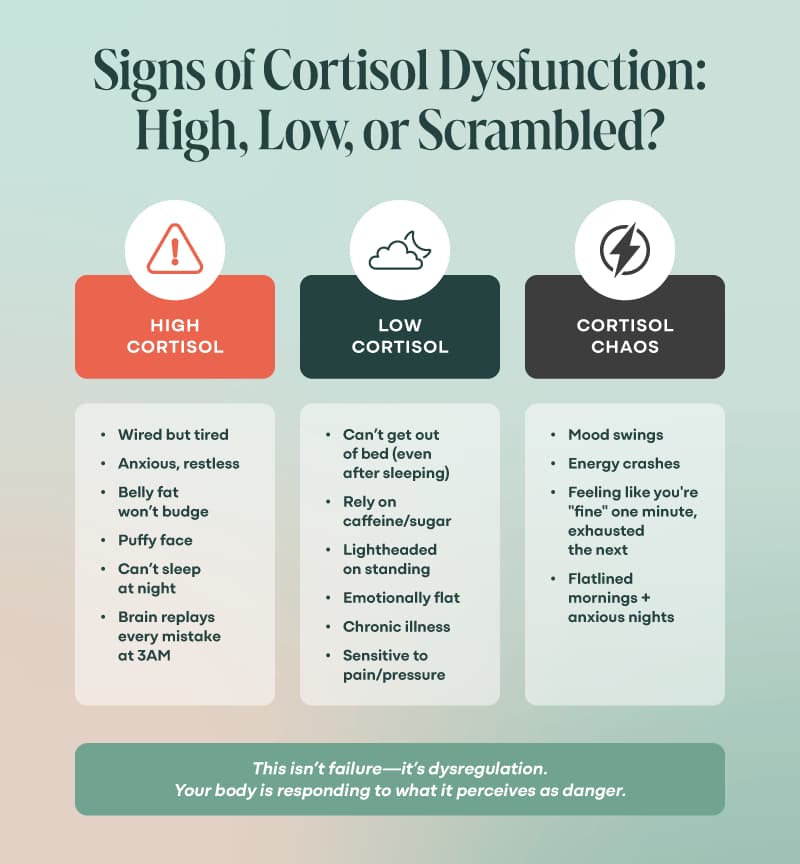
Signs of Cortisol Production Dysfunction: Too Much, Too Little, and Just Plain Scrambled
Cortisol isn’t “good” or “bad.” It’s just supposed to follow a pattern.
High in the morning → slowly tapering off through the day → nice and low at bedtime so you can rest.
But when your body’s been under chronic stress—whether from trauma, toxins, pathogens, or a constant sense of not being safe—cortisol stops following the rules.
And then things get weird.
Signs of High Cortisol Levels (Hyperfunction)
This is when your body’s stuck in red alert—producing too much cortisol for too long:
- You feel wired but exhausted
- You snap at little things (like someone breathing near you)
- Your belly fat won’t budge, no matter what you eat
- You’re anxious, restless, or jittery—especially at night
- Sleep feels impossible even though you’re desperate for it
- Your face is round and puffy
- You wake up at 3 AM with your brain rehearsing every mistake you’ve ever made
This phase can go on for months or years. Until…
Signs of Low Cortisol Levels (Hypofunction)
Eventually, your adrenals can’t keep up. The system crashes.
- You can’t get out of bed no matter how much you sleep (29)
- You rely on caffeine or sugar just to function
- You get lightheaded when you stand up
- You’re deeply tired—but still can’t sleep well
- You feel emotionally flat, foggy, or disconnected
- You have more pain, and are even sensitive to pressure (29)
- Your immune system is shot: you catch every cold, react to random foods, or stay sick forever
And the fun part?
Many people don’t fit neatly into one category.
They’re in cortisol chaos—high in the wrong places, low when they need it, and completely misaligned with their circadian rhythm.
This isn’t about discipline. It’s about dysregulation.
If you’re living in a world where your body’s constantly scanning for danger—from past trauma, environmental toxins, pathogens, or even your to-do list—your cortisol will reflect that.
Not because it’s broken. Because it’s listening.
The key isn’t to force cortisol up or down. It’s to help your system feel safe enough to return to its natural rhythm.
The Saliva Test Breakdown
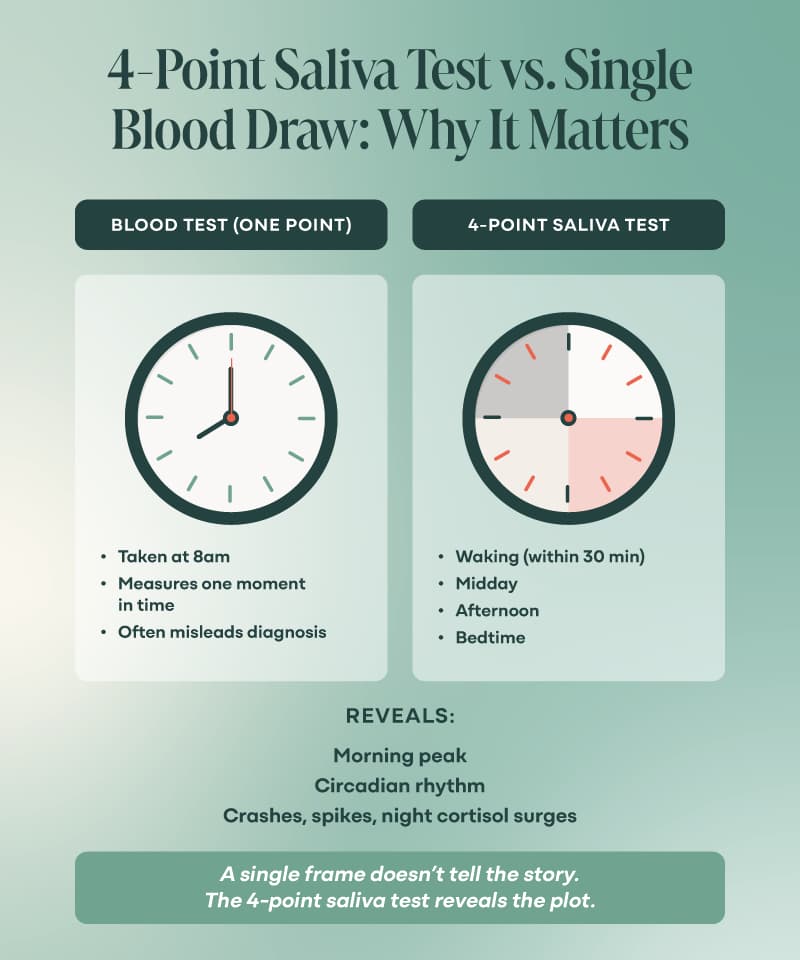
If you’ve ever had your cortisol tested through a single blood draw at 8 a.m. and been told, “You’re fine,” please know… you’re not crazy.
You’re just not being taken seriously.
That kind of test shows one moment in time.
It’s like judging an entire movie by looking at a single frame.
What provides more information is a 4-point salivary cortisol test.It measures cortisol at four key times over 24 hours:
- Within 30 minutes of waking
- Midday
- Late afternoon
- Bedtime
Why does this matter? Because cortisol isn’t static—it moves with your circadian rhythm. Or it should, if your system is working.
In a healthy cortisol rhythm (2):
- Morning: Highest point of the day. This is your “get up and go” spark.
- Afternoon: Gradual drop-off, but still stable enough to carry you through lunch without a crash.
- Evening: Starts to dip, helping your body wind down.
- Night: Low enough that melatonin can come out and play so you actually sleep.
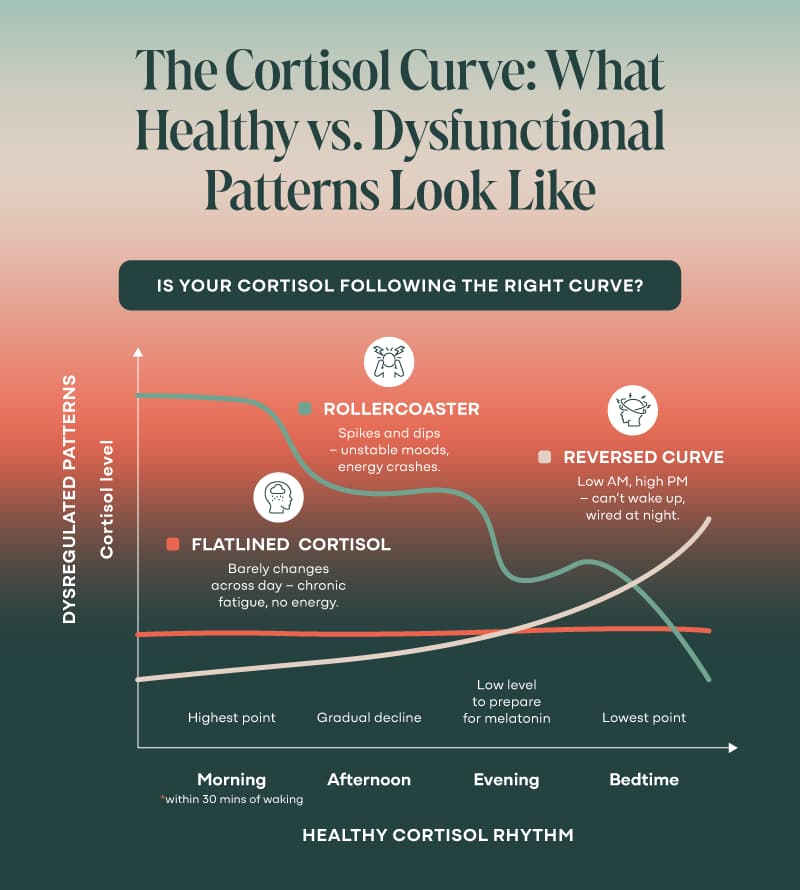
In a dysregulated pattern, you might see:
- Flatlined cortisol: Cortisol barely budges all day. You feel like a zombie and no amount of rest helps.
- Reversed curve: Low in the morning (hello, can’t get out of bed), spiking at night (hello, brain won’t shut up).
- Jagged rollercoaster: High highs and low lows—mood swings, energy crashes, and unpredictable symptoms.
And here’s the kicker: this isn’t just about stress.
These patterns are clues about deeper dysfunction—like mitochondrial breakdown, toxin overload, or chronic infection. (Remember Part I?)
If cortisol is off, it’s because something underneath it is screaming.
The test doesn’t give you all the answers—but it gives you the map.
And once you can see the terrain, you can stop wandering in circles and start choosing a path that heals.
Why Adrenal Cocktails Still Don’t Work (Yeah, I’m Doubling Down)
At this point, it should be clear: your body’s not dumb—it’s just drowning.
So, let’s revisit the adrenal cocktail.
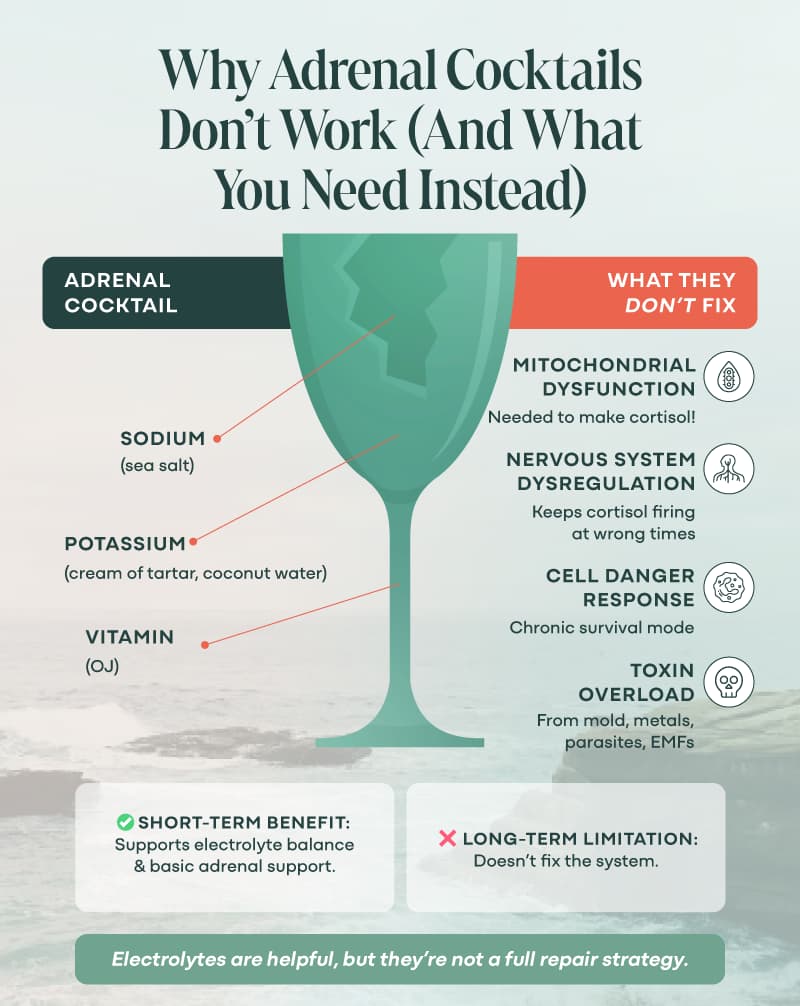
You’ve got potassium, sodium, maybe some vitamin C… and a ton of TikTok influencers swearing it “gave them their life back.”
Can it help?
Sure—for a little while. Especially if you’ve been chronically dehydrated, depleted, or living on oat milk lattes and vibes.
But if your cortisol is off—and staying off—an adrenal cocktail is like pouring electrolytes into a car that’s missing its engine.
Nice idea, wrong tool.
What Adrenal Cocktails Don’t Fix
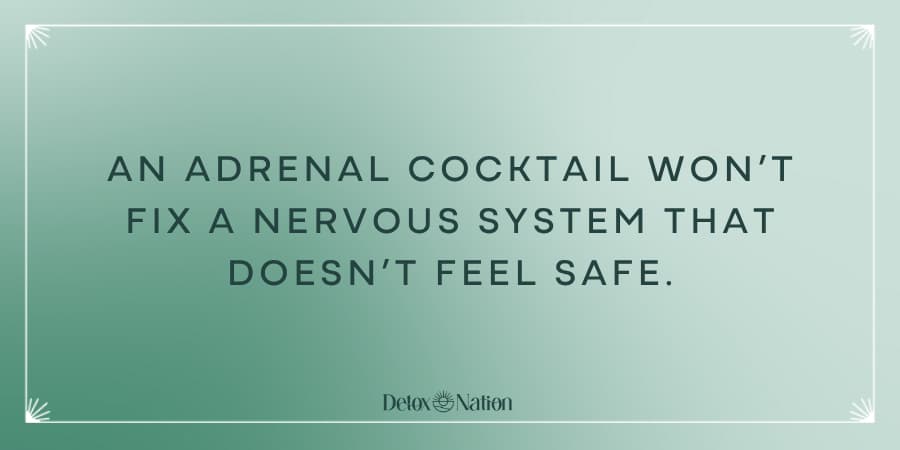
Mitochondrial Dysfunction
Cortisol production depends on healthy mitochondria.
These little powerhouses convert cholesterol into the raw materials your adrenals need to make cortisol (5, 6, 15).
But if your mitochondria are damaged—by mold, metals, EMFs, parasites, or years of overdrive—they can’t keep up.
No energy = no hormone synthesis. It’s not about willpower. It’s about cellular collapse.
Chronic Inflammation
If your body’s terrain is loaded with toxins or pathogens, inflammation keeps cortisol chronically elevated—until it crashes.
Adrenal cocktails do nothing to reduce that inflammation or turn off the danger signal.
They’re like trying to put out a house fire with a spray bottle.
Nervous System Dysregulation
If you’re stuck in a sympathetic (fight-or-flight) state, cortisol will be jacked up at the wrong times—or totally depleted because your body doesn’t feel safe.
And the brain is especially vulnerable because cortisol can cross the blood-brain-barrier (2).
Cocktails don’t create safety.
Safety comes from deep nervous system repair, not sipping mineral mocktails in your car between appointments.
The Cell Danger Response
Your body’s stress response system (including cortisol) is part of a larger pattern called the Cell Danger Response—a protective shutdown your cells enter when they detect overwhelming threat.
Once that switch is flipped, your body isn’t trying to “thrive”—it’s just trying to survive.
And you can’t hack that with a handful of Himalayan salt.
Healing isn’t about boosting hormones. It’s about fixing the conditions that made them collapse in the first place.
So, if you’ve been doing the cocktails, the herbs, the adaptogens—and you’re still exhausted—it’s not because you’re beyond help.
It’s because you need a whole-system reset, not another quick fix.
Cortisol and the Cell Danger Response: Your Body’s Red Alert
Let’s zoom out for a second.
You’ve got cortisol dysregulation, sure—but why is the system this fried?
Why are your hormones on a rollercoaster, your energy tanked, and your body acting like every noise, food, or smell is a threat?
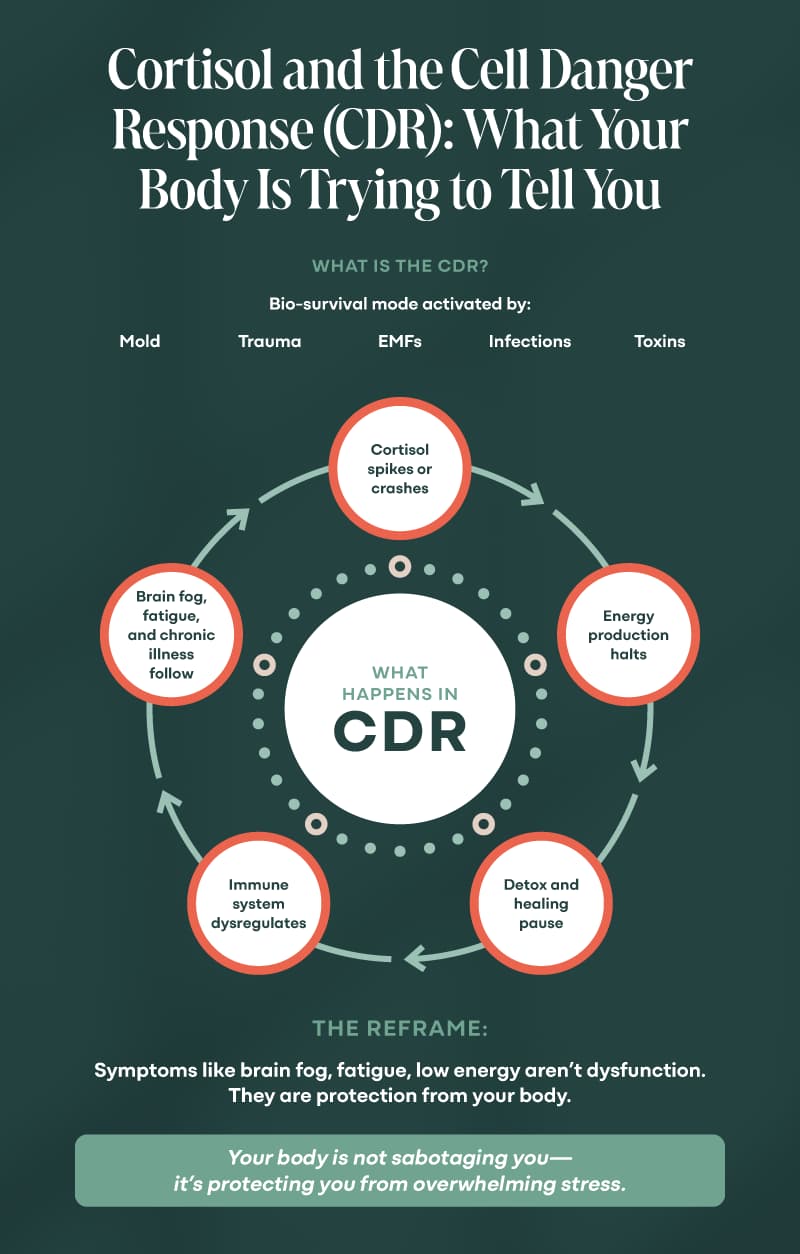
The answer lies in something called the Cell Danger Response (CDR).
(Stick with me—this explains a lot.)
The CDR is your body’s built-in bio-survival program. First proposed by Dr. Robert Naviaux (30, 31, 32, 33, 34, 35), it describes what your cells do when they detect overwhelming stress—be it from:
- Environmental toxins
- Infections (like parasites or viruses)
- EMFs or mold exposure
- Emotional trauma
- Nutrient depletion
- Or let’s be real—all the above
When your cells sense danger, they shut down normal function to conserve resources.
Energy production slows. Detox halts. Cortisol ramps up or crashes, depending on the stage. (And since almost all cells have cortisol receptors, this impacts virtually every cell.) (2)
Communication between systems becomes chaotic.
Basically, your body hits the brakes so hard, everything starts to stall.
And here’s the part nobody tells you:
Your symptoms aren’t dysfunction. They’re protection.
Brain fog? Protective.
Digestive shutdown? Protective.
Chronic fatigue? Protective.
Low cortisol? Also, protective.
Your body is not confused. It’s not sabotaging you. It’s not making a mistake.
It’s responding exactly as it should—to a world that’s become completely biologically overwhelming.
Cortisol is a messenger in this system.
It rises and falls depending on how safe your body feels.
And it will keep sending out stress signals until your body senses that the threat is over.
Which, for most of us, it isn’t—because we’ve never been taught how to resolve the root inputs of that threat.
That’s why functional healing isn’t about treating individual symptoms. It’s about reversing the danger signals—at the cellular level.
That’s when cortisol begins to regulate itself again. Not because you forced it to behave, but because you removed what was making it panic in the first place.
You can’t supplement your way out of the Cell Danger Response.
You have to signal safety—again and again—until your body believes it.
The Path Forward: Support the System, Don’t Force the Hormones
You don’t need to “hack” your cortisol.
You don’t need to chase more supplements or play whack-a-mole with symptoms.
You need to unwind the stress patterns your body has been stuck in for years—maybe decades.
That means creating the right conditions for your hormones, mitochondria, and nervous system to do what they already know how to do.
Here’s how we help your body stop bracing and start healing:
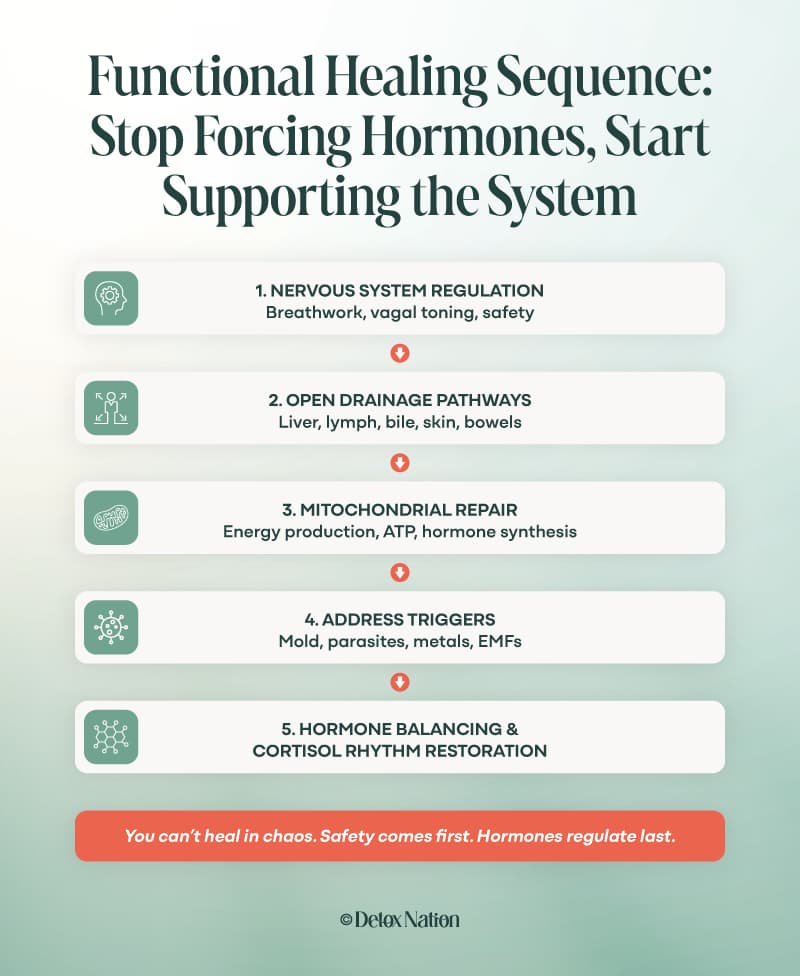
Nervous System Regulation Is Non-Negotiable
If your body doesn’t feel safe, it won’t heal. Period.
This means daily practices (yes, daily) that move you out of survival mode and into a healing state.
Breathwork. Gentle movement. Cold facial exposure. Vagal toning.
Cell-to-soul repair.
If you’re not in a healing state, detox becomes a trauma trigger.
Clear Your Drainage Pathways
Before you detox anything, your pathways must be open—lymph, liver, gut, skin, kidneys, bile.
If they’re congested, toxins get reabsorbed.
Adrenal fatigue is often a downstream symptom of a clogged internal sewer system.
Support Your Mitochondria
No energy = no healing = no hormone production.
Mitochondria aren’t just about energy—they’re the communication hub for your stress response.
If they’re inflamed or damaged, everything downstream (like cortisol) gets wonky.
This is where targeted nutrients, toxin removal, and bioregulatory support come in.
Address the Root Triggers of Your Chronic Stress
Parasites. Mold. Heavy metals. EMFs. Chemical overload.
These aren’t buzzwords—they’re the actual reasons your adrenals and cortisol are dysregulated.
If you don’t address them, you’ll stay stuck in a cycle of “almost better, then crashing again.”
Rethink Your Relationship With Healing
Healing isn’t random—it follows a hierarchy.
Your body heals in a specific order, based on safety, biology, and energy availability.
It prioritizes survival first: stabilizing the nervous system, clearing immediate threats like toxins or pathogens, and opening drainage pathways before deeper repairs (like hormone balance or brain function) can happen.
If you try to “fix everything” all at once—without following this sequence—you overwhelm the system and stall progress.
You can’t heal in chaos. The body must feel safe first.
This isn’t about perfection. It’s not about doing it all at once.
It’s about progress, flow, and working with your biology—not forcing it to comply.
Don’t force healing forward. Spiral it upward with a full-body reset that starts with safety, not strategies. Join the Rapid Energy Reset
Inside, you’ll learn how to open your drainage, repair your mitochondria, regulate your nervous system, and finally reclaim the energy you’ve been missing for years.
This is where you stop coping and start healing.
Your body hasn’t given up on you.
It’s just been waiting for the conditions to change.
Let’s change them—together.
How We Can Help
Guiding people to reclaim their health and vitality is our greatest joy. Our entire practice is dedicated to supporting you to be who you really are, at home in your body, because your body is able to heal itself.
Book A CallFAQs
1. Isn’t cortisol bad for you?
Nope. Cortisol is essential for waking up, managing inflammation, and surviving stress. It’s only a problem when your body gets stuck in high-alert mode.
2. What causes too much cortisol or dysregulation?
Chronic stress, toxins, unresolved trauma, infections, and mitochondrial damage can all throw your cortisol rhythm into chaos.
3. Can I have both high and low cortisol symptoms?
Yes. Many people are “cortisol scrambled”—high when it should be low, low when it should be high. It’s a rhythm issue, not just a hormone issue.
4. How does cortisol relate to the stress response and adrenal fatigue?
Cortisol is made in the adrenals and is produced in times of internal or external stress. In adrenal fatigue (a type of HPA axis dysfunction), your cortisol becomes dysregulated—either overproduced or burned out entirely.
5. Why don’t adrenal cocktails or supplements fix low cortisol?
Because they don’t address the cause—like poor mitochondrial function, chronic infection, or a nervous system stuck in fight-or-flight. They’re support, not a solution.
6. What’s the Cell Danger Response and how does it relate to cortisol?
It’s your body’s survival mode. When cells sense overwhelming stress, they shut down normal function—and cortisol goes haywire in response.
7. Can I heal my cortisol levels naturally?
Yes, but it’s not about forcing your hormones. It’s about creating the conditions for regulation—safe terrain, open drainage, nervous system repair.
8. What’s the connection between cortisol and mitochondria?
Mitochondria help your adrenals convert raw materials into cortisol. If they’re damaged, cortisol production drops—and so does your energy.
9. Which is better: A blood test, a cortisol urine test, or a saliva test?
A 4-point saliva test gives you more data about abnormal cortisol levels than a one-time blood or plasma cortisol test. They’re easier and more convenient than a 24-hour urinary free cortisol collection. Plus, getting a blood test is stressful and can cause higher cortisol levels in the body!