
Do you wake up daily and find new “fun symptoms” your body has developed overnight?
Are the symptoms nonspecific, so your doctors ignore them or chalk them up to stress?
Have you been told (or suspect) that you have Histamine Intolerance (HIT)?
If this sounds familiar, you’re not alone!
Histamine intolerance can mimic allergies and other conditions, so it can be hard to pinpoint.
You may struggle with increasing food sensitivities that seem to change on the daily.
Hives or other skin irritations may make it feel like you’ve been covered with itch-powder.
What if I told you that you don’t need to manage histamine intolerance?
That it’s a symptom of a deeper issue?
And even better, that you can figure out the root cause and heal by considering the causal chain (26) of your chronic symptoms.
Keep reading to learn about histamine intolerance, its symptoms, and what the actual causes can be!
Key Takeaways
- Histamine intolerance can cause various nonspecific symptoms.
- It’s a symptom of a deeper issue.
- You can heal (not just manage) histamine intolerance.
Understanding Histamine Intolerance
Histamine intolerance happens when you have an excessive level of histamine in your body OR if your body can’t break down histamine as it should.
It’s an imbalance.
Histamine builds up, causing symptoms like headaches, hives, or digestive issues.
These symptoms can change and get worse after eating certain foods.
Exposure, enzyme activity, gut health, and your microbiome all contribute to how your body processes histamine. We’ll explore all of these throughout this article.
What Is Histamine?
Histamine is a naturally occurring communication chemical in your body that’s found in almost all tissues (12).
For histamine to impact a cell, that cell must have a histamine receptor.
Histamine receptors are on the cells that line your blood vessels, mucosa, smooth muscle cells, GI tract, liver, pancreas, bile duct, your nervous system and immune cells (8, 23).
Therefore, histamine plays a role in (8):
- Allergic reactions and vasodilation
- Gastric acid secretion (19), smooth muscle relaxation, immune cell differentiation
- Sphincter of Oddi and bile duct contraction (24)
- Cognition and memory
- Immune regulation and inflammation
- Reduces pro-inflammatory cytokines in the brain (17)
- Gut ulceration and visceral pain (23)
The balance of histamine is key.
You need it for proper function, but large amounts of histamine can result in adverse effects like you experience in an allergic reaction.
When your body detects an allergen, this causes cells to release histamine, Those cells are specific immune system cells called mast cells and basophils (3).
As a side note: Mast cells are among the “first responders” to bacterial and parasitic infections (3).
This causes annoying symptoms like swelling and redness, and even itching so severe you want to grow claws to scratch it.
But where does histamine come from?
Sources of Histamine
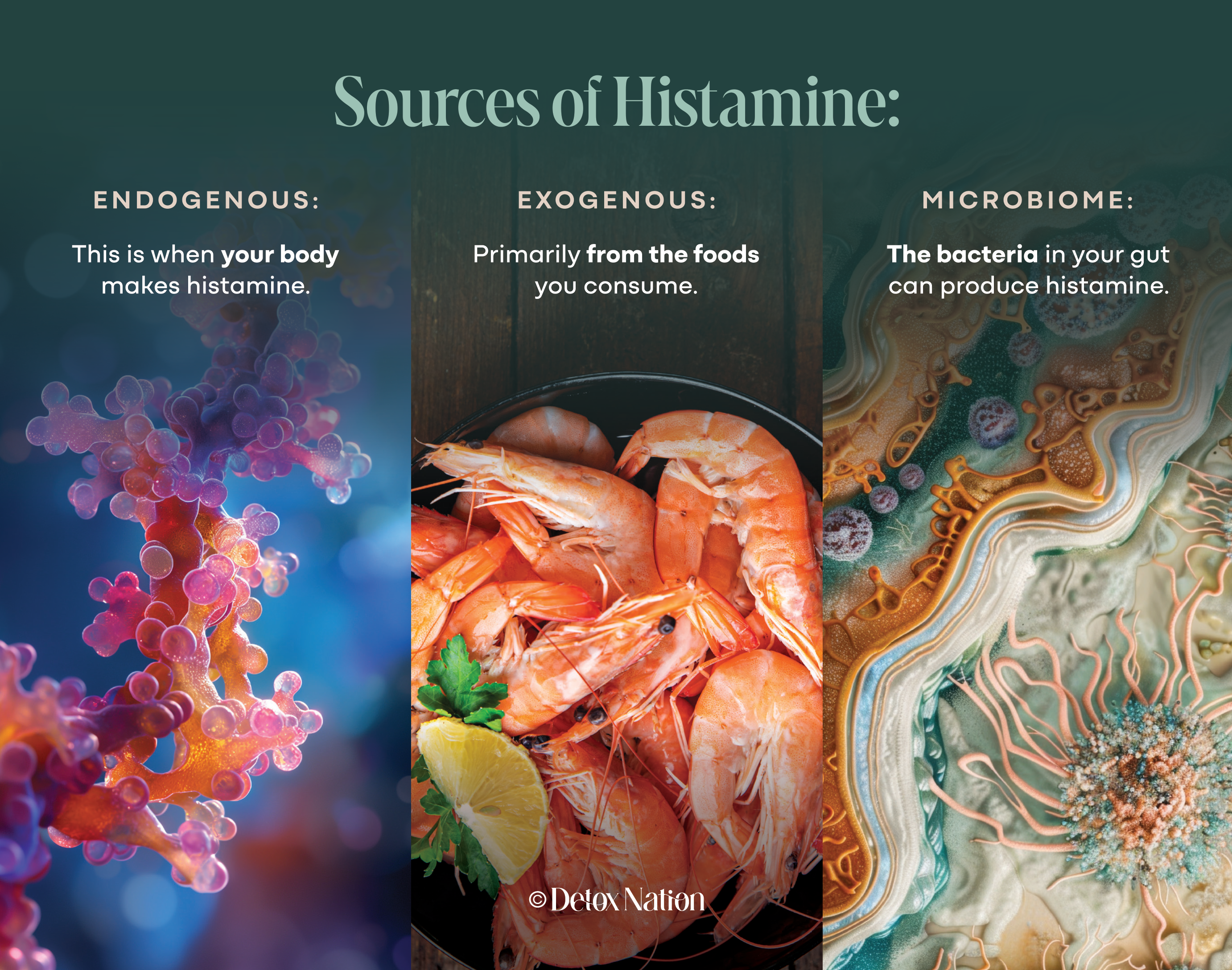
There are three main sources of histamine:
- Endogenous sources – this is when your body makes histamine.
- Exogenous sources – primarily from the foods you consume (8).
- Your microbiome – YES! The bacteria in your gut can produce histamine that impacts your body (6, 8, 16, 20).
Let’s look at food sources more closely.
Histamine is present in a wide variety of foods.
Some foods are high in histamine themselves, while others trigger your body to release endogenous histamine (10).
Common foods high in histamine include aged cheeses, fermented products, and certain processed meats.
Leftover fish and seafood also tend to have elevated histamine levels.
Join the Healing Labs program:
Healing Labs is a transformative 3-month journey to pinpoint hidden toxins, create a personalized detox plan, and get expert one-on-one support every step of the way. Book your free call today by following the link below and take the first step toward a healthier, more vibrant you. Let’s uncover what’s holding you back and create a clear path to healing together.
Book You Free Call TodayHistamine Balance
You need histamine for different cells in your body to communicate with each other but, like Goldilocks, you need just the right amount. Too much or too little histamine in the body causes problems. Your brilliant body has a “check-and-balance” system engaged throughout your body (via enzymes) to manage your levels.
What Is DAO?
Diamine oxidase (DAO) is one of two enzymes that help keep histamine levels in your body in check.
It degrades exogenous histamine to prevent passage to systemic circulation (16).
Without enough DAO, your body might struggle with too much histamine, leading to symptoms such as headaches or digestive issues.
DAO deficiency can result from various factors – let’s take a peek.
Factors That Decrease DAO
Several factors can lower DAO production or activity in your body:
- An altered gut microbiome (6, 13, 14)
- Mucosal damage (6, 16)
- Gut inflammation (6)
- Increased gut permeability (6, 8, 12, 13, 16)
- Chronic infections (1, 8, 12)
- Heavy metals (12)
- Alcohol (5
- Malnutrition (7)
- Genetic polymorphisms (But remember, genes don’t determine your health destiny. They must be activated or suppressed by your lifestyle.) (7)
- Medications (6)
Many of the things that reduce DAO levels and activity in your body are caused by something else. For example, you don’t just wake up with malnutrition or an altered gut microbiome.
Something caused it – but what?
Causal Chains
Understanding the causal chains involved in histamine intolerance can help uncover hidden factors that contribute to it.
What Is a Causal Chain?
Imagine you have a bucket.
In that bucket, you can put alllll of your toxic exposures.
Pesticides and herbicides on your foods? They go in the bucket.
Mycotoxins from mold exposure? Into the bucket!
Parasites? You got it! Worms and flukes and nematodes all go into the bucket.
Unfortunately, in modern society the toxic exposures are everywhere, and it doesn’t take long to fill up that bucket.
Heavy metals, EMF exposure, contaminated water, plastics, endocrine disrupting chemicals, food additives, medications, mental and emotional stress – the list goes on and on.
The bucket begins to overflow.
We call the overflow “symptoms,” and the bucket is your body.
The things that fill up your bucket are unique to you, as are the size and shape of the bucket.
Also unique is your ability to regulate your body, adapt to changes, tolerate interventions and more.
Over time, you develop a unique set of health circumstances or even chronic symptoms.
From this perspective, it doesn’t make sense to treat the final product (the symptoms you’re experiencing) and hope it resolves your health conditions.
You need to address how all the junk got into your bucket in the first place.
A Different Way of Thinking
The Causal Chain is like a flow chart of how everything got into your bucket.
Thinking this way helps us to see symptoms as warning signs, and not as the end diagnoses.
It helps us to trace health issues back to the root causes that created them in the first place.
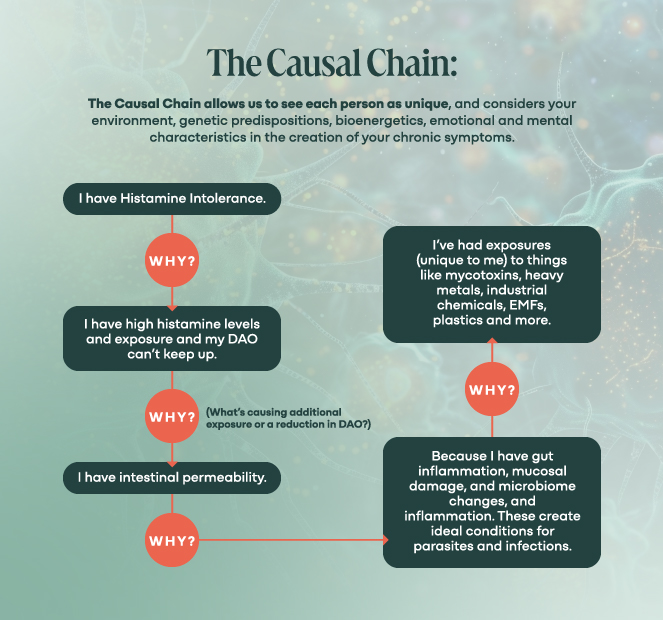
The concept of a Causal Chain allows us to see each person as unique, and considers your environment, genetic predispositions, bioenergetics, emotional and mental characteristics, and more in the creation of your chronic symptoms (26).
It also allows us to recognize that the healing process is equally unique and individualized.
In terms of Histamine Intolerance, the causal chain could go something like this:
I have Histamine Intolerance.
Why?
I have high histamine levels and exposure and my DAO can’t keep up.
Why? (What’s causing additional exposure or a reduction in DAO?)
I have intestinal permeability.
Why?
Because I have gut inflammation, mucosal damage, and microbiome changes, and inflammation. These create ideal conditions for parasites and infections.
Why?
I’ve had exposures (unique to me) to things like mycotoxins, heavy metals, industrial chemicals, EMFs, plastics and more.
You see?
In other words:
- Your exposures impact your health – even if you don’t notice it in the moment – and they are cumulative.
- Causing changes to your internal environment, especially your immune and digestive systems.
- This leaves you vulnerable to additional assault by parasites and infections.
- These further impair your body and cause your bucket to overflow.
- As your intestines are damaged, they become more permeable, allowing waste materials and toxins back into your blood.
- The unique array of toxins is carried through your blood and wreaks havoc in your body in a unique way.
In the case of HIT, histamine isn’t broken down and eliminated. Instead, it passes back into your bloodstream causing build up in your body.
The accumulation of histamine exceeds your body’s ability to eliminate it (5).
But this symptom is merely a manifestation of your causal chain.
Find the Root Cause
Finding the root cause of histamine intolerance involves looking beyond just the obvious symptoms.
You may have experienced that chasing chronic symptoms can be like a dog chasing its tail – it won’t get you anywhere.
While changing your diet to reduce foods that trigger histamine production may help in the short-term, it does nothing to identify and heal from the root cause at the core of your causal chain.
How do Exposures Start the Causal Chain of Histamine Intolerance?
Mycotoxins from mold, parasites, and heavy metals are known triggers.
They can overload your body’s detoxification systems, making it hard to break down histamine.
They damage your gut health and disrupt your microbiome.
Industrial chemicals found in food and water may further complicate this, putting extra stress on your body’s regulatory systems.
Identifying Symptoms of Histamine Intolerance
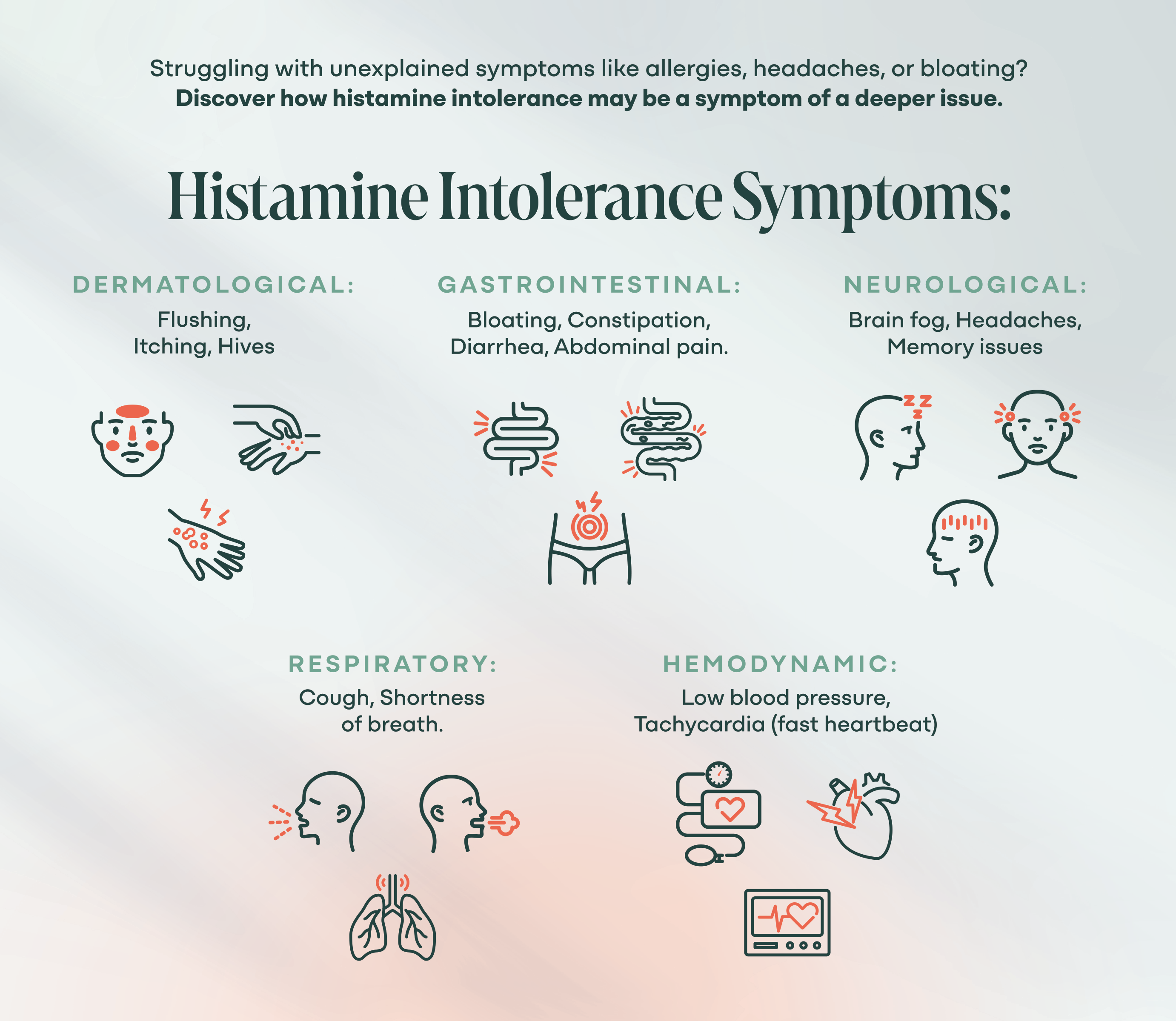
Changing and non-specific digestive, dermatological, neurological, or immune symptoms are a hallmark of HIT (4, 5, 6, 8, 11).
Dermatological
Your skin is an area of your body that can indicate histamine intolerance (6).
Symptoms often include flushing, which is a sudden feeling of warmth and redness (7), like you’re blushing for no reason.
You might also experience stubborn itching that doesn’t respond to topicals (7, 8).
Urticaria, also known as hives, is common (7).
These are raised, itchy welts that can appear anywhere on your body.
Keep an eye out for any unusual skin reactions that don’t seem to have a clear cause.

Gastrointestinal
Inconsistent digestive issues are another common sign (6). This means that eating an apple today might trigger symptoms, but a week from now you may seem to tolerate it fine.
You could experience constipation or the opposite, such as diarrhea (6, 7). Either way, you try to stay close to a bathroom!
Additionally, you might feel abdominal distention or bloating, making you uncomfortable in your regular clothes (6).
Frequent abdominal pain and reflux issues are other symptoms to consider (6, 7, 2).
Respiratory
Breathing problems can signal histamine intolerance (6).
A persistent cough could develop, especially if you can’t link it to a cold or allergy (2).
Sudden reactions to certain smells or environments might be noticeable and intermittent.
Neurological
HIT can impact your brain (6, 17, 18, 22, 25).
You could experience cognitive problems like memory issues or trouble concentrating.
Brain fog, where your thinking feels slow or cloudy, can be really frustrating. These are those times when you know you know the answer – or you know you should know the answer – but you just can’t figure it out.
Hemodynamic
Even your circulatory system can be affected.
Low blood pressure might make you feel dizzy or faint, especially if you stand up quickly (7).
Tachycardia, which is a fast heartbeat, can also occur without warning (7). I know from personal experience how terrifying this can be.
Histamine and the Gut
Histamine plays a crucial role in the gut, impacting inflammation, the microbiome, and intestinal permeability.
Mucosal Inflammation and Damage
Acute gut infections (parasites, bacteria, etc.) cause a loss of tolerance to a previously tolerated substance.
They also trigger increased inflammation, increased histamine, and increased cytokines (1).
Histamine perpetuates inflammation in the gut lining or mucosa, causing discomfort and pain.
Additionally, mucosal damage and inflammation reduce histamine degradation by DAO (6, 8, 13, 16 ).
Changes in Microbiome Composition
The balance of bacteria in your gut, known as the microbiome, is disturbed by mycotoxins, industrial chemicals, parasites, heavy metals, and more.
The balance of “good” to “bad” bacteria changes.
The abundance of histamine-secreting bacteria such as Staphylococcus, proteus, and Enterobacteriaceae increases (6, 14).
The abundance of gut-protective bacteria such as ruminococcus, prevotellaceae, and fecalibacterium decreases (6).
This results in:
- More histamine in the gut (produced by your gut bacteria),
- A decrease in DAO, and
- Increased histamine imbalance.
- Histamine is not degraded and is absorbed back into the bloodstream (4).
Eating high-histamine foods may tip the imbalance even further, fostering the growth of bacteria that produce more histamine and a cycle of increasing histamine levels.
Increased Gut Permeability
The inflammation, damage to your mucosal lining, and changes in the microbiome caused by your exposures all serve to weaken your intestinal barrier.
As the permeability of your intestines increases, toxins and metabolites like histamine enter your bloodstream instead of being eliminated.
This is called “leaky gut syndrome” and it’s a known driver of HIT (8, 13).
Histamine can also affect the walls of your gut, increasing their permeability and leading to more immune response and inflammation (9, 12).
Development of Food Sensitivities
Food sensitivity (or food intolerance) is simply an inability of your body to tolerate a substance it used to be able to tolerate (1).
It’s different than a food allergy because you aren’t “allergic” to it – you’re sensitized to it.
A sum excess of histamine (from your body, the foods you eat, and from bacteria in your gut) combined with conditions that decrease DAO production and activity serve to cause you to have more histamine than your body can break down and eliminate (5).
The excess histamine stays in your system, causing allergy-like symptoms.
Your bucket is full, and every serving of histamine-rich foods you eat causes it to overflow even more.
Histamine intolerance may even lead to new food sensitivities (12).
Histamine’s effect on the gut can create an environment where your body becomes hypersensitive to certain foods.
Making your body mistake these foods as threats.
A low-histamine diet can decrease these sensitivities and symptoms while you work on the underlying issues.
The Low-Histamine Diet
A low-histamine diet can help you manage the symptoms of histamine intolerance.
Core Principles of the Diet
The main goal is to reduce histamine intake from foods (1, 5, 10, 14, 15, 16).
You should avoid high-histamine foods and opt for those with lower levels.
Additionally, avoid foods that cause an endogenous release of histamine (10).
This means selecting foods based on their freshness, as histamine levels can increase in leftovers and processed foods.
Cooking methods also matter.
Choose strategies that minimize histamine accumulation, like eating freshly prepared meals rather than those that are aged or fermented.
Foods to Embrace and Avoid
Understanding which foods fit into a low-histamine diet is crucial.
Embrace fresh pasture-raised or pasture-finished meat, poultry, and unprocessed options. Some organic fruits like apples and pears, vegetables like carrots and broccoli, and grains such as rice and quinoa are favorable.
Avoid high-histamine foods like aged cheese, smoked or canned seafood, fermented foods, and alcohol. Also, steer clear of foods like tomatoes, spinach, and processed meats.
A Diet Isn’t Enough
Diet alone will not fully resolve histamine intolerance.
It’s important to consider the causal chain that led to your chronic symptoms.
Remove sources of toxic exposures, drink distilled water, support your drainage and detoxification systems, remove parasites, and heal your gut to find your way back to vibrant health.
Conclusion
Living with histamine intolerance is no fun, and a low-histamine diet can only do so much.
To truly heal, you need to address your causal chains and eat to understand the root causes behind your sensitivities.
Histamine intolerance is fixable, but no one can do it for you.
I can’t wait to see you on the inside!
Frequently Asked Questions
What foods should I avoid if I’m following a low-histamine diet?
If you’re on a low histamine diet, stay away from aged cheeses, cured meats, and fermented foods. Even certain fruits like strawberries, tomatoes, and citrus can cause issues because they trigger histamine release. Alcohol is also a big one to avoid.
I want to geek out on the science of Histamine Receptors!
Histamine receptors are involved in many bodily responses. There are four main types: H1, H2, H3, and H4. These receptors handle everything from allergic reactions to stomach acid production. They’re found in different parts of your body like the brain, gut, and immune cells.
How are the symptoms of Histamine Intolerance connected to mycotoxins, parasites, industrial chemicals, and heavy metals?
Histamine intolerance symptoms can sometimes overlap with reactions to mycotoxins, parasites, and chemical exposures. These elements can stress your immune and digestive systems and create the causal chain for many chronic symptoms.
P.S. — If the insights in this blog resonated with you, it’s time to take action. Hidden toxins like mold, parasites, heavy metals, and chemicals can silently impact your health—but there is a path to comprehensive healing. Join the Healing Labs program: a transformative 3-month journey to pinpoint hidden toxins, create a personalized detox plan, and get expert one-on-one support every step of the way. Book your free call today by following the link below and take the first step toward a healthier, more vibrant you. Let’s uncover what’s holding you back and create a clear path to healing together.
Join the Healing Labs program:
Healing Labs is a transformative 3-month journey to pinpoint hidden toxins, create a personalized detox plan, and get expert one-on-one support every step of the way. Book your free call today by following the link below and take the first step toward a healthier, more vibrant you. Let’s uncover what’s holding you back and create a clear path to healing together.
Book You Free Call Today