

You probably think you’re drinking clean water.
I thought I was, too.
Filtered through the fridge? Check.
Looks clear in the glass? Great.
But here’s the uncomfortable truth: if you’re still feeling fatigued, bloated, foggy, inflamed, or like your nervous system is constantly on edge, your water might be part of the problem.
Let me tell you about Jess, one of my clients. She was doing all the things: gluten-free, organic, taking the supplements, even dry brushing like a champ.
But her fatigue never budged. Brain fog? Still there. Bloating after every meal? Like clockwork.
We traced it back to the “high-end” reverse osmosis filtration system she’d installed a year ago.
She resisted purchasing a water distiller because in her mind, she’d already spent a fortune to provide clean water.
But after months of nothing changing, she finally purchased a small distiller.
Her symptoms improved virtually overnight!
But then they returned a few months later.
It was a mystery, until we discovered that the small water distiller didn’t fulfill all her family’s water needs. So she went back to using the reverse osmosis water for herself.
The one she hadn’t cleaned.
Inside that neglected system was a thriving colony of mold and biofilm, dosing her daily with the very toxins we were trying to clear.
Every sip was a setback.
If you’re here, it’s not because you’re naive, it’s because you’re paying attention and you know that healing today means looking where most people don’t, including your water.
Key Takeaways
- “Filtered” doesn’t always mean clean, and your symptoms don’t lie.
- Know your filter’s mechanism and its limits.
- Distilled and remineralized water is a healing powerhouse.
Water 101: Why the ‘Clean Tap’ Myth Needs to Die
Your tap water is legally “safe,” but that doesn’t mean it’s clean.
Most people think that if it passes government standards, it must be fine.
But those standards haven’t been updated to reflect the chemical soup we live in today.
In fact, many of the 85,000+ chemicals approved for use in the U.S. aren’t even tested for in your water supply. And the ones that are allowed are often set at levels that protect industry, not your health.
Take chlorine, for example. It’s used to disinfect water (which sounds like a good idea), but it reacts with organic matter in pipes to form trihalomethanes, which are known carcinogens.
Water is supposed to be the easiest “yes” in your healing plan. But if the water coming out of your tap is dosing you with toxins, even your best detox effort is swimming upstream.
But this is fixable! And the first step is knowing what you’re really dealing with.
Let’s unpack how filters work, and what that fancy filter in your kitchen might be missing.
How Do Water Filters Work?
A 2024 study on water filtration and purification systems found that 31% of the sample participants used pitcher filters, 21% used water softeners, 21% used reverse osmosis systems, 4% used a faucet-mounted filter, and 1% used a whole-house carbon filter (8).
You’re not alone in your quest for clean water!
A water filter is any system that removes impurities from water by trapping, absorbing, or neutralizing them. But not all filters are created equal.
The Four Basic Mechanisms of Water Filtration
- Mechanical filtration: Think of this as a sieve—removing dirt, sand, rust, and larger particulates. Great for visible gunk. Useless against chemicals, microbes, or heavy metals.
- Activated carbon adsorption: This is where most “filter pitchers” shine. Activated carbon traps chlorine, some VOCs, and a few pesticides (5, 6). But it’s like using a lint roller to clean your whole house—helpful but limited.
- Ion exchange: This tech swaps out unwanted ions (like calcium or magnesium, which cause water hardness) for sodium or hydrogen (6, 8). Often used in softeners (not necessarily filtration) and can sometimes add sodium to your water.
- Reverse Osmosis (RO): RO pushes water through a semi-permeable membrane, filtering out fluoride, heavy metals, nitrates, parasites, minerals (8, 27, 29, 30), and even some pharmaceuticals (5, 6).
Each method has its limitations, and no one system is flawless (10). Most filters use a combination of these methods.
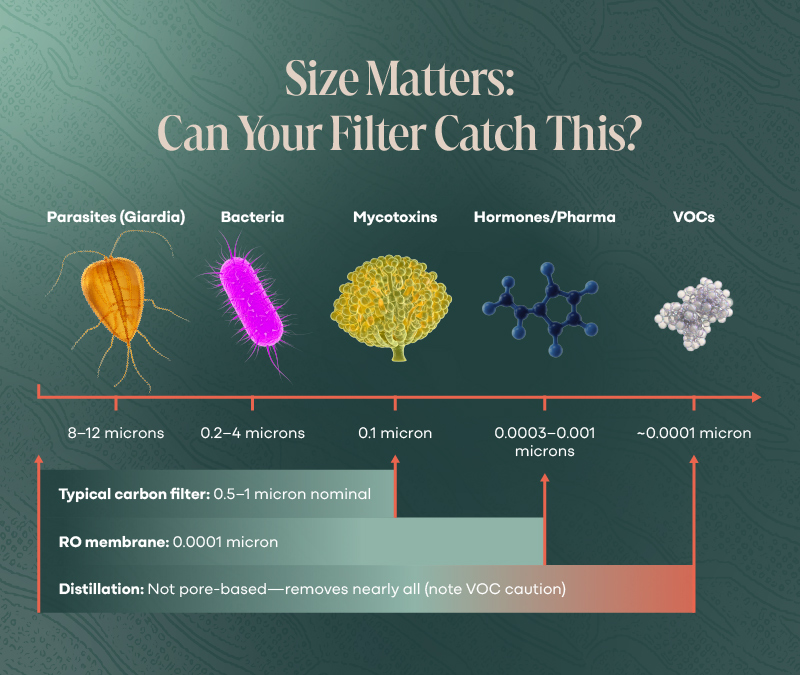
(Pore) Size Matters
When you’re shopping for a water filter (or trying to figure out if the one you already have is doing anything), you’ll sometimes see words like “absolute pore size” and “nominal pore size” thrown around.
Absolute pore size means the filter blocks everything larger than that size, every time (1, 6). It’s a hard cutoff.
If a filter says it has a 1-micron absolute rating, no particles over 1 micron are getting through.
Nominal pore size, on the other hand, lets most troublemakers slip past (1, 6).
A 1-micron nominal filter might only block around 80-90% of 1-micron particles—and the rest sneak into your glass.
That might be fine if you’re just trying to get rid of sand or rust, but if you’re trying to dodge parasites, mycotoxins, or microbial fragments because you’re already living with chronic inflammation, nominal isn’t good enough.
Your body deserves a filter that’s consistent and serious about its job, because you’re doing the serious work of healing.
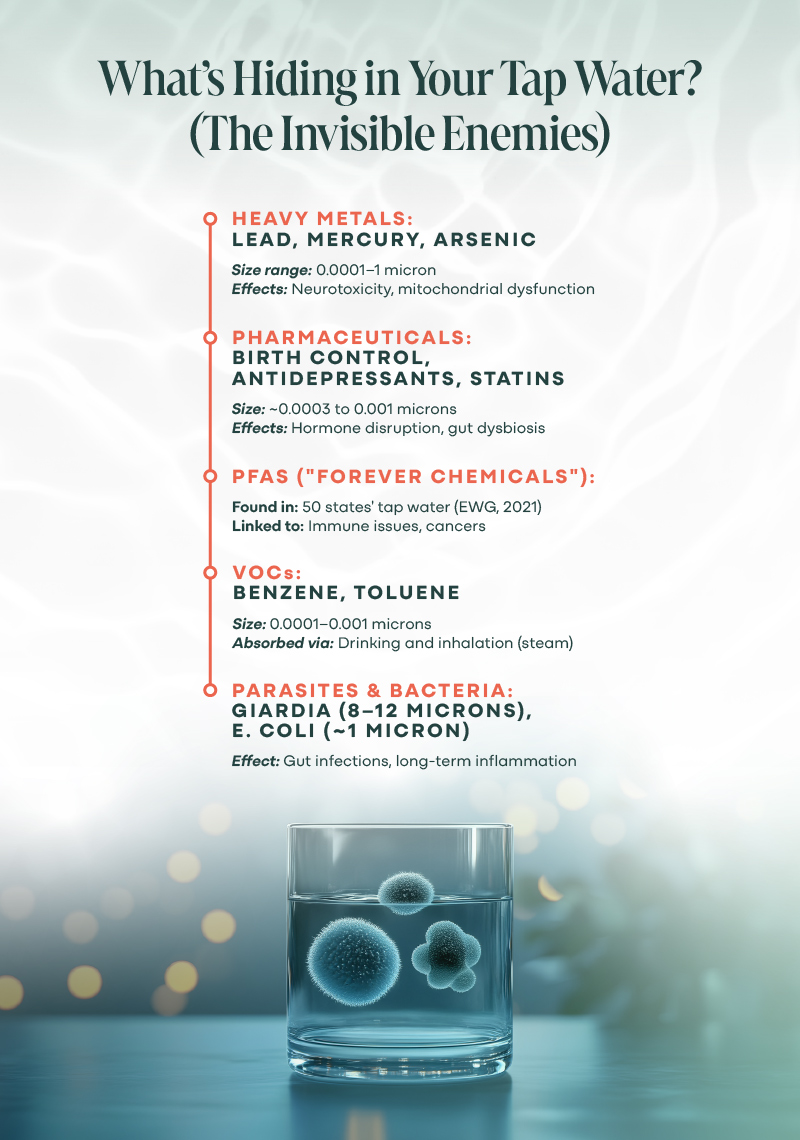
Here’s a quick list of water contaminants and their sizes (from large to small):
- Metals
- If the ions are dissolved, the sizes are 0.0001 to 0.001 microns.
- If they are bound to other particles, the sizes can range from 1 micron to hundreds of microns
- Microplastics: 1-100 microns
- Parasites (6)
- Giardia: 8-12 microns
- Cryptosporidium: 4-6 microns
- Bacteria (E. coli, salmonella): 0.2-4.0 microns (6)
- Mycotoxins: 0.1 microns
- Viruses: 0.004 to 0.1 microns (6)
- Hormones/pharmaceuticals: 0.0003-0.001 microns in size
- VOCs: 0.0001 to 0.001 microns
For some context, the period at the end of a sentence is about 500 microns.
If you’re relying on mechanical filtration, make sure the absolute pore size is appropriate for your needs.
Next, we’ll break down the major types of filtration systems (and the hidden risks nobody tells you about).
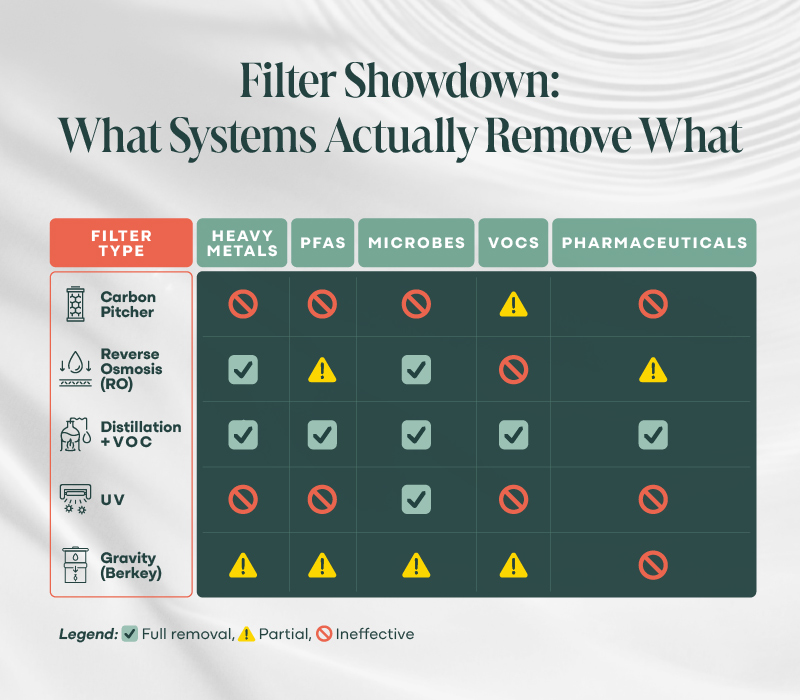
The Big 5: Types of Water Filtration & Purification Systems
It’s easy to feel overwhelmed by all the options out there. Everyone’s got a “miracle filter” to sell you, and most of them come with bold claims and tiny print.
But when you’re dealing with chronic symptoms, your filter is one of the most important health tools.
So, let’s talk through the five most common systems, and what they do for your body (and what they don’t).
1. Carbon Filters (Think Brita or PUR)
Carbon filters are the entry-level option—affordable, easy to find, and usually come in a pitcher or screw onto your faucet.
They do a decent job removing chlorine and lead, they improve taste and might catch a few VOCs (volatile organic compounds) (1, 6), but that’s about it. They won’t touch fluoride, heavy metals, pharmaceuticals, or microbes.
And here’s the kicker: if you don’t change the filter religiously, it becomes a breeding ground for bacteria and mold.
These filters have a specific shelf life and must be replaced regularly (6).
I’ve had clients faithfully drinking from their trusty pitcher, wondering why their gut was still inflamed—until we cracked open the filter. (Cue horror movie soundtrack.)
They’re better than nothing, but they’re not nearly enough if you’re serious about healing.
2. Reverse Osmosis (RO)
Reverse osmosis uses almost three times as much water as it treats (6).
It forces water through a semi-permeable membrane, removing nearly everything: fluoride, heavy metals, nitrates, some pharmaceutical residues, and even some microplastics (5, 6, 17, 27).
The average pore size of an RO membrane is about 0.0001 microns, but here’s what most people miss: RO systems require regular maintenance.
If you forget about the filters, mold and biofilm can start building up inside the system, quietly wrecking everything you’re trying to heal (4, 19, 20).
Additionally, RO water has very low levels of calcium, magnesium, and phosphorous which is “insufficient for human needs” (27, 30).
3. Distilled Water
If RO is the overachiever, distilled water is the purist.
It’s basically steam-captured water, which means it removes everything: metals, microbes, chemicals, radioactive particles, plastics—the whole toxic buffet (6).
It’s also mineral-free, which freaks some people out. But don’t worry, that’s fixable.
The real benefit of distillation is that there are no filters to rot and no tanks to mold. It relies on “state change” instead of mechanical filtration or pore size.
Just clean, repeatable purity. (Which is why I recommend it!)
For people recovering from mold illness, heavy metals, or nervous system dysregulation, it’s the safest bet.
4. UV Light Systems
These are less common in homes, but worth mentioning.
UV systems kill bacteria and viruses by disrupting their DNA.
They don’t remove anything—you’re still drinking the remains—but at least those microbes are no longer replicating.
The problem is, UV only works if your water is already clear. If you’ve got cloudy or particle-laden water, the light doesn’t penetrate effectively.
5. Gravity Filters (Berkey or AquaTru)
These are popular for a reason. There is no electricity required, they have a decent filtration range, and they’re portable.
Some can remove chlorine, metals, bacteria, and a few pesticides. But just like the others, if you don’t clean and change the filters regularly, you’re creating a swamp in your kitchen.
Gravity filters can be a solid choice, especially if you’re renting or traveling. Just keep your expectations (and maintenance schedule) realistic.
I’ve seen filters grow entire ecosystems when neglected for too long. Think of them like a sourdough starter gone rogue.
The Safest Water for Deep Healing
Discover why distilled water is the cleanest, most effective way to hydrate, detox, and support your body’s natural repair. This free guide gives you everything you need to get started today.
Get My Free GuideThe Takeaway: No System Is Perfect
Every water filtration system comes with trade-offs, and the best choice depends on your health goals, your terrain (internal and external), and your capacity to stay on top of maintenance (6, 10).
So, before you buy the prettiest filter on Instagram, ask: what’s really in my water? And what do I need it to do?
Water Filter Standards: Who’s Actually Watching the Water?
Let’s talk about those shiny stickers on water filters—the ones that say things like “NSF Certified” or “Meets EPA Standards.”
What Is NSF Certification?
NSF International (formerly the National Sanitation Foundation) is a third-party testing organization.
This is important because there are no federal regulations in place for residential water filters, purifiers, or RO systems (17).
If your filter claims NSF certification, that’s a good sign—it means the system has been tested by an independent lab, not just the company’s marketing department.
But—and this is a big “but”—the type of certification matters.
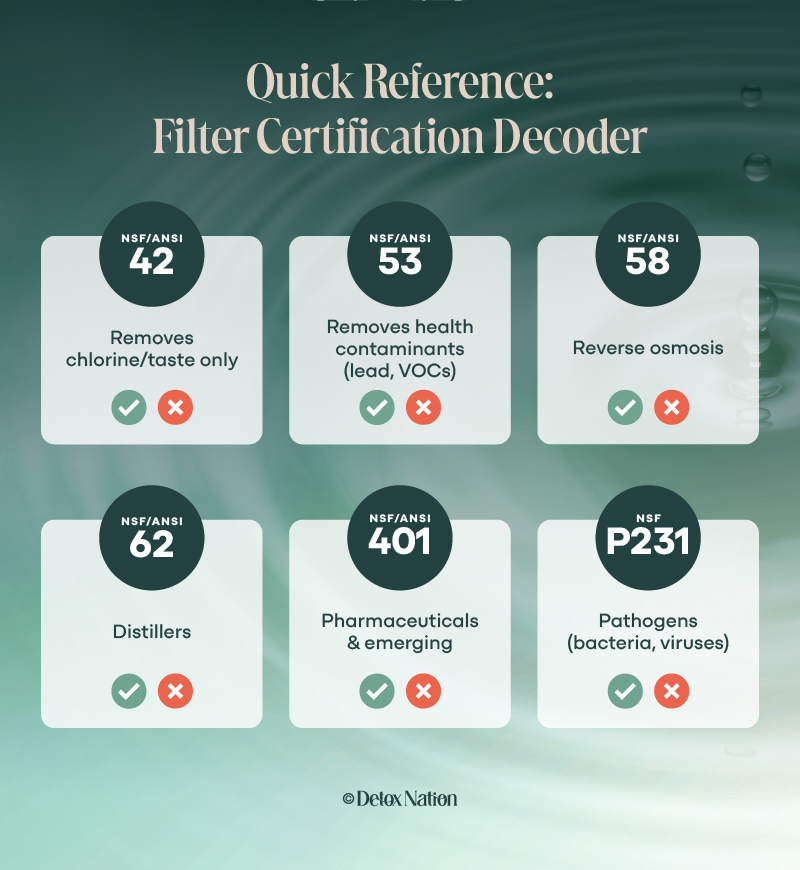
There are different NSF/ANSI standards, and each one tells you something specific (17):
- NSF/ANSI 42: This is the lowest bar. It means the filter improves taste and odor, usually by removing chlorine. That’s it.
- NSF/ANSI 53: This one’s more legit. It means the filter can reduce certain health-related contaminants like lead, mercury, or VOCs. But not all filters certified under 53 remove all contaminants; it depends on what they’ve been specifically tested for.
- NSF/ANSI 58: This standard is for reverse osmosis systems. It includes performance criteria for things like total dissolved solids (TDS) reduction and fluoride.
- NSF/ANSI 62: Covering distillation systems.
- NSF/ANSI 401: This is the new kid on the block, covering emerging contaminants like pharmaceuticals and BPA. If your filter hits this standard, it’s a serious contender.
- NSF P231: For microbiological purification—think bacteria, viruses, and live cysts. You’ll see this more often on portable or gravity-fed systems.
When a company says, “NSF Certified,” you need to ask: Which one? And what was tested?
Because “certified to reduce contaminants” could mean it takes out chlorine and nothing else.
What About ‘Meets EPA Standards’?
Sounds great on paper—but it’s vague.
EPA standards are set for municipal systems, not home filters.
Saying a product “meets EPA standards” is kind of like saying your salad is as healthy as fast food regulations allow. Not exactly reassuring.
Red Flags to Watch For
- Phrases like “filters up to 99% of contaminants” with no specifics. What contaminants? In what conditions?
- “Lab-tested” without a third-party name attached. If it’s their own lab, it doesn’t count.
- No mention of maintenance schedule, lifespan, or actual contaminant list. A good company wants you to understand exactly what you’re getting—not guess.
Once you understand the standards, you can bypass the hype and make an informed decision that supports your body’s healing process, because the right filter can help you heal.
What Water Filters Don’t Remove
Okay, so you’ve got the sleek filter, the sticker says, “NSF Certified,” and your water tastes way better than it did before.
You’re feeling good—maybe even a little smug.
But then, you still feel bloated. Still foggy. Still reactive.
That’s when it hits: just because your water tastes clean doesn’t mean it’s helping your body heal.
Let’s talk about what even the best filters often miss.
Mold and Biofilm
Let’s start with the gross stuff.
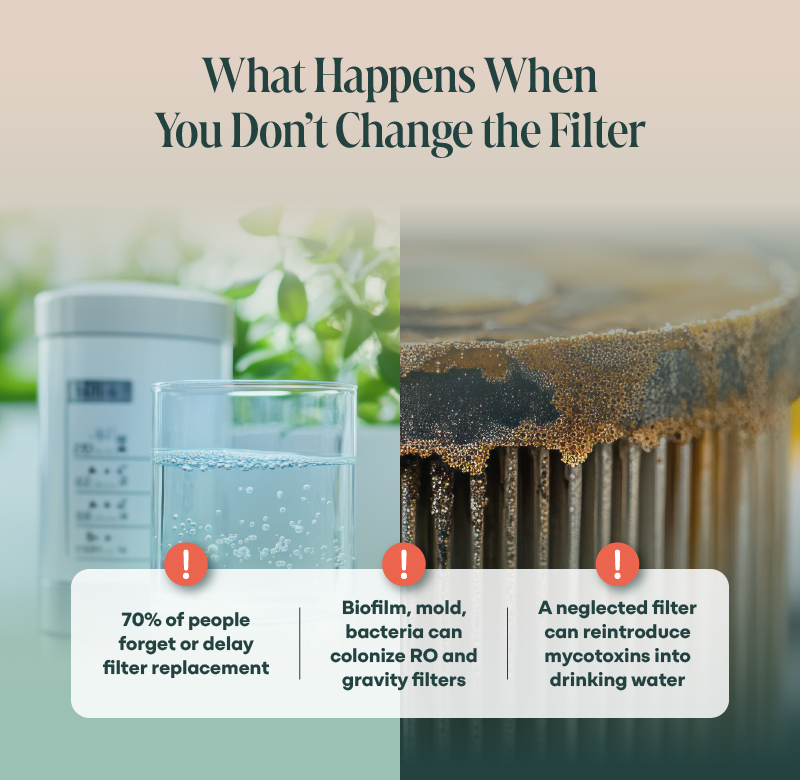
If your filter hasn’t been changed on time (and let’s be real—most people wait too long), it can become a breeding ground for bacteria, mold, and biofilm (4, 19, 20).
Especially in reverse osmosis systems or gravity-fed filters.
These microbes form slimy layers inside the filter, turning it into a delivery system for the exact things you’re trying to avoid.
I’ve seen clients—especially those with mold illness—getting re-exposed through their water without even realizing it.
They were detoxing with one hand and drinking mold spores with the other.
Endotoxins, Mycotoxins, and Microbial Fragments
Even if a filter kills or removes live pathogens, it often doesn’t catch the debris they leave behind, like endotoxins (bacterial fragments) and mycotoxins (mold toxins).
These tiny fragments are invisible but powerful. They’re known to trigger inflammation, immune dysregulation, and nervous system chaos, and most filters aren’t designed to catch them (but distillation leaves them behind).
If you’re sensitive or already dealing with chronic symptoms, these fragments can keep your system in a constant state of alarm.
PFAS, Pharmaceuticals, and Emerging Contaminants
We live in a world where microdoses of antidepressants, birth control, and blood pressure meds are literally in the water (13).
PFAS (aka “forever chemicals”) are in nearly every water supply (11).
Most basic filters don’t even touch these (but distillation does).
You need high-grade or certified systems tested for NSF 401 to remove them reliably, otherwise you’re hydrating with a pharmaceutical cocktail.
Radioactive Particles
Depending on where you live, naturally occurring radioactive elements like radon, uranium, and radium can end up in your water (6).
Municipal systems may not screen for them, or if they screen them, they don’t treat.
Distillation can remove these.
Most standard filters? Not so much.
The takeaway here isn’t fear—it’s clarity.
Your symptoms might not be mysterious at all. They are logical responses to invisible exposures you never knew were there (and didn’t consent to).
Your filter could be the source of the exposure if it’s neglected or not built to handle the toxic burden of modern life.
You deserve to feel safe with every sip.
Practical Tips for Better Drinking Water
It doesn’t matter how pure your water could be if your system is growing slime or sitting in the corner unplugged because replacing the filter felt like solving a Rubik’s Cube in the dark.
Let’s make this simple. Here’s how to follow through on what you’ve learned.
Understand Your Water
Recognize that much of the research out there is on municipal water treatment, not home filters and systems, so you’ll have to use some common sense.
If you’re not quite ready to purchase a water distillation system, here are some steps you can take to learn more about your water.
- Obtain the water quality report or consumer confidence report from your local water supplier (1, 6, 9).
- Check out the Environmental Working Group’s Tap Water Database.
- Test your own water.
Choose What Fits Your Life (Not Just Your Health Goals)
Yes, you want clean water, but if your filtration system feels like a full-time job, you won’t keep up with it.
The best water filtration system for you is the one you’ll maintain.
Ask yourself:
- How much time do I really have to clean and replace parts?
- Am I renting, traveling, or staying put?
- Do I need portable, plug-in, countertop, or under-sink?
- What am I trying to remove—mold, metals, fluoride, parasites, pharmaceuticals? All the above?
Once you answer that, you can narrow down your options without getting lost in the marketing jungle.
Set It and Support It
Most filters don’t fail because they’re bad.
They fail because they’re neglected. Here’s a basic rhythm to stay ahead of the curve:
- Store all water in glass or stainless steel (10)
- Put filter changes on your calendar. Seriously. Set reminders in your phone. Don’t rely on memory.
- Clean what you can clean. Tanks, gravity filter parts, distiller chambers—keep them scrubbed and dry when not in use.
- Track how you feel. If your symptoms return out of nowhere? Check your water system. A moldy filter can mimic an autoimmune flare. I’ve seen it happen more than once.
- Remember that remineralized distilled water is best.
The Bottom Line
If the water you’re drinking is still laced with toxins, mold, or pharmaceutical residues, you’re asking your body to heal while it’s under fire, and that’s unsustainable.
But once you know better, you can do better. You don’t have to fix everything overnight. You don’t have to find the “perfect” system or spend a fortune. You just start where you are, get curious, and take the next step.
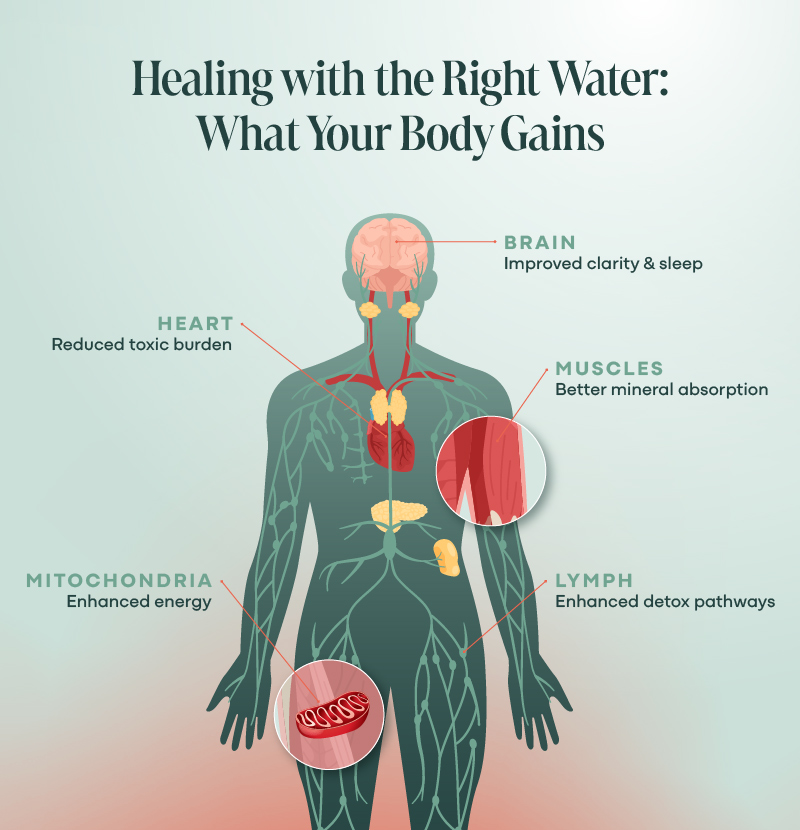
Your body knows how to heal. All it needs is the right support—and that starts with the water you drink every single day. Let’s make every sip count.
FAQs
1. Do I really need to filter my water supply if it looks and tastes fine?
Yes. Taste and clarity don’t tell you anything about contaminants like heavy metals, PFAs, pharmaceuticals, or microbial fragments that could still be in your water.
2. Is bottled water safer than tap water?
Usually not. Bottled water is often just filtered municipal water, and it comes with microplastics and questionable storage conditions. Plus, it’s a sustainability nightmare.
3. How often should I replace my water purifier filter?
Way more often than you think. Follow the manufacturer’s guidelines religiously—or better yet, set reminders. Once a filter’s dirty, it’s not filtering anything.
4. Is distilled water dangerous because it has no minerals?
No. Distilled water is clean. You simply need to add minerals back in—easily done with a pinch of sea salt or trace mineral drops.
5. Do UV water filters remove chemicals or heavy metals?
Nope. UV filters only deactivate microbes. They don’t touch chemicals, metals, or pharmaceuticals lurking in your water.
6. Can my filter make me sick if I don’t maintain it?
Absolutely. Mold, biofilm, and bacteria love neglected filters. A dirty filter is worse than no filter at all.
How We Can Help
Guiding people to reclaim their health and vitality is our greatest joy. Our entire practice is dedicated to supporting you to be who you really are, at home in your body, because your body is able to heal itself.
Book a Call