

You’ve been told the sun is dangerous.
That if you don’t slather yourself in SPF 50 every morning — rain or shine — you’re basically inviting wrinkles, cancer, and early death.
So, you did what you were told.
You applied the sunscreen.
You tried the “clean” brands.
You added it to your moisturizer, your makeup, your lip balm.
Maybe you even wore it indoors (because, you know… blue light).
But here’s the part no one warned you about:
You also absorbed chemicals that disrupt your hormones.
You washed those same chemicals down your drain — where they bypassed wastewater treatment and ended up in your drinking water, your food supply, and yes… your bloodstream.
You may have noticed skin rashes, weird breakouts, or hormone shifts and thought, “Huh, that’s odd.”
It’s not odd. It’s predictable.
And if you’re reading this, you’re probably scrappy enough to have already figured that out.
This article is for you — the person who’s realized that “safe” doesn’t always mean safe, and “recommended” doesn’t mean risk-free.
You’re the one taking responsibility for your health because no one else is going to do it for you.
So, let’s talk about sunscreen ingredients — the kinds that protect you from the sun and the kinds that quietly poison your terrain.
We’ll break down the toxins, the marketing myths, and the real way to build your skin’s resilience — from the inside out.
Key Takeaways
- Sunlight isn’t dangerous — it’s necessary.
- You’re not just exposed at the beach.
- You can protect your skin and your health from the inside out.
Sunlight Isn’t the Enemy — It’s a Necessity
You are biologically wired to thrive in the sun.
Not survive it — thrive.
That might feel like a radical statement when every dermatologist you’ve ever met makes it sound like you have to be a vampire.
But the truth is, your body needs sunlight like it needs sleep, hydration, and real food.
Let’s talk about what happens when sunlight hits your skin — no SPF filter, no hat, no chemical interference:
- Vitamin D synthesis: UVB rays convert cholesterol in your skin into vitamin D (1, 9, 20), a hormone that regulates over 1,000 genes. Not a “nice-to-have”—a biological non-negotiable. Low D levels are linked to autoimmune disease, depression, osteoporosis, and even some cancers.
- Mental health boost: Sunlight triggers serotonin production, which helps regulate mood, appetite, and circadian rhythm. Ever feel like a functioning human for the first time in weeks after a sunny walk? That’s not in your head. That’s neurotransmitters.
- Mitochondrial support: Infrared light from the sun stimulates your mitochondria — the little power plants inside your cells — to make more ATP. Translation? You feel like you have energy.
- Structured water formation: According to Dr. Gerald Pollack’s research, sunlight helps build “exclusion zone” (EZ) water in your cells — the kind of cellular hydration that makes detox and nutrient absorption possible.
- Immune function: Sunlight increases nitric oxide, which improves blood flow and immune surveillance.
We are chronically sun-deficient.
We swapped the healing power of sunlight for fluorescent lights, Zoom fatigue, and a bottle of endocrine disruptors labeled “reef safe.”
And we wonder why our energy, mood, and immunity are fried.
The sun is not the problem. The problem is the toxic burden you’re carrying that makes your skin hyperreactive in the first place.
What Is Sunscreen Toxicity?
You know that slightly greasy film that sticks around after sunscreen?
The one you scrub off your arms but still smell on your clothes three days later?
Sunscreen toxicity is what happens when the very product marketed to protect you is adding to your body’s toxic burden.
These compounds are absorbed, stored, and circulated inside your body (19, 24, 27, 34, 36, 37, 38).
Common Sunscreen Ingredients
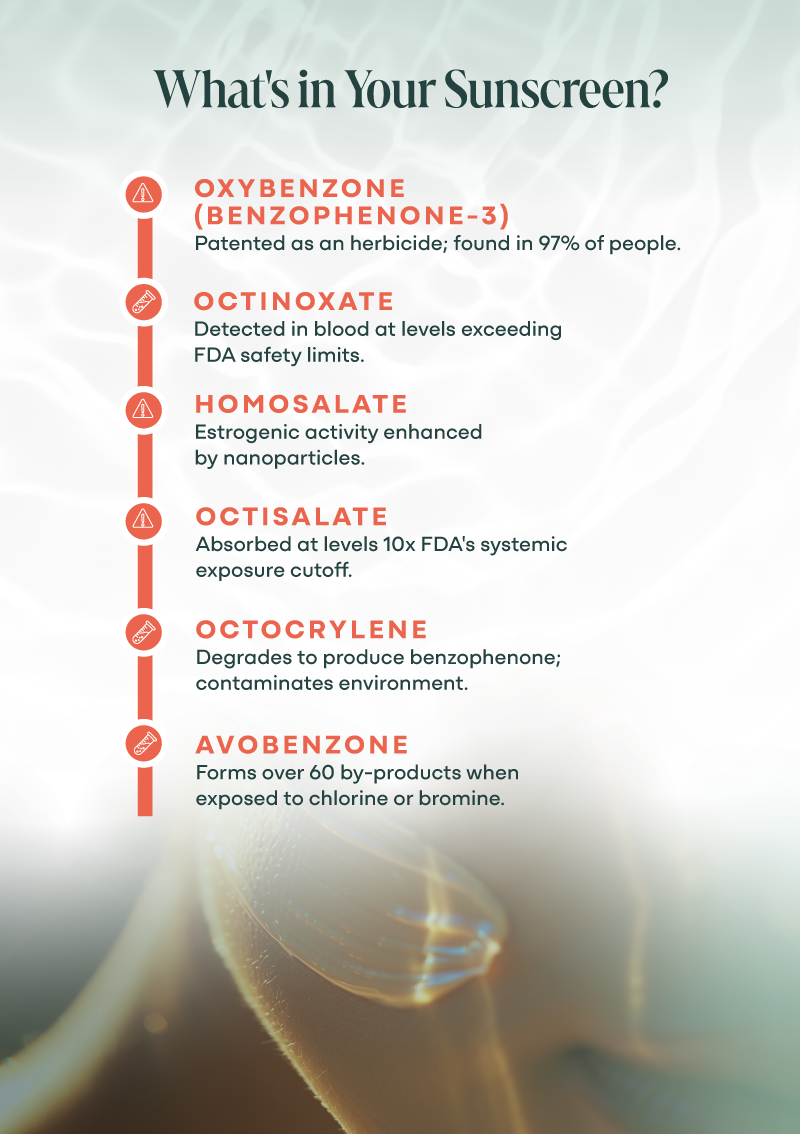
Let’s take a look at the six most common chemical filters you’re probably wearing right now (even if you’ve “gone clean”):
- Oxybenzone (AKA Benzophenone or BP-3) – patented as an herbicide in 1954 by Monsanto (5) and now found in the urine of 97% of people (4).
- Octinoxate – has been found in blood at levels exceeding 16x the FDA safety level (36)
- Homosalate – Its estrogenic activity is enhanced by nanoparticles (3, 33)
- Octisalate – Has been found to be absorbed in the skin at levels 10x the FDA’s cutoff for systemic exposure (36)
- Octocrylene – The dominant sunscreen in environmental contamination, it is often contaminated with benzophenone and can degrade to produce benzophenone (1, 5, 12, 36)
- Avobenzone – When exposed to bromine or chlorine in pools or water treatment facilities, it can create over 60 by-products, toxicity unknown. (16) Looking at you, Banana Boat, Coppertone, Hawaiian Tropic, and Pre-Sun (25)!
You’ll find them in most conventional sunscreens, yes – usually in combinations. (And they all have multiple other names they can be listed as – look them up in PubChem!)
But also, in moisturizers (5, 19, 38), lip balm (5, 36), cosmetics (2, 15, 19, 33, 34, 38), shampoo (1, 5, 38), deodorant, baby wipes, and even your perfumes (5, 34, 38).
They aren’t just in personal care products.
They’re in textiles (2, 38), paint (2, 38), surface water (5, 13), and sewage sediment (5, 13).
And thanks to industrial runoff and their uncanny ability to bypass water filtration, they’re also in our drinking water (18, 34, 39), our indoor dust (13, 39), and — wait for it — our food via packaging and microplastics (2, 5, 15, 17, 34) .
How We Can Help
Guiding people to reclaim their health and vitality is our greatest joy. Our entire practice is dedicated to supporting you to be who you really are, at home in your body, because your body is able to heal itself.
Book a CallSo how toxic are they? Here’s the short version:
- They’re lipophilic, which means they love fat — and once they’re in, they can hang out in your tissues for the long haul (1, 2, 7, 18, 39).
- They’re endocrine disruptors, mimicking or blocking hormones like estrogen, testosterone, and thyroid hormones (5, 12, 15, 19, 22, 24, 30, 34, 36, 39).
- They’re photoreactive, meaning they break down under sunlight and form even more toxic byproducts. (Yes, you read that right.) (4, 16)
- They’re listed as “contaminants of emerging concern” in environmental science (5, 13) — which is science-speak for “Oh crap! We didn’t think they were a big deal until now… and now we can’t get rid of them.”
Worst of all?
These chemicals are rarely used solo (11, 13, 33).
Most sunscreens combine multiple UV filters in one product — and no one is testing what those combinations do to a human body over time.
(You are the test subject. And you didn’t sign a consent form.)
When we talk about sunscreen toxicity, we’re talking about a cumulative load of uninvited chemicals that your liver, lymph, and endocrine system now must process.
And your skin — the largest organ of detox — is both the entry point and the battleground.
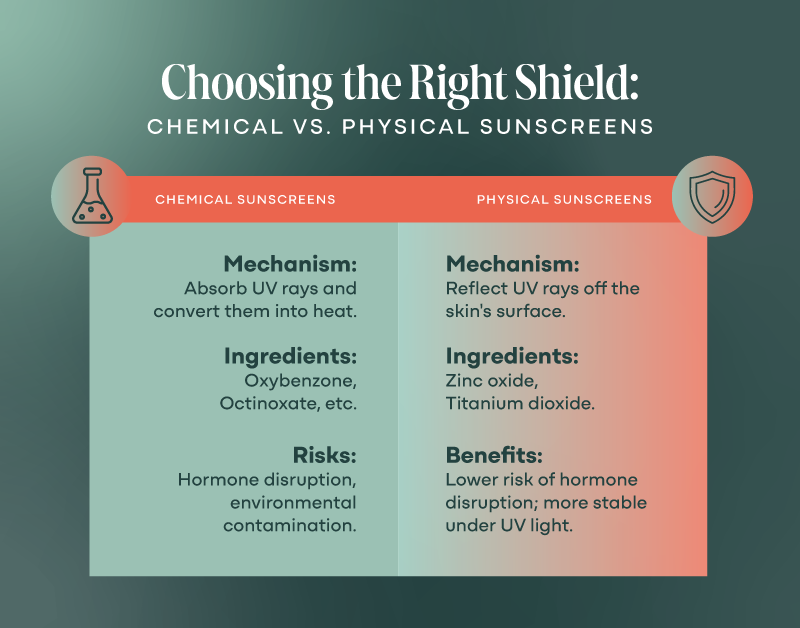
Chemical vs. Physical Sunscreens: What You’re Really Rubbing In
Okay, let’s clear up the confusion: “Organic” and “natural” in sunscreen marketing mean absolutely nothing.
In chemistry, organic just means carbon-based — which includes things like formaldehyde and gasoline.
Fun.
Instead of getting caught in label limbo, let’s use a more helpful lens:
Chemical (Organic) Sunscreens
These work by absorbing UV rays and converting them into heat, dispersing it before your cells get singed (6, 20, 32).
Sounds fancy, right?
Here’s the catch:
- Many of these filters — especially our top six troublemakers — break down in sunlight. That means they not only become less effective, but they can form toxic breakdown products right on your skin.
- Some (like octocrylene) even form benzophenones, which are carcinogenic and highly stable — meaning they stick around in your body and the environment (5, 36).
- And yes, they penetrate the skin. Studies show measurable concentrations of these filters in your body — sometimes within hours of application (19, 24, 27, 34, 36, 38. Where can they be found:
- Blood or serum (19, 24, 27, 34, 36, 37) – even fetal blood (38)
- Breast milk (19, 24, 27, 34, 36, 38)
- Urine (19, 24, 27, 34, 36, 37, 38)
- Semen (34)
- Amniotic Fluids (24, 34, 38)
- Placenta (24, 38)
- Umbilical Cord (38)
- Adipose Tissue (38)
- And they can even cross the blood-brain-barrier (7, 38)
When your sunscreen ends up in your bloodstream, that’s not “topical protection.” That’s internal exposure.
Physical (Inorganic or Mineral) Sunscreens
These use zinc oxide or titanium dioxide to sit on the skin’s surface and reflect ultraviolet rays — more like a mirror than a sponge (6, 20, 32, 36).
In general, they:
- Don’t penetrate as deeply (20, 32)
- Don’t photodegrade (20)
- Are more stable under ultraviolet light (20)
- And have a much lower risk of hormone disruption
But even here, there’s nuance.
When these minerals are used in nanoparticle form (to make them “invisible” on the skin), they can act like chemical sunscreens — penetrating cells, producing reactive oxygen species, and behaving unpredictably.
Just so we’re clear, nanoparticles and nanoplastics are bad (10, 21, 33, 35).
So, if you’re using a mineral sunscreen, make sure it’s non-nano, third-party tested, and doesn’t have sneaky additives like chemical preservatives, silicones, or synthetic fragrances.
Because you’re not just protecting your skin — you’re protecting your terrain.
UVA, UVB, and the Broad-Spectrum Myth
Most people shop for sunscreen like it’s a numbers game.
SPF 15? Meh.
SPF 30? Maybe.
SPF 50+? Yes please — that’s practically immortal, right?
Not quite.
UVB: The Burn Ray
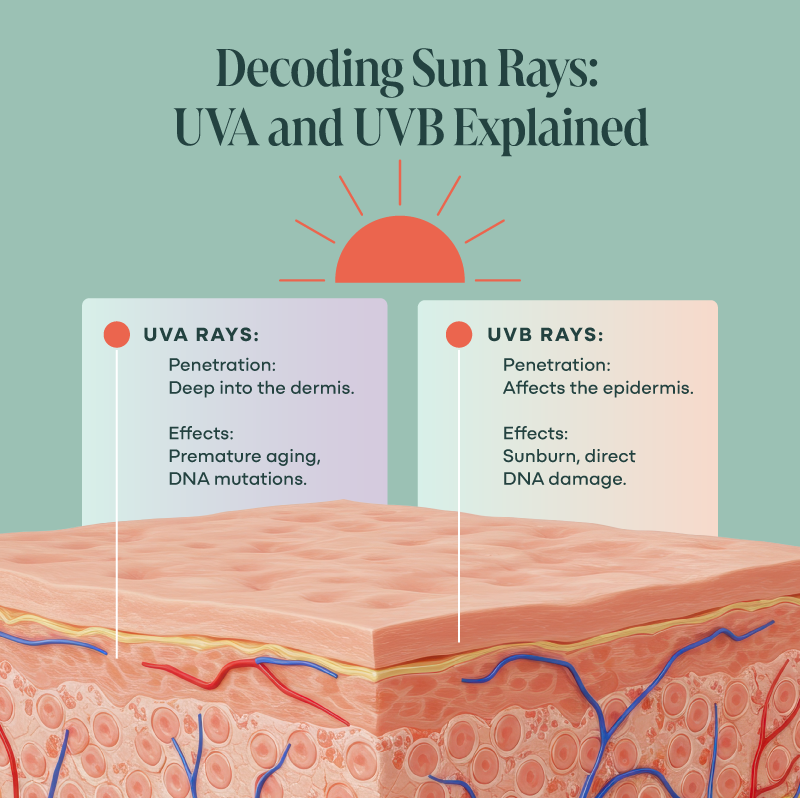
UVB rays are what cause sunburn — they penetrate the outer layers of your skin (32).
About 5-10% of all ultraviolet radiation that reaches the Earth’s surface is UVB radiation
SPF ratings are based almost entirely on how well a sunscreen blocks UVB.
So, if you don’t burn, the product “works,” right?
Nope.
UVA: The Deep Damage Ray
UVA rays go deeper into the skin, into the dermis, where they cause oxidative stress, premature aging, collagen breakdown, and even DNA mutations (20, 32).
And here’s the kicker: UVA damage doesn’t come with a sunburn warning.
You don’t feel it happening — but your cells do.
Now let’s talk “broad-spectrum.” Sounds reassuring, doesn’t it?
But here’s the issue:
- Most chemical sunscreens are much better at blocking UVB than UVA (32).
- That means your skin won’t burn — but your cells can still get hammered by deep UV damage.
- Even worse, by preventing the burn signal, you stay out longer in the sun than your body naturally would, soaking up more invisible damage while thinking you’re safe.
And remember, most sunscreens use a combo of filters to try and cover the whole spectrum (11, 13, 33).
But these filters aren’t tested together for long-term safety or synergistic toxicity (11, 13, 33).
The more you layer them, the more unstable the formula becomes — and the more toxic byproducts you absorb.
While your SPF 50 bottle might promise “complete protection,” what you’re really getting is selective protection, chemical exposure, and a false sense of safety.
The sun isn’t the enemy. The chemical filter cocktail is.
The Body Burden Impact
If you think sunscreen is something you only put on your skin during beach season — I’ve got bad news and worse news.
The bad news? You’re probably exposed to these same chemicals every single day, whether you use sunscreen or not.
The worse news? These compounds are showing up in places they were never meant to be — places you aren’t even thinking to look.
You’re not just dealing with what’s in your sunscreen — you’re dealing with cumulative exposures from dozens of sources, every single day.
This is why symptoms start to stack —because your internal terrain is overwhelmed by the constant input it wasn’t intended to handle.
Bioaccumulation & Environmental Fallout
Let’s say you’ve been using conventional sunscreen for the past 10 years.
You didn’t know better — no judgment.
But your body?
It remembers.
Because many chemical UV filters are bio accumulative — they build up in fat tissue, organs, and breast milk over time (1, 2, 7, 18, 39).
They don’t just pass through.
They’re lipophilic, meaning they love fat.
And since your brain, hormones, and cell membranes are all built on fats?
Yeah. They settle in the places that matter most.
And it’s not just your body paying the price.
Toxic to You = Toxic to Everything Downstream
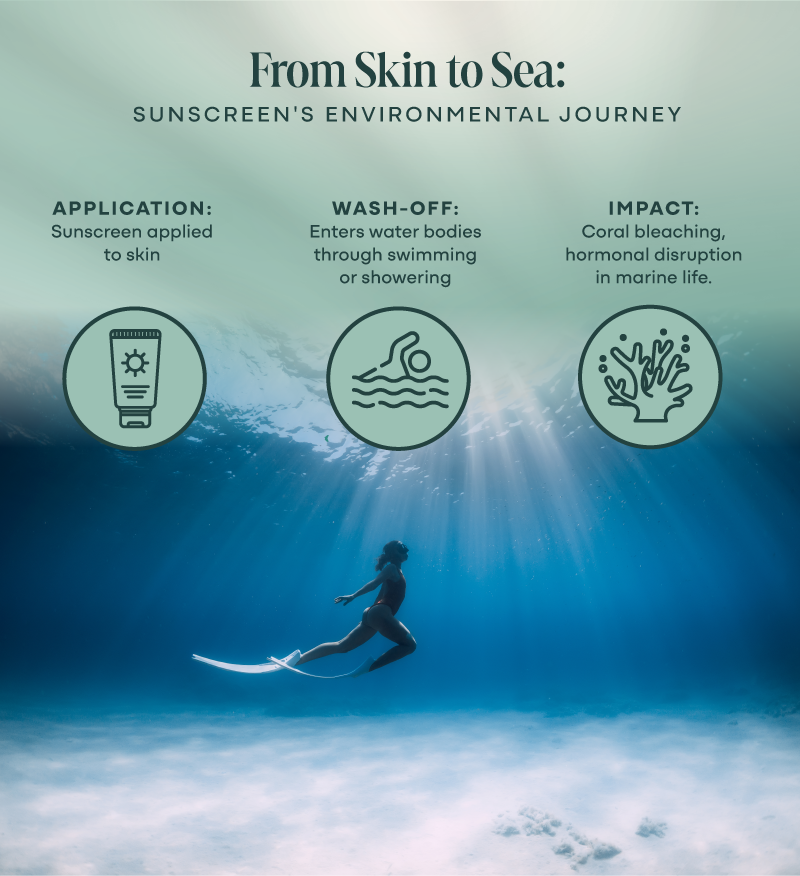
When you shower, swim, or wash your hands, those filters rinse off your skin and head straight into wastewater systems.
The problem? Standard treatment plants weren’t designed to handle chemical sunscreens — or most other “emerging contaminants,” for that matter (4, 9, 25).
So, what happens?
- They flow into rivers, lakes, and oceans — still biologically active (1, 4, 5, 15)
- They disrupt coral reefs, causing bleaching even at low concentrations
- They alter the hormones of fish and amphibians, feminizing male species and reducing fertility
- They accumulate in aquatic life — which, yes, can end up on your plate
- This aquatic toxicity is one reason why some of these chemicals have been banned in Key West, Hawaii, Palau, the Marshall Islands and the US Virgin Islands (1, 5, 9, 18, 26, 29, 30, 34).
The same chemical you put on to “stay safe in the sun” is now cycling back through your faucet, your food, your air — and your cells.
The Earth is trying to filter it out. So is your liver.
Neither is winning. (But this IS fixable!)
Endocrine Disruption & Cellular Chaos
Let’s not sugarcoat it: These sunscreen chemicals don’t just sit there looking pretty.
Once they’re inside you, they start rewriting the script for how your body runs the show.
Many of the most common chemical UV filters — especially oxybenzone, octinoxate, and homosalate — are confirmed endocrine disruptors (5, 12, 15, 19, 22, 24, 30, 34, 36, 39).
That means they interfere with your hormonal messaging system, the one responsible for regulating everything from your metabolism and mood to your sex hormones and sleep cycles.
And since hormones operate on whispers, not shouts, even small exposures can create big shifts over time.
Here’s what these chemicals can do:
- Mimic estrogen and bind to hormone receptors, sending false signals that can lead to estrogen dominance, irregular cycles, low libido, endometriosis, PCOS, and fertility struggles (3, 15, 22, 33, 36, 38, 39).
- Disrupt thyroid function, slowing your metabolism, tanking your energy, and contributing to weight gain and brain fog (3, 15, 18, 34, 38).
- Impact testosterone production, which affects everything from muscle mass to mood to reproductive health (5, 34, 36, 38).
- Trigger oxidative stress and mitochondrial damage (1, 32) — so your energy tank feels permanently stuck on “low.”
- Cause endothelial dysfunction a known cause of cardiovascular disease (18, 19).
- Cause skin rashes, hives, contact allergies, or photo allergies (4, 5, 6, 25, 29, 30, 36)
- Promote breast cancer (18, 36, 38, 39)
- They are neurotoxic (38), genotoxic (22), obesogenic (12), mutagenic (5), and carcinogenic (5, 36)

How to Protect Yourself (Without Hiding From the Sun or the World)
Now that you know your SPF might be sneakily messing with your hormones, frying your mitochondria, and poisoning fish — what can you do?
Don’t worry.
This isn’t about becoming a mole person who avoids the sun and only bathes in moonlight.
This is about getting smarter, not smaller.
Here’s how to protect yourself — in ways that support your biology.
Rethink Sun Exposure: Become Sun-Savvy, Not Sun-Phobic
You were never meant to live indoors full-time under LED lighting.
You were designed to interface with the sun.
So, let’s do it smarter:
- Get intentional sun exposure daily — ideally before 10am or after 4pm when UV intensity is lower.
- Expose more surface area for short periods (think arms, legs, chest — not just the back of your hands).
- Avoid burning — not sunlight. Let your body gradually build its melanin armor like nature intended.
- Wear protective clothing (hats, loose sleeves) when you’re out longer than your skin’s natural threshold.
- Use non-nano zinc oxide-based mineral sunscreens only when needed, and only from trusted brands that test for contaminants.
- Calendula and geranium essential oils have an SPF of 8.3 and 6.45, respectively (9). Protect your skin and smell nice, naturally!
Remember: the goal isn’t zero UV. It’s healthy interaction with light — without chemical interference.
Upgrade to Internal Sun Protection (Yep, That’s a Thing!)
Sunscreen shouldn’t be your only defense.
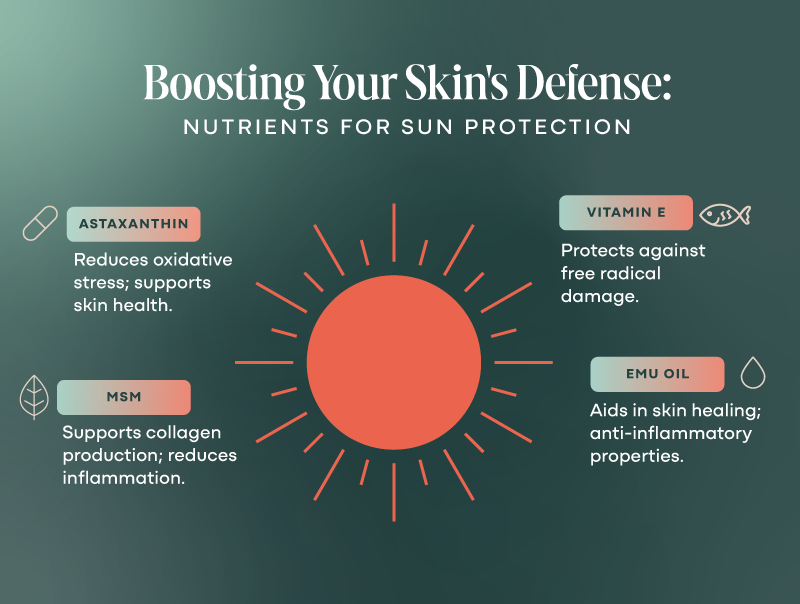
Let’s talk internal sunscreen — the way your body protects itself when it’s properly nourished and supported with things like:
- Astaxanthin – A fat-soluble antioxidant from microalgae that literally gives salmon its color. It helps your skin handle UV exposure without damage, reduces oxidative stress, and supports eye and brain health (43, 44, 46, 47).
- MSM (methylsulfonylmethane) – Helps your body build keratin and collagen while calming inflammation. It also supports detox pathways, so you’re not as reactive to sunlight in the first place.
- Vitamin E (mixed tocopherols and tocotrienols) – Shields your cells from free radical damage caused by UV exposure (41, 42).
- Emu oil – Used topically, it supports skin healing and barrier repair — great for after-sun care or inflammatory skin conditions (40, 45). Just make sure it’s pure and sourced responsibly.
When your internal terrain is strong, your skin doesn’t freak out in the sun.
It adapts, it protects, it heals — like it was designed to do.
Clean Up the Daily Layers
Sunscreen may be the headliner, but it’s not the only actor on stage.
Scan your daily products for these chemical UV filters — especially the top six — and swap them out one by one.
Start with what you use most often or in the largest amounts:
- Face products
- Body lotion
- Shampoo/conditioner
- Lip balm
- Baby products (seriously — check those labels)
Look for ingredient transparency, third-party testing, and brands that don’t rely on greenwashing or “reef safe” fluff.
If it doesn’t clearly state “non-nano zinc oxide” or “UV protection via minerals only” — assume it contains chemical filters.
Conclusion: The Sun Isn’t the Problem — But the Chemicals Might Be
Here’s what no one tells you when they hand you that “dermatologist-recommended” bottle of SPF 50:
Your body already knows how to do this.
It knows how to respond to sunlight, repair DNA, regulate hormones, and build resilience — when it’s not drowning in synthetic interference.
Sunscreen toxicity isn’t just about one product or one summer.
It’s about decades of messaging that told you your body was too weak for the sun, too fragile to trust, too broken to protect itself.
And that the solution was in a bottle filled with chemicals no one can pronounce — let alone eliminate.
But you’re not fragile. You’re not broken. And you’re not powerless.
You’re part of nature.
You were built for light, rhythm, connection, and flow.
And when you clean up your terrain and nourish your internal systems, you don’t just survive the sun — you thrive in it.
How We Can Help
Guiding people to reclaim their health and vitality is our greatest joy. Our entire practice is dedicated to supporting you to be who you really are, at home in your body, because your body is able to heal itself.
Book a CallFAQs
1. What’s wrong with chemical sunscreens if the FDA approved them?
The FDA’s outdated testing doesn’t account for long-term exposure, chemical combos, or how these toxins interact once they’re in your bloodstream — which they absolutely do.
2. I use “reef safe” sunscreen — isn’t that clean?
Not always. “Reef safe” isn’t a regulated term, and many still contain nanoparticles or sneaky endocrine disruptors hiding behind chemical code names.
3. How do I know if my sunscreen is toxic?
Flip the bottle — if you see any of the top six (oxybenzone, octinoxate, homosalate, etc.), it’s time to toss it.
4. What’s the deal with internal sunscreen?
It’s not a gimmick — nutrients like astaxanthin and vitamin E help your body naturally resist ultraviolet damage and reduce inflammation from the inside out.
5. Should I avoid the sun completely?
Nope. Smart sun exposure is essential for vitamin D, mood, immune function, and cellular energy. You’re meant to thrive in the sun — not fear it.
6. How else am I being exposed to these toxins?
Besides sunscreen, they’re in your makeup, shampoo, food packaging, indoor dust, and even your drinking water. It’s not about panic — it’s about awareness.