
Exposure to radon gas in your home is like giving your body a low-dose radiation drip. The health effects of radon exposure include cancer, chronic exhaustion, tight lungs, and symptoms your doctor keeps side-eyeing.
There’s this awful moment many of us go through: when you realize you feel worse at home than anywhere else.
Not emotionally—physically.
Like your body sighs with relief the minute you leave the house, but tenses right back up as soon as you walk through the door.
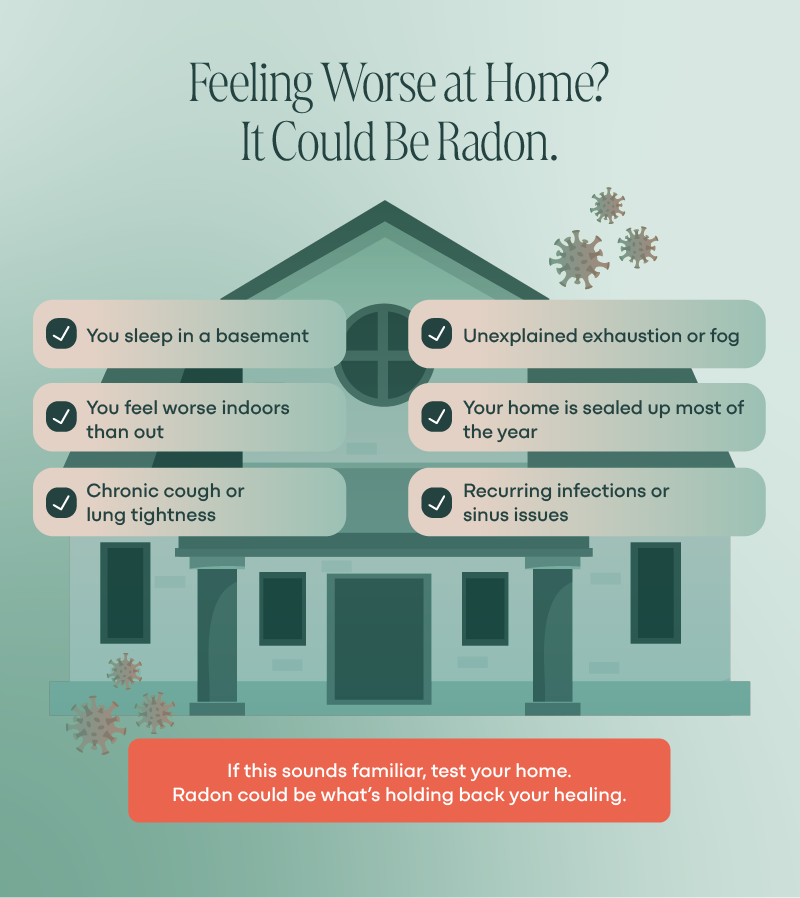
Maybe your lungs feel tight in the basement.
Maybe you wake up groggy no matter how early you went to bed.
Maybe it’s just this persistent, low-grade sense that your body is stuck in molasses—and no doctor has been able to tell you why.
If that’s you, it’s time to talk about radon.
The invisible, odorless, radioactive gas quietly jacking up inflammation, fatigue, and worse in people who are already running on fumes.
Not sexy, I know.
No one’s posting #radonawareness on Instagram.
But this invisible gas might be quietly disrupting your body’s healing signals—especially if your terrain is already overwhelmed.

Radon is sneaky. Unless someone told you to test for it (and let’s be honest—who did?), you probably haven’t thought about it at all. But if you’re dealing with chronic symptoms like:
- unshakable fatigue
- tightness in your chest or shortness of breath
- recurring sinus or respiratory infections
- that frustrating “I just don’t feel right in this house” feeling…
…it’s worth investigating. Especially if you sleep in a basement bedroom. Or if your house was built before the 2000s. Or if your doctor keeps shrugging and saying, “everything looks normal.”
Because here’s the thing: Radon is the #2 cause of lung cancer in the U.S. after smoking—and it doesn’t wait until you’re 70 to start disrupting your health.
But this isn’t a doom spiral.
It’s an opportunity. Once you know what you’re dealing with, you can take steps to fix it. And that’s what this guide is all about—understanding radon exposure, recognizing the signs, and reclaiming your terrain.
You don’t need to live in fear. But you do need to know what’s in your air.
Let’s break it down.
Key Takeaways
-
- If your house is giving you “bad vibes,” it might not be energetic—it might be radioactive.
- Radon doesn’t knock politely—it slips in through cracks, crawlspaces, and sump pumps.
- There’s no safe level of radon—and no, your doctor probably didn’t test for it.
What Is Radon Gas, Anyway?
Radon is a radioactive gas that forms naturally when uranium breaks down in soil, rock, and groundwater. (Yes, uranium—as in the stuff they use in nuclear reactors. And yes, it’s literally in the earth beneath your house.)
Radon seeps up from the ground and can enter your home through tiny cracks in the foundation, gaps around pipes, sump pumps, or crawl spaces (5, 10, 17, 24, 27, 30, 33, 34).
If your home is well-sealed or poorly ventilated—congrats, you’ve just created the perfect radon trap.
It’s completely invisible.
No smell. No taste. No color.
It doesn’t burn your eyes like mold, and it won’t set off your smoke detector. But that doesn’t mean it’s harmless.
Radon is measured in picocuries per liter (pCi/L) or Becquerels per cubic meter (Bq/m3).
The EPA recommends action if your indoor air levels are 4.0 pCi/L or higher.
But the reality is that there is no known safe level of radon (10).
Radon is a slow burner. You won’t notice it after a weekend at your cousin’s place.
But spend years living above it—and the health impacts can be devastating.
Only it won’t look like “radon poisoning” (that’s not a thing doctors are trained to recognize).
How We Can Help
Guiding people to reclaim their health and vitality is our greatest joy. Our entire practice is dedicated to supporting you to be who you really are, at home in your body, because your body is able to heal itself.
Book A CallIt’ll look like mystery symptoms that refuse to budge, no matter how “clean” your lifestyle is.
So, if you’ve been:
- hitting walls in your detox progress
- waking up tired even after a full night’s sleep
- or feeling inexplicably worse after moving into a new home
It’s time to consider whether your environment—not your willpower—is the real issue.
And radon is a solid place to start looking
The Dirty Truth: Health Effects and Risks From Radon in Homes
You probably already know that radon causes lung cancer (1, 3, 12, 14, 17, 18, 21, 22, 23, 26, 28, 33, 34)—it’s the second leading cause after smoking (2, 6, 14, 16, 18, 22, 23, 26, 28).
But here are a few facts you might not know:
- It’s the primary cause of lung cancer in non-smokers (2, 18, 27).
- It’s the primary source of background radiation in your life (2, 5, 8, 12, 22, 24, 28, 33, 34).
- The half-life of radon is 3.8 days (5, 17, 22, 24, 27, 34).
- One out of every 15 US homes has increased levels of radon (10, 24, 30).
- It’s classified as a Group 1 Carcinogen (2, 5, 16, 27)
- In addition to lung cancer, it’s associated with leukemia (2, 7, 17, 21), stomach cancer (2, 17), non-Hodgkin’s lymphoma (2, 17), brain cancers (2, 17), melanoma, kidney, and liver cancers (2).
- It can reach your brain through your olfactory system (basically, your nose is hard-wired with a direct connection to your brain), and it can easily cross the protective blood-brain-barrier (34). As it decays, the resulting products are less mobile, resulting in extended radiation to the brain (34).
- For every 100Bq/m3 increase in radon concentration, the risk of lung cancer increases by 11-16% (12, 21).
- Bathrooms and kitchens tend to have the highest concentrations (25).
And you also might not know how many other health issues can quietly build up from long-term radon exposure, especially if your body’s already dealing with chronic stress or a history of toxic overload.

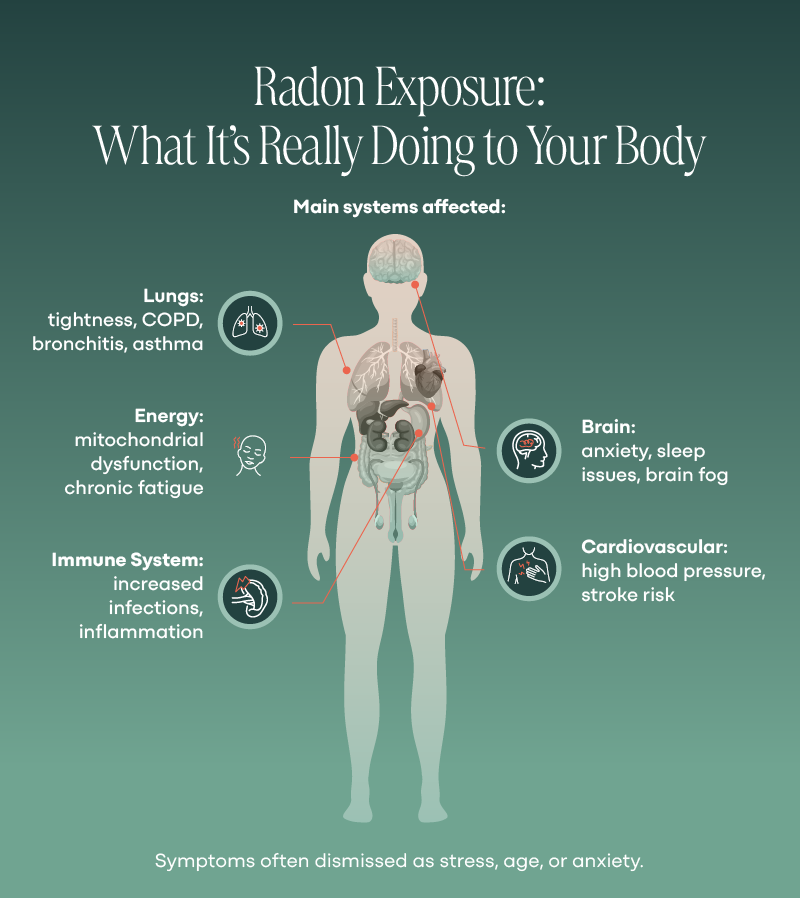
Over time, radon can mess with:
- Your lungs — not just in the “cancer” way, but in the “why can’t I take a deep breath in this house” kind of way. Think chronic tightness, recurring coughs, or respiratory infections that just keep circling back.
Also, COPD (2, 15, 24, 30); chronic bronchitis (2); respiratory disease (2, 5, 17, 30); and asthma (15).
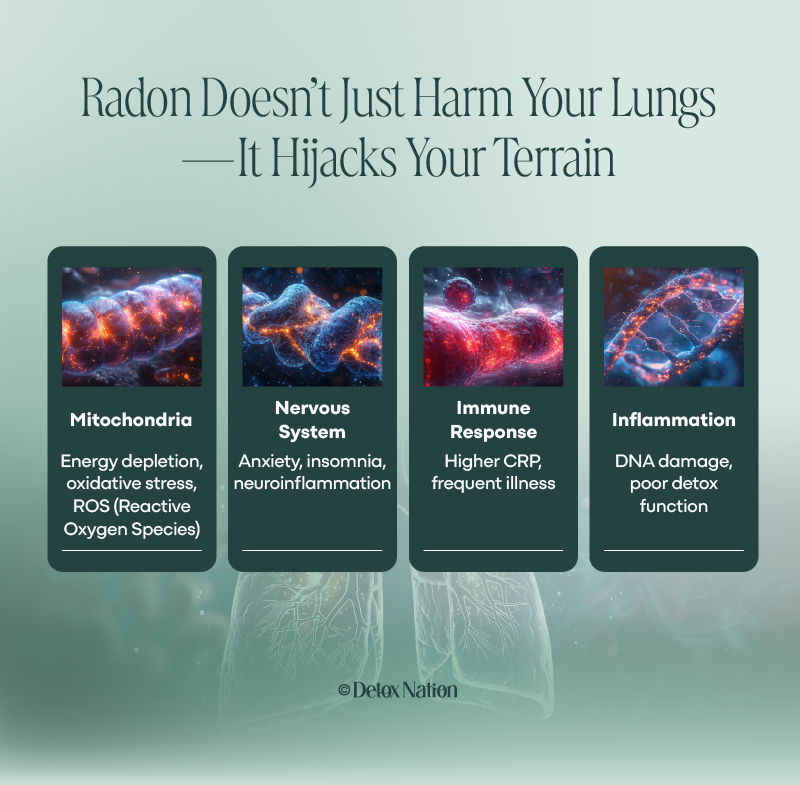
- Your energy — because your mitochondria (your cells’ energy factories) don’t love constant low-dose radiation (6, 26, 31, 34). You might feel wiped out, foggy, or like your get-up-and-go got up and left.
Radon causes increased inflammation (12, 26, 30, 34), the production of Reactive Oxygen Species (2, 16, 21, 22, 24, 24, 26, 27, 34) and oxidative stress (21, 24, 26, 30, 31, 34), further derailing your mitochondria and energy.
- Your nervous system — people exposed to radon long-term have reported anxiety, sleep issues, mood swings, and even brain fog that seems worse at home than anywhere else.
Also, neurodegeneration (2). The research is a little conflicted here. One study found no association between radon and Alzheimer’s, Parkinson’s, or motor neuron disease (32) while another one found an increased deposition of radon in the brains of patients with Alzheimer’s (34).
Common sense tells me if radon increases inflammation (12, 26, 30, 34), oxidative stress (21, 24, 26, 30, 31, 34), and DNA damage (2, 12, 21, 22, 24, 26, 28, 34), then it can also cause neuroinflammation and degeneration.
- Your immune system — radon exposure can trigger inflammation or suppress your defenses, which means you’re more likely to get sick, stay sick, or feel like your body is always “just on the edge” of functioning (26).
- Your cardiovascular system – Radon increases blood pressure (1), cardiovascular disease (1, 2, 17, 34), stroke (6, 34), atherosclerosis (34), and C Reactive Protein (34).
The tricky part? These symptoms are vague.
They overlap with mold exposure, chronic fatigue, EMF sensitivity, even grief.
So, most people don’t connect the dots.
Not even your doctor—unless you’ve got a unicorn for a GP who asks about your crawl space (if so, keep them forever).
This is why so many people say, “I feel worse at home, and I don’t know why.”
Radon could be part of that answer.
And here’s what I want you to know:
If your body feels off, it’s not “in your head.” It’s in your environment.
Are You Breathing It In? How Exposure to Radon Happens
Here’s the part no one warns you about: you don’t have to live near a nuclear plant to have a radon problem.
In fact, if you live in a regular ol’ house with a foundation, you might be breathing it in every day without knowing it.
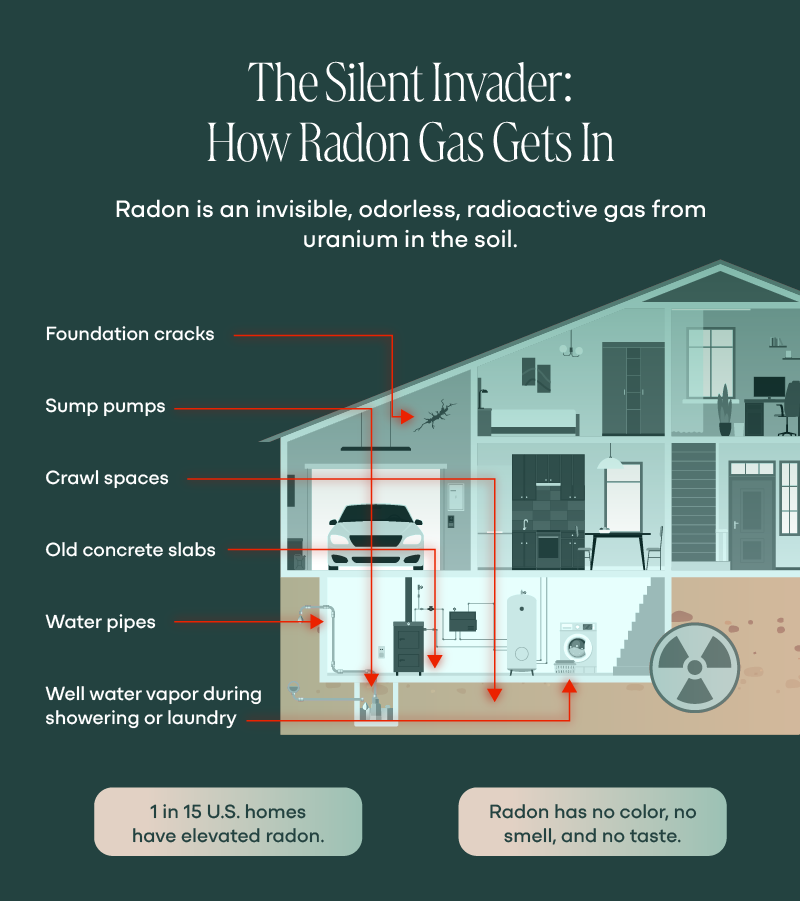
Radon comes up from the ground, plain and simple. In addition to foundation cracks etc. mentioned previously, it can also be found:
- In building materials (2, 10, 18, 21, 27, 30)
- In groundwater (2, 9, 10, 17, 18, 20, 21, 22, 27, 33, 340
- In well water (10, 14, 18, 21, 22, 33)
- Sump pumps, especially if they’re uncovered (2, 5, 14)
- Even through concrete, if it’s old or porous enough
- Release of radon gas from water into the air during showering, doing dishes, doing laundry, etc. (10, 17, 18, 22, 34)
Once it’s in, if your home doesn’t have good airflow (which is most of us, especially post-2020 when we all sealed up to “save energy”)—radon just hangs out (5, 17, 18, 21, 27). It builds up.
And your body absorbs it, breath by breath (6, 8, 10, 17, 18, 21, 22, 27, 28, 33, 34).
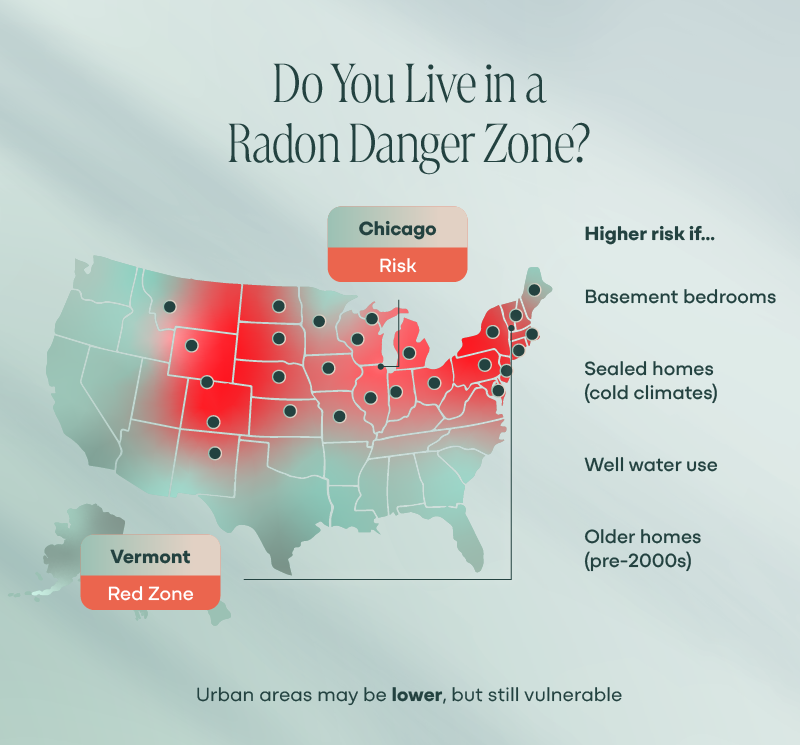
You’re at higher risk if:
- You sleep in a basement bedroom (even if it’s finished)
- Your home was built before the 2000s
- You live in a “radon hot zone” (and yep, those exist—large parts of the U.S. and Canada are red-flagged, especially the Midwest and Northeast) (11, 22)
- Your windows stay closed for most of the year
- You use well water—radon can sneak in through that too in certain areas (10, 14, 18, 21, 22, 33)
- You live in colder climates where your home is closed to conserve heat (18, 25) or in regions with moisture in the soil (17, 18, 23). Radon can move up to 6 feet in dry soil, but it can only move about an inch in water-saturated soil (17).
- Your home has been through extreme weather events (hurricanes, tornadoes, flooding) which can damage the foundation and seals (23).
- You live in a rural area – urban areas have as much as 31% less average radon levels (14), although high radon levels have also been found in large cities (27).
And it’s not just homes. Radon has shown up in schools, office buildings, apartment complexes—anywhere with contact to the ground and poor ventilation (5, 9, 17, 18, 21, 27).
But don’t panic—remember, this isn’t about living in fear. It’s about knowing what you’re working with. If you’re doing “all the right things” but your symptoms won’t budge, your house might be part of the problem.
And good news? There’s a way to test for that—and fix it. We’ll get to that next.
And remember: just because your house passed a radon test when you bought it five years ago doesn’t mean it’s still safe now. Foundation shifts, drainage issues, and even seasonal changes can affect radon levels over time.

How to Reduce Indoor Radon Risk
Here’s the good news: testing for radon doesn’t require a hazmat suit or a PhD. At the end of this article, I’ll give you a link to the radon meter I recommend.
If you’re feeling stuck in your health despite all the work you’ve put in—this is an easy win. One little test could reveal a major block in your healing path.
This isn’t about perfection. It’s about removing what’s in the way of healing. And sometimes that’s not another supplement—it’s the air you’re breathing.
Step 1: Let the Air Move to Reduce Radon Levels
Radon builds up in stagnant air. So, your first move is to get things flowing:
- Open windows whenever possible (especially on lower floors).
- Use fans to improve circulation, particularly in stuffy areas.
- If you’re in a cold climate, investigate an HRV (heat recovery ventilator) to bring in fresh air without losing all your heat.
- Avoid spending time in unventilated basement rooms until mitigation is in place.
Small shift, big impact.
Step 2: Seal the Leaks for Radon Reduction
Radon enters through the path of least resistance. That means:
- Cracks in your foundation or basement floor
- Gaps around plumbing or wiring
- Floor drains and sump pumps
- Exposed crawlspaces
You don’t need to concrete over your life—just seal the obvious entry points. Think silicone caulk, radon-rated sump pump covers, and crawlspace vapor barriers.

Step 3: Install a Radon Mitigation System
This is the gold standard. If your levels are consistently over 2.0 pCi/L, especially over 4.0, you’ll want to bring in the pros.
A radon mitigation system is basically a vent pipe and fan that sucks the radon from beneath your home and vents it safely above the roofline—before it ever gets into your living space.
It’s quiet, effective, and typically costs between $800 and $1500. Not pocket change—but cheaper than another round of bloodwork and guesswork.
Look for certified professionals through the National Radon Proficiency Program (NRPP) or National Radon Safety Board (NRSB). This isn’t a DIY project you want to improvise with YouTube tutorials.
Step 4: Support Your Terrain
Even after you lower your radon levels, your body may need help recovering from the hit. This is where bioregulatory support really shines:
Because your body isn’t broken—it’s just overwhelmed. And it’s been trying to adapt for a long time.
Terrain Support to Resolve Health Effects of Radon
Okay, you’ve tested. You’ve opened windows. Maybe you’ve even booked a mitigation install. Amazing. That’s half the win.
The other half? Supporting your terrain so it can finally take a breath and shift out of defense mode.
Your body’s not broken—it’s been surviving. Let’s give it what it’s been asking for.
1. Reboot Your Mitochondria
Radon exposure messes with your cells’ ability to make energy. If you’ve been dragging yourself through the day, it’s not “just burnout.”
Some mitochondrial love can go a long way:
- CoQ10 or Ubiquinol (especially if you’re over 35)
- Acetyl-L-Carnitine for cell energy and brain fog
- Magnesium to support cellular detox and energy transfer
- B-complex (methylated) for foundational energy pathways
These aren’t magic bullets, but they help restore your body’s natural rhythm—so it can finally exhale.
2. Boost Lung and Lymph Support
Your lungs and lymph are two of your body’s main detox channels. Radon exposure can bog them down, so it’s time to get things moving:
- Dry brushing
- Gentle rebounder or walking (especially outdoors)
- Breathwork to reset your nervous system and oxygenate tissue
Your body needs flow, not force. Gentle wins here.
3. Nervous System = Mission Control
If you’ve been living with radon, your nervous system’s been stuck in “survival mode.”
It’s time to allow relaxation—and restore communication between your brain and your body.
Try:
- Vagus nerve stimulation (gargling, cold face plunges, humming—yes, really)
- Soma Support like the Occipital Slide
You don’t need to do it all. Just one tool consistently makes a difference.
4. Give Yourself Permission to Slow Down
Your body’s been holding the line, waiting for help. Now that you’re addressing the root, give it the space to recalibrate.
This might look like:
- Letting go of over-supplementing
- Saying no to one more protocol
- Sleeping more
- Crying it out because now you finally know it wasn’t “just in your head”
This is the part most people skip. Don’t.
Integration is where the healing lands.
That’s the terrain side of radon recovery. It’s not about hacking your way to better—it’s about returning to a baseline your body can trust again.

Healing Starts With Awareness
Radon doesn’t show up on bloodwork. It doesn’t come with a warning label. But for so many people, it’s the missing piece of the chronic symptom puzzle.
If your body has felt like a battleground—if you’ve tried every diet, every supplement, every weird healing gadget—and you’re still waking up tired, heavy, or foggy—please hear this:
It might not be you. It might be your house.
That means you can do something about it.
Testing for radon is simple. Fixing it is doable.
And once it’s out of the picture, your body can finally stop fighting an invisible war every time you take a breath.
You deserve to live in a space that helps you heal—not one that holds you back.
If this hit home, take the next step and get a radon test kit.
Your brilliant body wants to heal. It just needs the environment to match.
Let’s make that happen.

FAQs About Radon (a.k.a. The Toxin No One Warned You About)
What is radon, exactly?
It’s a radioactive gas that comes from uranium in the soil. Yes, uranium. Yes, it’s under your house. Don’t panic—we can work with it.
How does radon get into my home?
Through cracks in the foundation, gaps around pipes, sump pumps, crawl spaces—even through old concrete. Basically, it’s not shy.
Can I smell or see radon?
Nope. No smell, no color, no taste. It’s the stealth ninja of indoor toxins.
Is there a radon test to know if radon is a problem in my home?
Yes. That’s the only way to know. Your body’s been dropping hints, but radon doesn’t come with a calling card.
What symptoms could radon exposure cause and does it cause lung cancer?
Fatigue, chest tightness, brain fog, poor sleep, sinus issues, mood swings—and the “I just feel worse at home” mystery that no supplement seems to touch. Yes, radon is the second most common cause of lung cancer.
Is radon only a problem in basements?
Basements are radon’s favorite hangout, but if it’s in your foundation or water, it spreads throughout the house. No floor is immune.
How We Can Help
Guiding people to reclaim their health and vitality is our greatest joy. Our entire practice is dedicated to supporting you to be who you really are, at home in your body, because your body is able to heal itself.
Book A Call